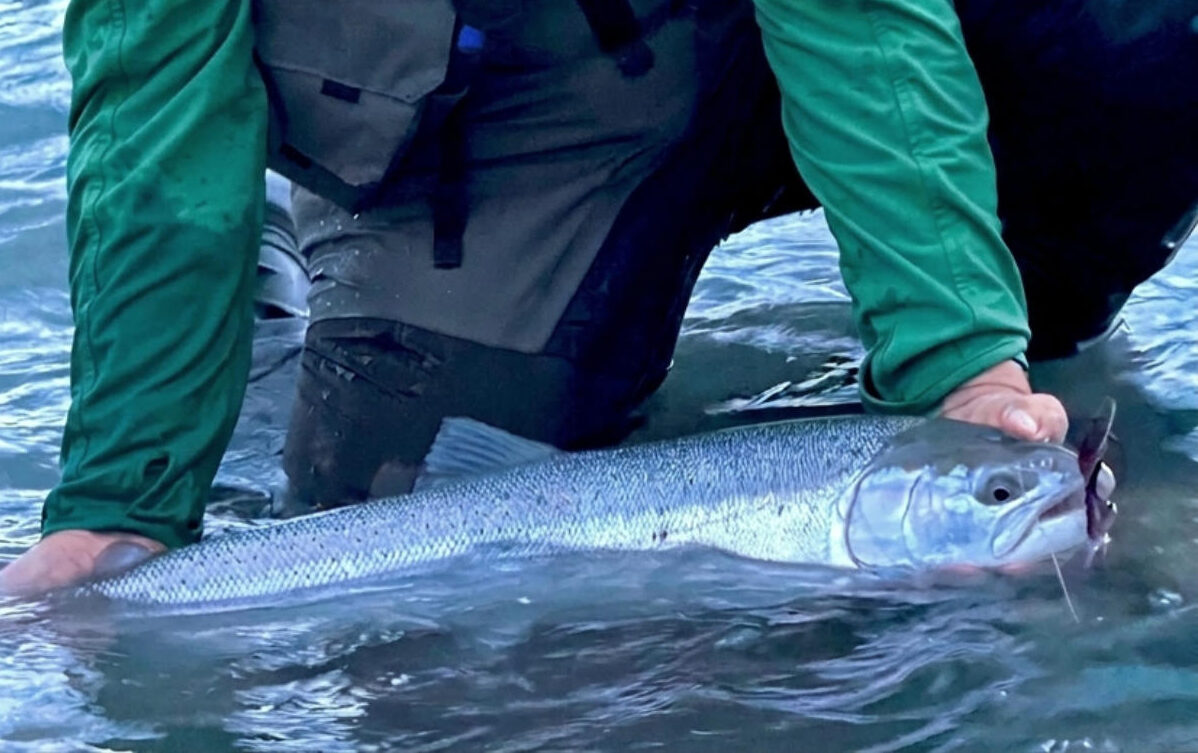

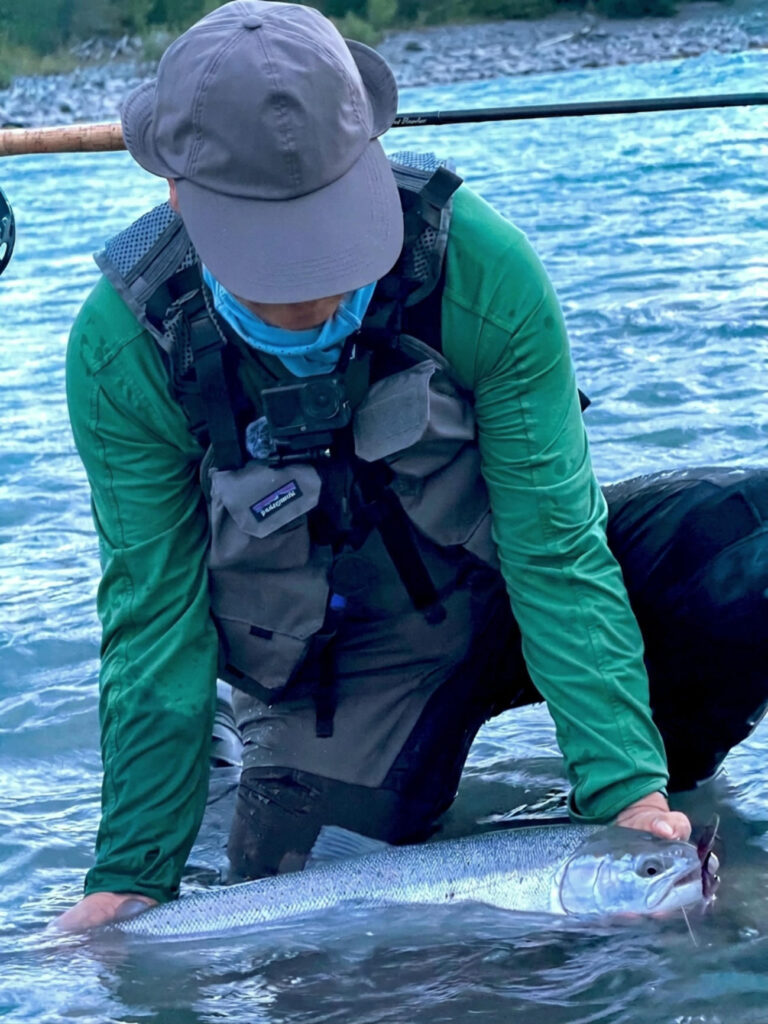
今年のスキーナのサマーランスチールヘッドはかなり好調。このランの100メートルの間だけで7匹食わせた。逃した20ポンド級の獲物は残念だったのだけれど、、。 The Skeena summer run is on fire this year. I hooked seven steelhead in just a 100-yard stretch. The one that got away was a massive 20-pounder, though…
08-26-2026 Click here for English
Written by Hiro Masaki
今月は、カナダ スキーナにサマーラン・スチールヘッド狙い。
目的は、盛夏のベストコンディションのサマーラン・スチールヘッドをスイングとドライフライで狙うこと。
そしてスキーナ随一の、もっと正確に言うと世界最高峰のスチールヘッド・ガイド、ジェイミー・クロエッテに一週間、マンツーマンでついてもらって彼の指導の元、最新のスイングテクニックの洗い直しをすると言う贅沢なプラン。
と言ってもコストセーブはしたいので、宿はスコットランドのフライフィッシャーと二人でテラスの町に一軒家を借り切り、そこで二人で宿泊することで超格安、超快適な宿泊環境を確保した。今回は宿の周りに何匹かクマが居座っていて、宿での夕食後にジェイミーが目の前2メートルでクマと突然鉢合わせする、と言うご愛嬌はあったのだけど、、、
この宿が何と言っても素晴らしかったのが、そのローケーション。宿の目の前はスキーナの一級ポイントだからいつでも好きな時に気軽に川に出て、好きな時に釣りができる。この宿前スポットでは今回はスチールヘッドには巡り合わなかったけど、スコットランドの相棒とサーモンは何匹か釣ることができた。
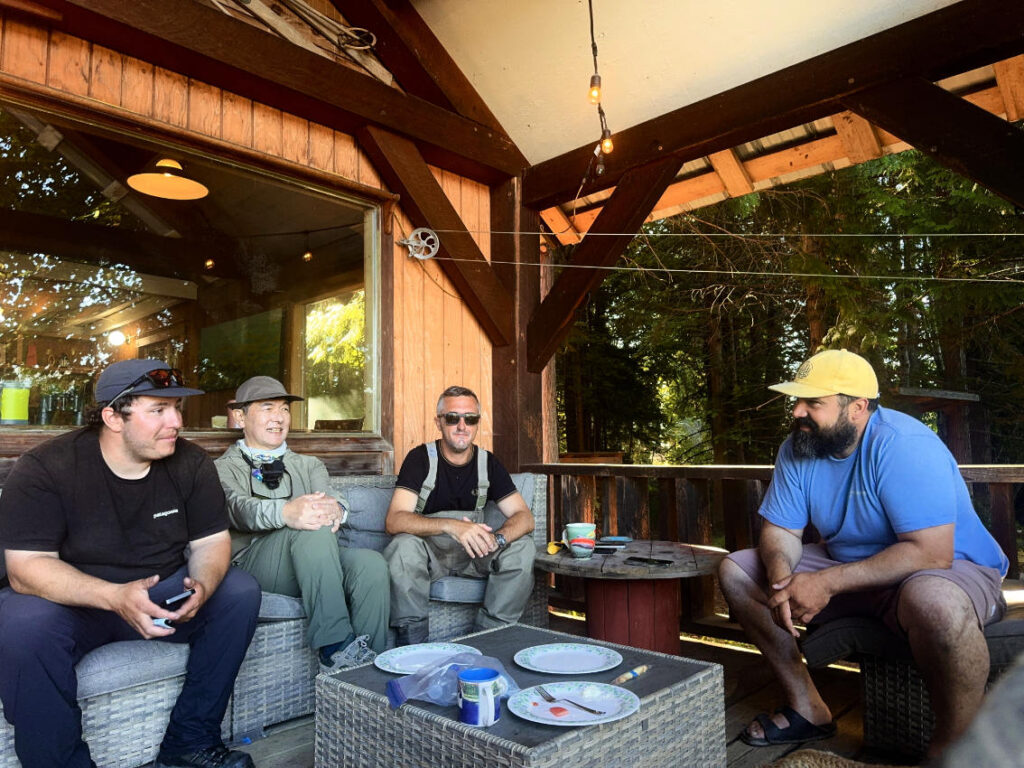

貸切一軒家の宿で、釣り話は尽きない。右は、宿からの眺め。ここは一級ポイントでもある。
ここ数年の私のスキーナ水系の印象はスチールヘッドとチヌーク(キング)サーモンに関して言えば、どちらも海からの戻りが今一つ低調気味、と言う感じだった。特に去年はスチールヘッドの戻りは過去70年で7番目に不調の年だったのだけど、その要因の一つは恐らくスーパーエルニーニョによる川の水温の加熱、春の雨不足による渇水がその原因だったのだと思う。
でも“今年は絶対いいはず“と踏んでいたのだけど、そのヨミ予測は見事にビンゴ!
初日の朝からいきなり100メートルのランで7匹食わさせると言う経験もさせてもらった。内一匹は、軽く20ポンド超えで、そいつは20ポンドテストのティペットをいとも簡単に切って行った。一緒に釣りをしたジェイミーも25ポンド超えを掛けて、激闘のすえ岩に巻き込まれ、こいつにも切られる一幕があった。
今年は、PNW(パジフィックノースウエスト。北太平洋沿岸域)でのエルニーニョの影響は去年と違って殆どない。また春の間にスキーナ上流域の山々の森林地帯では比較的に潤沢な降水量が観測され、それによって上流の森林地帯が程よく水を蓄えていたからスキーナの水量も大方理想状態。面白いのは、釣りのコンディションはいつも北海道、道北のアメマス、イトウとリンクすると言うことだ。今年の北海道は去年と逆で前半戦は振るわなかったが、去年ダメだった夏は逆に涼しい日が多くトロフィークラスのアメマス、イトウのいい便りが連発している。
スキーナも正に同じで、スチールヘッドの海からの戻り状況は7月に入ってからは絶好調が続いている。
今期のスチールヘッドのスキーナシステム内での累計遡上数は、8月17日時点でここ6、7年の平均を大幅に上回る40,260尾に達しており、8月の下旬も好調だったので、今年は過去10年で最高のスチールヘッドの戻り年になる可能性があるのではないだろうか。
反面、チヌーク(キング)サーモンの戻りは相変わらず低調で、これは彼らの重要な餌場であるベーリング海でのピンクサーモンとの生存競争の過激化が学術論文で指摘されている。気になるのは、ソックアイサーモンが今年は激減している点で、そのためにカナダ政府は早々にソックアイの商業漁獲制限を発令して来た。もしかするとその漁獲制限がために商業価値がないスチールヘッドの混獲による海洋投棄が軽減したことが、今現在のスチールヘッドの好調に繋がっている面も一部ではあるのかもしれない(スキーナに戻るべきスチールヘッドの10から40%程度が混獲で漁船から投棄されているとスキーナワイルド自然保護基金は主張している)。 因みに今年はピンクサーモンはかなり少ないけど、本年は2年周期で来る戻りの中休み年に当たるので、多分これは心配する必要はないと思う。
いずれにしても、スキーナでのスチールヘッドは雨の恵みが適度にあれば、これから秋に向けてのシーズンも期待できる素晴らしい年になることだろう。
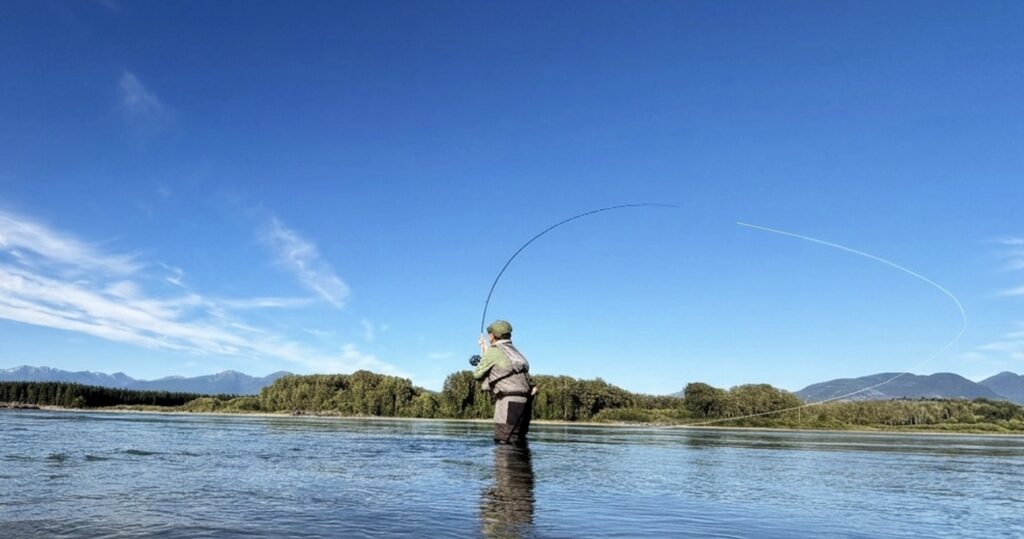
さて、ここからは、スペイフィッシングのオタク専用向けの内容です。
ジェイミー・クロエッテとの釣りは毎朝4時起床、釣りは5時半に開始、そして夜の9時半までやりぬく。これを一週間続けるのだけど、このルーティーンは筋金入りの釣り馬鹿じゃなきゃできない訳で、その意味では自分は間違いなくその類い人種であることを証明してみせた一週間だった。
今回、私がジェイミーに期待していたことは、彼の超一流のガイディングを受ける他にもう一つあった。それは彼から最新のスイングフィッシング・テクニックを学ぶことで、彼と一緒に釣りをしながら自分のテクニックを根本的に洗い直してもらうことだった。
彼のトップ中のトップのプロのワザは、ひたすら学ぶことばかり。100個の新しい発見があった。
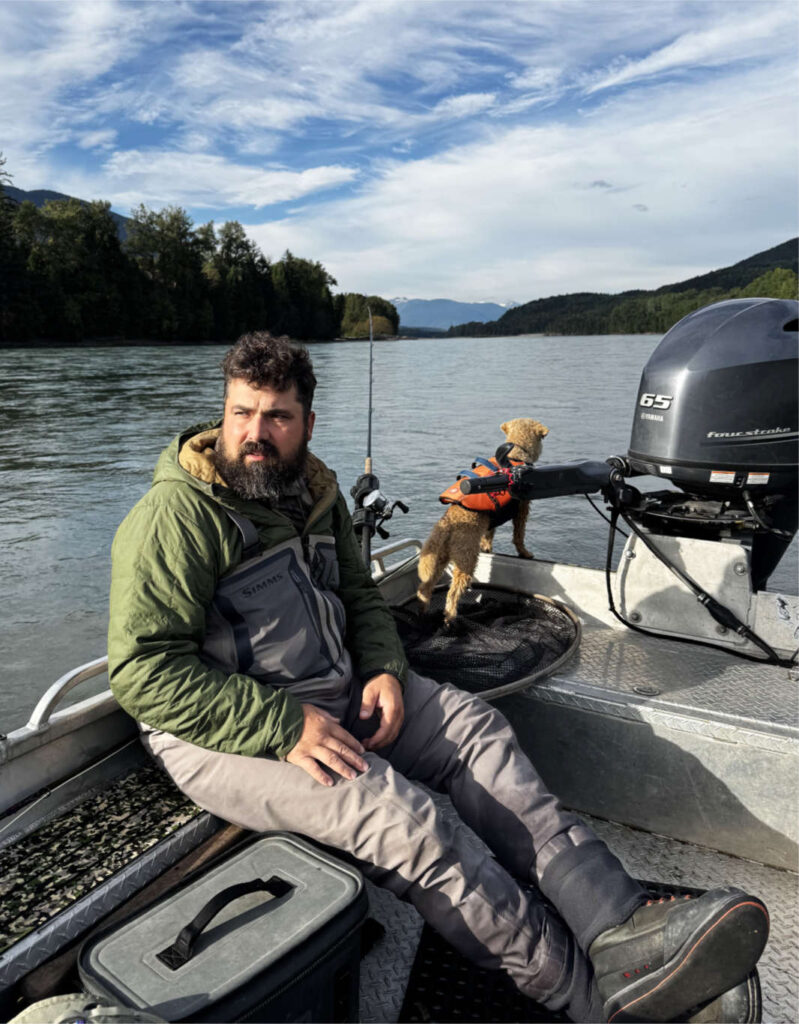
スキーナ水系一のガイド、ジャイミー・クロエッテ。彼の信頼できる相棒のRioと共に。
PNWのスチールヘッディングと言うと、多くのアングラーが普通最初に思い浮かべるのがスカジットラインに重〜いT11からT17クラスのシンクティップを使うスタイルではないだろうか?
サマーランのスチールヘッドと言えども、一般的にスチールヘッドはフライをベタ底でスイングさせるのが定石と信じる人はひじょうに多い。
でもジェイミーのようにスチールヘッドとスイングフィッシングを知り尽くした一部の超一流のフライフィッシャーは、スイングの質を殺しかねないT14やT17でボトムレイヤーをズリ引きする方法は、ほぼ絶対と言って取らない。
これは、サマーランスチールヘッドに限らず、ウィンターランにおいてもしかりだ。
重いティップを使うと「フライがボトムを流れるから急流でもゆっくりフライを泳がせられて、魚が余裕を持ってフライを捉えられるからより釣れる」と言われがち。でもシンクティップの扱いを心得ていないと多くの場合、「フライラインのフローティングのベリー部は水面近くの流れに乗って早くドリフトしフライより先行して下流に流れる、つまりベリー部がフライを引っ張っている状態になる」。またフライの遊泳層がシンクティップの先端よりも水面近くに留まることも起こり得る。これだとスイングの質としては最悪の状態で、これでは魚な反応はグッと落ちる。
ボトムレイヤーをズリ引きするやり方は取らない、と言ってもその分岐点は摂氏 10℃ (華氏50°F)の水温にあると言う。
この温度を下回るほどに確かに魚の活性は徐々に落ち始め、スチールはボトムレイヤーに縛られ始めるので時にシンクレートの高いシンクティップ(T14以上)も有効になる。でも、多くのアングラーがPNWを訪れる4月から10月は、摂氏10℃の水温を下回る状況にはあまり遭遇しないはずだ。
スキーナで言うと海から川に戻ったスチールヘッドは上流にむかって一日10から20キロメートル移動するのだけれど、コーホーサーモンの卵を追っているような場合は別として、そのスピードでの移動中、基本的に視界はミドルウォーターコラム(中層)から水面近くに向けられている。多分、そうでないとスキーナの重い急流の中で、あれだけの巨体を上流に向けて逆走しながら1日何十キロも泳ぎ切るだけの筋肉とそれを支えるエネルギー確保はできないだろう。
この時、ジェイミーのようなトップクラスのスチールヘッダーが最も注意を払う点は、フライが魚の視界に入った瞬間に、いかに自然で生命感のある動きをしているかということ。そのために、フライは極力シンクティップの重さだけに頼って沈めるのではなく、ラインに意図的なスラックを作るメンディングなどを駆使して沈めることに重きをおく。これにより、圧倒的に優れたスイミングアクションが実現する。
このことはスイングフィッシングに精通したアングラーにとっては当たり前の常識ではあるのだけれども、私含めてその完成度はプロのスインガーには遠く及ばないことが多い。
フライは下流に向かってスイングするほどに、そしてロッドティップとラインとフライが直線状に配列してくるほどに流れに抵抗するから水面に向かい始める。結果として、スイングの後半では自分がフライを通そうと思っていたのにそのウォーターコラム(泳層)を外して水面近くをスイングさせてしまっていることはないだろうか?
そして、フライの生命感の醸出がいかにできるか? ターゲットフィッシュに全く泳いでいないフライ、つまりただのゴミと化した生物反応のないフライを魚の目の前をデッドドリフトで通してしまったら、そのフライがいきなり泳ぎ出してもそれを追い食いするほど魚は馬鹿ではない。
セレクティブで賢いブラウントラウトをドライフライで釣る時に、一回ドラグの掛かったフライを魚に見せてしまったら、その次のキャストで同じ魚に対していかに綺麗にナチュラルドリフトさせようが、その時は既に手遅れ、ゲームオーバーなのはよくある話。
ここでも同じルールが当てはまる。川に入ってまだ数日しか経っていないスチールヘッドであっても、綺麗にスイミングしていないフライが目の前を何度も通過すれば、その場所は新鮮味を失い、やがて魚はフライを完全に無視するようになる。
ジェイミーのような上級スチールヘッダーはスイングの質を徹底的に高めるために、沈みの早い銅製のメタルチューブやタングステン・コーンヘッドといった重量物にすら頼らない。それよりもスチールヘッド・フライを生命感あふれるアトラクターとして仕上げることに細心の注意を払う。マテリアルを必要最小限に抑え、オーストリッチやマラブーがシャンクに対してドライフライのハックルのように垂直にフレヤーが広がるようにタイイングすることで、水中で本物の生物が呼吸しているかのようなアクションを生み出すのだ。
これらのことにどう対処するか、その完成度こそが如実に、そして露骨に釣果の差となって現れる。十分な理解と経験量が必要とされるわけで、ここがスイングフィッシングの面白さの冥利がある、と言うわけだ。
そして最後にもう一つ。ミスキャストや不適切なスイングを極力減らすと言うこと。一見単純に聞こえるが、一投ごとに安定した有効なスイングを確実に繰り返し実行できる能力は極めて重要だ。 一投ニ投のキャストのたびに確実に数歩ずつ下流へ移動し、常に新鮮な状態でフライを魚に見せること。一つの場所に留まり続けることは、魚を警戒させ、ポイントを台無しにする場合もあり、多くの場合は逆効果になり得る。
言い換えれば、良いラン(ストレッチ)を釣る際、その場所に最初に入った釣り人が圧倒的な優位性を持っていることを認識しなければならない。先行者の後を追う場合は、まだフライを通していないスジに届くよう遠くにキャストする、フライのサイズを下げ、色を変える、といった調整も有効になってくる。
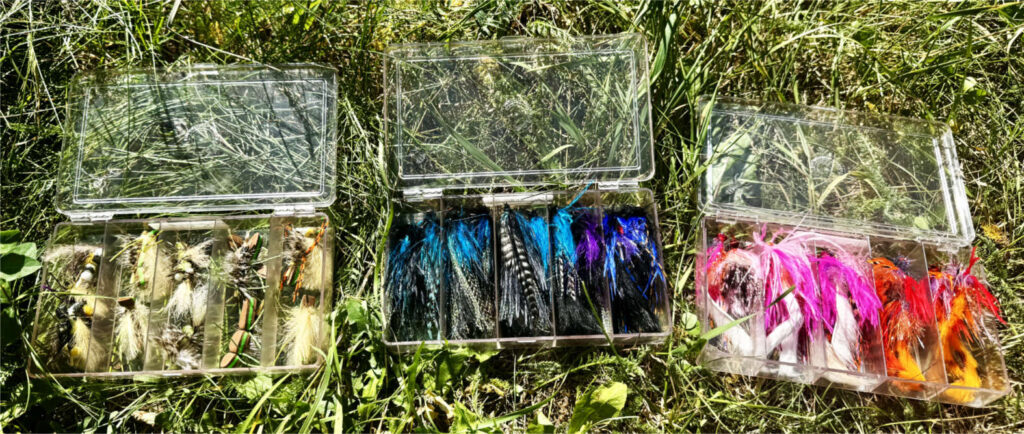
私のドライフライボックスと、スイング用フライ。 カラーバリエーションよりもサイズと重さを揃えるのがポイント。
最新のフライライン、シンクティップのトレンド
この3年位、スカンジとスカジットのフライライン、それに交換式シンクティップは、次の新しいトレンドを作り始めている。
それは、スカンジとスカジットの中間路線を行く、ハイブリット・テーパーが新しいトレンドを形成し始めている、と言うことだ。
別の言い方をすると、スカンジとスカジットの双方のラインのいいとこ取りをしたラインが急に頭角を表している、とも言える。
ついちょっと前までは、スカジットラインは短く太く重いライン、スカンジラインは長め細め軽め、と言われてきた。でも最近のトレンドを具に見ると、この言い方自体はオールドスクールの常識になりつつあるのかもしれない。
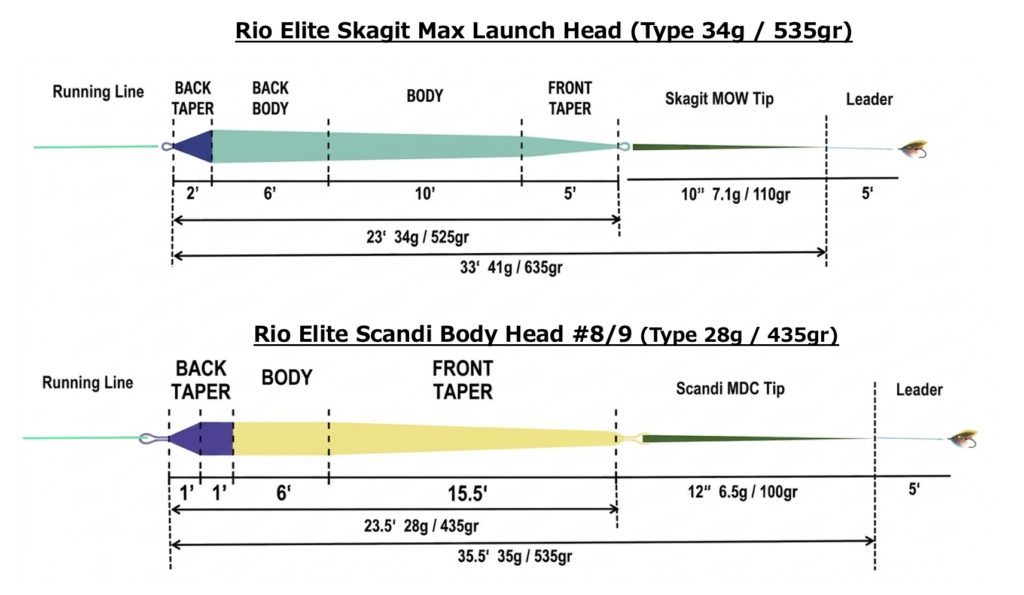
以下のイラストはRio社で見る売れ筋のスカジットラインとスカンジラインの、両者のテーパーデザインがどのように異なるかを示している。どちらも同じロッドのためのセッティングだ。 一昔前なら、スカンジはもう少し長いのが一般的だったけれども、今や長さ的には両者の差はどんどん縮まっている。 一方で、同じ8/9番ロッド用のフライラインの重さの差は6グラム(100グレイン)ある。
これはキャストの仕方をライン種に合わせて変えなければならないことを意味するわけで、恐らく、この点がスペイキャストの入門者にとって最も難解な部分、入門のハードルをあげて難しくしている部分と言えるだろう。
今後はスカンジラインのFront Taper部分(下の図だと15.5′ )は短くなり、Body部(下の図だと6′ )は長くなって行く傾向が進むであろう。
つまりこの両者のラインがハイブリッド化するのが今のトレンドと言うことだ。
フライラインについて言うと、正直言って今回ジェイミーに一週間ついて指導してもらう前までは、私はスカジットラインは好みのライン種ではなかった。僕にとっては何と言ってもショートスカンジ(交換式ティップ含めて35から37フィート)が一番好きなライン種で、これだと「エレガントなスペイキャスティングが楽しめるし、ラインがスカジットに比べて細いからフライの泳ぎがずっと良い。キャストも綺麗なDループとVループのデリバリーループが作り易く、またスカンジより少しラインが長いから打ち返しの手返し効率も高い、よって良く釣れるライン」と思って来た。
でも食わず嫌いでは進展がないので、今回は一週間に渡りスカジットラインを使った取り組みに集中してみた。 その結果、最新の装備を使うとそれはそれでかなり魅力のあるライン種であると見直した次第。
スカジットとスカンジラインのプラス面とマイナス面を以下、まとめてみた。
スカジットテーパーのシューティングヘッドラインは、PNW(パジフィックノースウエスト。北太平洋沿岸域)発祥のラインシステムで、このラインの一般的に言われているメリットは:
- ペイロード(シンクティップやフライの運搬能力)が高いこと。そして、
- ターンオーバー力が強いので風の中でのキャストに有利である、と言うこと。
対してデメリットとしてよく言われるのが:
- デリケートなプレゼンテーション性にかけると言う言い方。そして、
- ラインが太く重いので軽く細いライン、例えばスカンジラインに比べてスイング性能が落ちる、つまりフライの泳ぎが犠牲になる、と言う見方。
この従来から言われてきたデメリットは、本当なのであろうか?
スカジットラインは、確かにロングキャストしようとして、強いシューティングモーションを掛けるとその強い推進力からランニングラインをリールからジジーと引き出して、ターンオーバー時に勢い余ってライン先端がキックして大きなスラックを作ってしまうことが多い。この現象は間違いなくマイナス面ではあるが、比較的簡単なテクニックで容易にカバーすることができる。ループがターンオーバーする直前に、トップハンドの中指で軽くラインタッチして減速させることで、ラインをスムーズかつ静かに水面へ着水させることができる。
スイング性能が落ちる(スカンジラインに比べて)と言うマイナス面について言うと、以前は確かにそうであったと言える。でも昨今、シンクティップの技術革新がこの欠点を急速にカバーし始めている。
従来、スカジット用のシンクティップは10フィートのレベルラインが標準であった。しかし最近では、Rio社をはじめとするメーカーから、12〜20フィートというより長い、マルチデンシティ(多重密度)のテーパードティップが充実したラインアップで登場している。
さらに、メインボディ(ヘッド)の先端部自体がスローシンク仕様に設計された新しいマルチデンシティ(多重密度)タイプのラインが広く普及し始めている。これにより、交換式のティップと組み合わせることで、フライラインからフライにかけて水中で徐々に、かつスムーズに沈み込んでいくようになり、スイング性能も大幅に向上させている。私個人としては、長すぎる交換式ティップは好みではないのだけれども、ヘッドの先端が沈むデザインであれば、交換式シンクティップの長さを短めに抑えることができる。今回、スキーナ川でこのセッティングを試してみたところ、デリケートなプレゼンテーションとキャスティング性能がともに大幅に向上しているという鮮明な印象を受けた。従来のスカジット特有のスイング性能に対する不満が、これによって劇的に解消されていることを感じるところだ。
一方で、スカンジテーパーのシューティングヘッドラインは、スカンジナビア発祥のラインシステムで、このラインの一般的に言われているメリットは:
- ライン全長がスカジットに比べると長いので、キャストの打ち返しの手返しが良い。
- デリケートなプレゼンテーションができること。そして、私の観点でいうと最も大事なポイントは、
- ラインが軽く細めだとフライのスイング性能、つまりフライの泳ぎがスカジットに勝る、と言うこと。
対してデメリットとしてよく言われるのが:
- ペイロード(シンクティップやフライの運搬能力)が低いこと。そして、
- スカジットに比べると強風下でのキャストには弱みが出る、と言うこと。
さて、この従来から言われてきたデメリットは、本当なのであろうか?
近年のショートスカンジ(35-37フィート)のラインの多くは、交換用のティップがボディとの進化したインテグレイテッドテーパーデザインによってターン性能は昔に比べて劇的に改善されていて、T11までのシンクティップなら使い勝手は問題ない。高丸翔平デザインによる日本のRiver Peak社のCantamシリーズは、非常に良くデザインされた私の好みのラインで私が最も使うお気に入りのラインだ。
ただ、スキーナや北海道の天塩川のような大河で絶えまないふきさらしの風が吹くような大場所で、更に場所によって100ft(30m)越えのキャストが頻繁に要求されるような場所ではもう少しパンチ力が欲しい、と思う時が多々ある。
このようなコンディションに対応するのに、必然と言っていい形で最近なって登場し始めたのが、スカジットとスカンジのハイブリットラインだ。
この種のハイブリットラインで現在、最新トレンドをリードしているのは、やはりスペイフィッシングの先進国、北欧のブランドのメーカー。それにカナダのBridge社が見逃せない。
メーカーとしては、
- スエーデンのFrödinflies(フローディンフライス)社の Salarシリーズ
- フィンランドのVision社のHYBRID DOUBLE HAND SHOOTING HEADシリーズ
- ノルウェーのGuideline社の3D+ Compactシリーズ、
- カナダのBridge社の Torrent, Torrent MD(マルチデンシティ)シリーズ。
これらのラインは、スカンジラインをベースとしたハイブリッドラインとなっている。 (BridgeのTorrent MDはスカジットがベース)
ヘッド部は従来のショートスカンジに比べて少し長めにし、そして、交換式ティップはラインのヘッド部とデザイン的にインテグレートさせており、全体的にバランス性、パンチ力も高めている。
これらのスカンジナビアのメーカーやカナダのBridge社は、ベースとするラインはフローティングヘッドであるも、アトランティックサーモンのスイングフィッシングにおける最近のトレンドは変化している。 アトランティックサーモン・シーズンの初期に、フライをボトムレイヤーまで沈めるため、彼らは最近では、フライラインのヘッドのフロント部分から沈むように設計されたマルチデンシティ・ラインを提供している。さらに、それらヘッドにインテグレイテッドさせた交換式ティップは明確なテーパーを備えており、マルチデンシティ(多重密度)設計を採用しているため、ラインの最先端部からフライラインのメインボディに向かって、スムーズな沈下速度(シンクレート)を実現させている。
今回、私はスキーナでは、シンクティップ部にはRioのマルチデンシティー、テーパードティップの最新版MDCシリーズを使用したが、非常に満足のいくパフォーマンスを発揮した。
因みにハイブリットラインカテゴリーとして先陣を切ったのは、AirfloのRage Compactシリーズ。このラインは私は試したことがないが、メーカーの説明によると、水面近くのレイヤーに特化したテーパーとして打ち出しており、シンクレートの高めの交換式シンクティップは想定していない、となっている。
と言うことで、スペイフィッシングの世界もどんどん進化し、相変わらず移り変わりが激しい。恐らく、上記の私の説明は、極めて難関で何を言っていることが分からない方も多いと思うが、最新テクニックを知りたい方は、是非、スペイフィッシングに精通したフライショップに足を運んで相談するか、FFIツーハンドロッド公認THMCIインストラクターに相談してみることをお勧めします。
Written by Hiro Masaki. All rights reserved.
Skeena, The Summer-run Steelhead Chronicles
The Skeena summer run is on fire this year. I hooked seven steelhead in just a 100-yard stretch. The one that got away was a massive 20-pounder, though…
Written by Hiro Masaki
This month, I head to the Skeena River in Canada to target summer-run steelhead.
My main objective is to swing flies and fish dries for these summer-run steelies when they are in their absolute prime. To make this trip truly exceptional, I’ve booked a week of one-on-one guiding with Jamey Cloete—one of the Skeena’s, and arguably the world’s, finest steelhead guides—to refine my swing techniques under his expert mentorship.
That said, to keep costs in check without sacrificing comfort, I split a rented house in the town of Terrace with a fly fisher from Scotland. It turned out to be incredibly reasonable and exceptionally comfortable. We did have a bit of a classic Canadian surprise, though: a few bears had taken up residence around the house. Right after dinner one evening, Jamey stepped outside and came face-to-face with a bear just 8 feet away!
But what truly made this place outstanding was its location. Right in front of our doorstep was a prime piece of Skeena water, allowing us to step out and fish whenever we pleased. Although we didn’t hook any steelhead in this home pool this time, my Scottish fishing partner and I did manage to land several salmon.
The fishing talk never ends back at our rented house. On the right is the view from the lodge—which also happens to be a prime piece of water.
Over the past few years, my impression of the Skeena system has been that both steelhead and Chinook (King) salmon runs were feeling rather sluggish, with fewer fish returning from the ocean. Last year was particularly grim—the steelhead run was ranked the seventh worst in the past 70 years. I suspect a major culprit was the Super El Niño, which overheated river temperatures, combined with a spring rain deficit that caused drought conditions.
Even so, I had a strong hunch that “this year would absolutely be the one.” And my prediction hit the bullseye.
Right on the morning of day one, I had the thrilling experience of hooking seven fish in a single 100-yard run. One of them easily cleared the 20-pound mark and snapped my 20-lb test tippet without breaking a sweat. Jamey, who was fishing alongside me, also hooked a massive 25-plus pounder; after a fierce battle, the fish wrapped the line around a rock and broke off as well.
This year, the Pacific Northwest has been free from El Niño, and healthy spring rainfall in the upper Skeena watershed has kept water levels near-ideal, mirroring strong white spotted sea run char and taimen conditions in Hokkaido. Consequently, the steelhead return has been exceptional since July, reaching a cumulative 40,260 fish by August 17th and pointing toward a potential decade-high return.
Meanwhile, Chinook runs remain low due to intensified competition with pink salmon in the Bering Sea, a critical feeding ground, as noted in recent academic papers. The concerning part is that sockeye numbers have plummeted this year, prompting the Canadian government to swiftly impose commercial fishing restrictions. This regulation may indirectly contribute to the current strong steelhead numbers by reducing bycatch and discards of this non-commercial species; the Skeena Wild Conservation Trust claims that approximately 10% to 40% of steelhead heading back to the Skeena are discarded from fishing boats as bycatch. On a side note, while pink salmon numbers are quite low this year, this is likely nothing to worry about, as it reflects the normal off-year of their two-year cycle.
In any case, as long as there is an adequate amount of rain, this year promises to be a spectacular autumn season for steelhead in the Skeena.
Now, from here on out, this content is strictly for the spey fishing geeks.
Fishing with Jamey Cloete meant waking up at 4:00 AM every single morning, stepping into the water by 5:30 AM, and grinding it out until 9:30 PM. Keeping up this routine for an entire week requires a hardcore, borderline-obsessive passion for fishing. In that sense, this trip definitely proved that I belong exactly to that breed of anglers.
Aside from receiving his world-class guiding, I had another major expectation for my time with Jamey. I wanted to learn his cutting-edge swing fishing techniques and have him fundamentally overhaul my own approach while we fished together.
Watching a top-of-the-top professional work his magic was a masterclass in itself; I must have walked away with a hundred new insights.
Jamey Cloete, the best guide in the Skeena system, alongside his trusted companion, Rio.
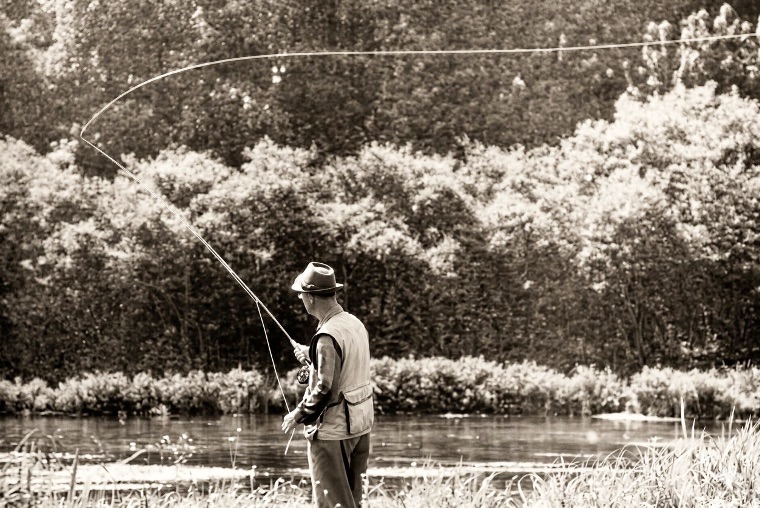
When people think of steelheading in the PNW, the first style that comes to mind for most anglers is likely using a Skagit line paired with heavy sink tips in the T-11 to T-17 class.
Even when targeting summer-run steelhead, there is a very widespread belief that the standard, proven tactic is to swing the fly right along the riverbed.
However, a select group of top-tier fly fishers who know steelhead and swing fishing inside out—like Jamey—almost never resort to dredging the bottom layer with T-14 or T-17 tips, which can utterly ruin the quality of the swing. This rule applies not only to summer-run steelhead but also to winter-runs.
It is commonly argued that using a heavy tip yields better results because “it keeps the fly down on the bottom, allowing it to swim slowly through fast water and giving fish a better window to track and take it.” However, without proper sink-tip management, you often end up in a situation where “the floating belly of the line gets caught in the surface current, outpacing the fly and dragging it downstream.” Or/and the fly may also remain suspended closer to the surface than the tip of the sink tip. This results in the worst possible swing quality, which severely kills your chances of getting a strike.
That said, the turning point for abandoning the dredging approach lies at a water temperature of 50°F(10°C).
Once the temperature drops below this threshold, the fish’s activity levels admittedly begin to decline, and steelhead become pinned to the bottom. In such conditions, a fast-sinking tip like T-14 or heavier can indeed be effective. However, from April to October—when most anglers visit the PNW—there is little chance you will encounter water temperatures below 50°F.
In the Skeena River, steelhead returning from the ocean migrate upstream at a pace of 10 to 20 kilometers a day. Except when they are actively pursuing coho salmon eggs, their field of vision during this rapid migration is basically directed from the middle water column up toward the surface. Most likely, this is because they wouldn’t otherwise be able to secure the muscle power and underlying energy required to swim dozens of kilometers a day, fighting against the heavy, rushing rapids of the Skeena with such massive bodies.
At this moment, what top-tier steelheaders like Jamey pay the closest attention to is how natural and full of life the fly behaves the very instant it enters the fish’s field of vision. To achieve this, they place great emphasis on sinking the fly not by relying too much on the weight of a sink tip, but by utilizing mends that intentionally introduce slack into the line. This approach results in an overwhelmingly superior swimming action.
While this is common knowledge among seasoned swing anglers, for many of us—myself included—our execution often falls far short of what the pros achieve.
The further down-stream your fly swings, and the more your rod tip, line, and fly align in a straight line, the more the fly will resist the current and begin to rise toward the surface. As a result, during the latter half of the swing, might you unintentionally be pulling your fly right out of your targeted water column, causing it to skim just beneath the surface?
And then there is the question of how to breathe life into the fly? If you drift a fly past a target fish that shows absolutely no swimming motion—essentially dead-drifting a lifeless piece of debris with zero biological response—the fish is not foolish enough to chase and strike it when it suddenly starts swimming out of nowhere.
When targeting selective, educated brown trout with dry flies, it is a well-known story that if you show the fish a fly that drags even once, it is already too late. No matter how perfectly you execute a natural drift on your very next cast to that same fish, the game is over.
The same rule applies here. Even for steelheads that have only been in the river for a few days, if a fly that is not swimming cleanly passes in front of them multiple times, the spot loses its freshness, and the fish will eventually ignore the fly entirely.
Advanced steelheaders like Jamey do not rely on heavy objects like fast-sinking copper metal tubes or tungsten coneheads to maximize the quality of their swing. Instead, they pay meticulous attention to finishing their steelhead flies as attractors bursting with life. By keeping materials to minimum and tying ostrich or marabou so that they flare perpendicular to the shank—much like a dry fly hackle—they create an action in the water that mimics a living creature breathing.
How you address these challenges, and the ultimate execution of these tactics, directly and undeniably dictates your catch rate. This requires deep understanding and extensive experience, which is exactly what makes the true reward and joy of swing fishing so profound.
And one last thing: minimize miscasts and improper swings as much as possible. It sounds simple enough, but the ability to consistently execute a stable, effective swing with every single cast is absolutely critical. Move a few steps downstream after every couple of casts to keep presenting a fresh fly to the fish. Staying in one spot for too long can spook the fish and ruin the pool; more often than not, it backfires.
In other words, when fishing a good run or stretch, one must realize that the angler who enters the water first holds an overwhelming advantage. If you are following behind another angler, subtle adjustments become effective—such as casting further to reach seams that have not yet been fished, downsizing and changing color of your fly.
My dry fly box and swing flies. The key is to have a variety of sizes and weights rather than colors.
The Latest Trends in Fly Lines and Sink Tips
Over the past 3 years or so, Scandi and Skagit fly lines, along with interchangeable sink tips, have begun carving out a brand-new path.
This emerging trend focuses heavily on hybrid tapers that bridge the gap between traditional Scandi and Skagit lines. Hybrid Tapers.
In other words, lines designed to offer the absolute best of both worlds are rapidly rising to prominence.
Until recently, the conventional wisdom was that Skagit lines were short, thick, and heavy, while Scandi lines were longer, thinner, and lighter. However, a closer look at recent trends in line design suggests that this distinction may be becoming old school common sense.
The illustration below shows how the taper designs of RIO’s best-selling Skagit and Scandi lines differ from each other. Both are set up for the exact same rod. Years ago, Scandi lines were typically longer than Skagit lines, but nowadays, the difference in length between the two is shrinking rapidly. On the other hand, there is a 6-gram (100-grain) difference in weight between these fly lines designed for the same 8/9-weight rod.
This means you must adjust your casting technique to match the specific line type. This is likely the most confusing part for Spey casting beginners, raising the barrier to entry and making it difficult to learn.
Moving forward, the front taper section of Scandi lines (the 15.5′ section in the diagram below) will likely trend shorter, while the body section (the 6′ section in the diagram) becomes longer.
In other words, the current trend is the hybridization of these two line styles.
To be honest, prior to spending a week under Jamey’s guidance, Skagit lines were never my cup of tea. My absolute favorite had always been short Scandi lines (including interchangeable tip section 35 to 37 feet). In my mind, they allowed for elegant spey casting, and because the line was thinner than a Skagit, the fly swam far better. It was easier to form clean D-loops and efficient V-loop delivery loops. Plus, because the head is longer than a Skagit, it required less stripping between casts, making it a highly efficient, fish-catching line system.
However, a stubborn refusal to try new things leads to zero progress, so I decided to dedicate this entire week to focusing on Skagit line setups. The result? I came away with a completely renewed appreciation, realizing that with the latest modern tackle, it is actually a highly compelling and attractive line type.
Below, I have summarized the pros and cons of both Skagit and Scandi lines.
The Skagit taper shooting head is a line system born in the Pacific Northwest (PNW). The generally accepted advantages of this system are:
- Its high payload capacity, meaning its ability to carry heavy sink tips and large flies. And,
- Its powerful turnover force, which makes it highly effective when casting into the wind.
On the other hand, the commonly cited disadvantages are:
- A lack of delicate presentation capability. And,
- The belief that because the line is thick and heavy, its swing performance is inferior to lighter, thinner lines like Scandi tapers, meaning the realistic swimming action of the fly is sacrificed.
Are these negative drawbacks actually true?
It is true that when you attempt a long cast with a Skagit line and apply a powerful shooting motion, the immense forward momentum often pulls running line off the reel with a violent zip, causing the tip to kick aggressively at turnover and create a massive amount of slack. This phenomenon is undoubtedly a downside. Although this phenomenon is undoubtedly a drawback, it can be easily compensated for with a relatively simple technique. Just before the loop completes its turnover, lightly touching the line with the middle finger of the top hand can gently decelerate it, allowing the line to settle onto the water smoothly and quietly.
Traditionally, a 10-foot level line was the standard for Skagit sink tips. Recently, however, manufacturers like Rio have introduced an impressive lineup of longer, 12-to-20-foot multi-density tapered tips.
Furthermore, new multi-density lines—featuring a main body (head) with a slow-sinking tip section—are becoming common. Combined with interchangeable tips, this design allows the entire setup from the fly line to the fly to sink gradually and smoothly through the water column, significantly enhancing swing performance. While I personally dislike overly long interchangeable tips, a head with a sinking front section allows you to shorten the sink tip itself. When I tested this setup on the Skeena River this time, I was left with a vivid impression that both delicate presentation and casting performance had improved substantially. I truly felt that this dramatically resolves the long-standing frustrations with the swing performance unique to traditional Skagit lines.
On the other hand, the Scandi taper shooting head is a line system that originated in Scandinavia. The generally accepted advantages of this system are:
- Since the overall line length is longer than a Skagit, it requires less stripping between casts, making the fishing cycle highly efficient.
- It allows for a delicate presentation. And, from my perspective, the most critical point:
- Because the line is lighter and thinner, its swing performance—meaning the realistic swimming action of the fly—is far superior to a Skagit.
In contrast, the commonly cited disadvantages are:
- Its payload capacity, meaning its ability to carry heavy sink tips and large flies, is quite limited. And,
- Compared to a Skagit line, it struggles when casting into strong headwinds.
So, are these negative aspects actually true?
Many modern short Scandi lines (around 35 to 37 feet) feature advanced, integrated taper designs between the belly and interchangeable tips. This has dramatically improved their turnover capability compared to the past, making them perfectly capable of handling sink tips up to T-11 without any issues. The Cantam series by Japan’s River Peak, designed by Shohei Takamaru, is an exceptionally well-crafted line that matches my preferences perfectly and remains my absolute favorite go-to setup.
However, on massive rivers like the Skeena or Hokkaido’s Teshio River, where you face a relentless, windswept blowout and are frequently required to make long-distance casts exceeding 100 feet (30 meters), there are many moments when you find yourself wishing for just a bit more punching power.
To address these precise conditions, it was perhaps inevitable that hybrid lines—blending the characteristics of both Skagit and Scandi—have recently begun to emerge.
The current trendsetters for this type of hybrid line are, unsurprisingly, brands from Scandinavia—the powerhouse of Spey fishing. Additionally, Bridge from Canada is another manufacturer that cannot be overlooked.
Key manufacturers spearheading this movement include
These hybrid lines are built upon a Scandi-taper blueprint. (Bridge’s Torrent MD is Skagit based line.)
Compared to traditional short Scandi heads, the main belly is designed to be slightly longer, while the interchangeable tip integrates seamlessly with the body.
While these Scandinavian manufacturers and Canada’s Bridge feature a floating head as their baseline, recent trends in Atlantic salmon swing fishing have shifted. To get flies down into the bottom layer during the early season, they now offer multi-density lines designed to sink from the front of the head. Furthermore, their interchangeable tips, which integrate seamlessly with the head, feature a distinct taper and utilize a multi-density design, ensuring a smooth sink rate from the very tip of the line back toward the fly line main body.
On the Skeena this time, I paired my setup with Rio’s latest MDC (Multi-Density Compensation) series—a multi-density, tapered sink tip system—and it delivered an exceptionally satisfying performance.
Incidentally, the pioneer in the hybrid line category was Airflo’s Rage Compact series. Although I have not personally tried this line, according to the manufacturer’s description, it is marketed as a taper specialized for near-surface layers and is not intended to be used with fast-sinking interchangeable tips.
As you can see, the world of spey fishing continues to evolve rapidly, with trends shifting at a relentless pace. I expect that for many readers, this deeply technical breakdown might sound incredibly complex or downright confusing. If you are eager to master these latest techniques, I highly recommend visiting a dedicated fly shop staffed by spey fishing experts, or reaching out to an FFI Certified Two-Handed Casting Instructor (THMCI) for proper guidance.
Written by Hiro Masaki. All rights reserved.