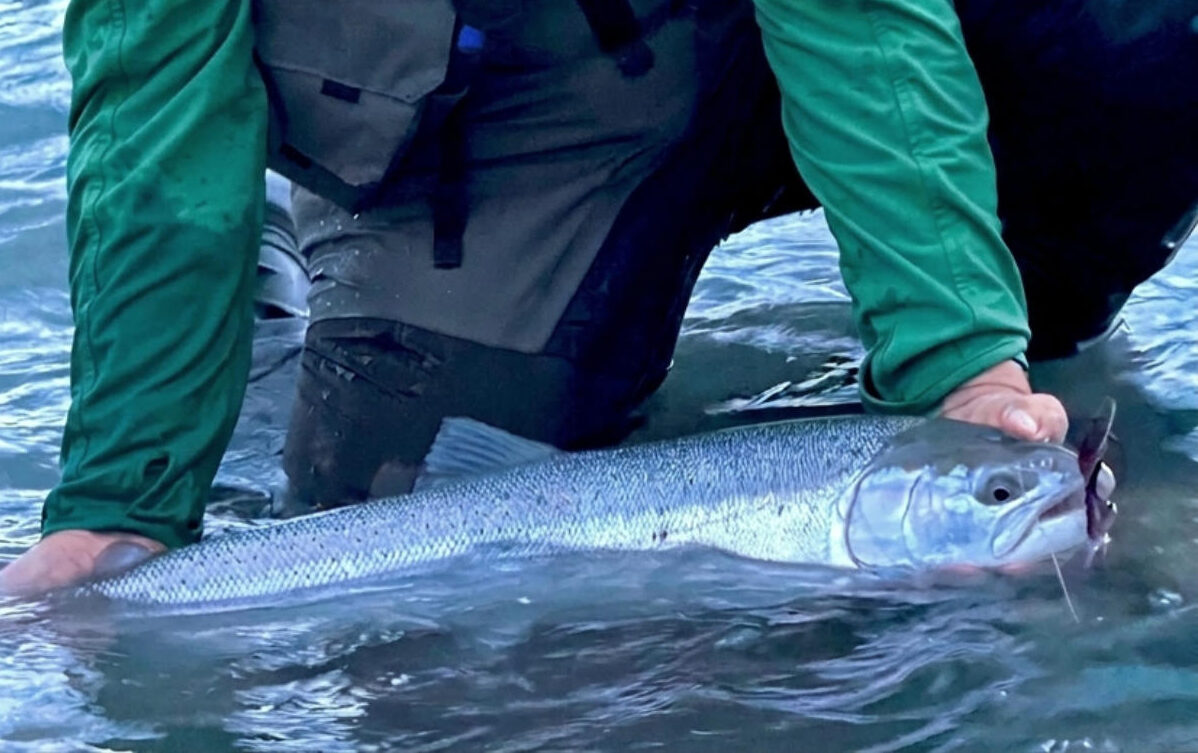
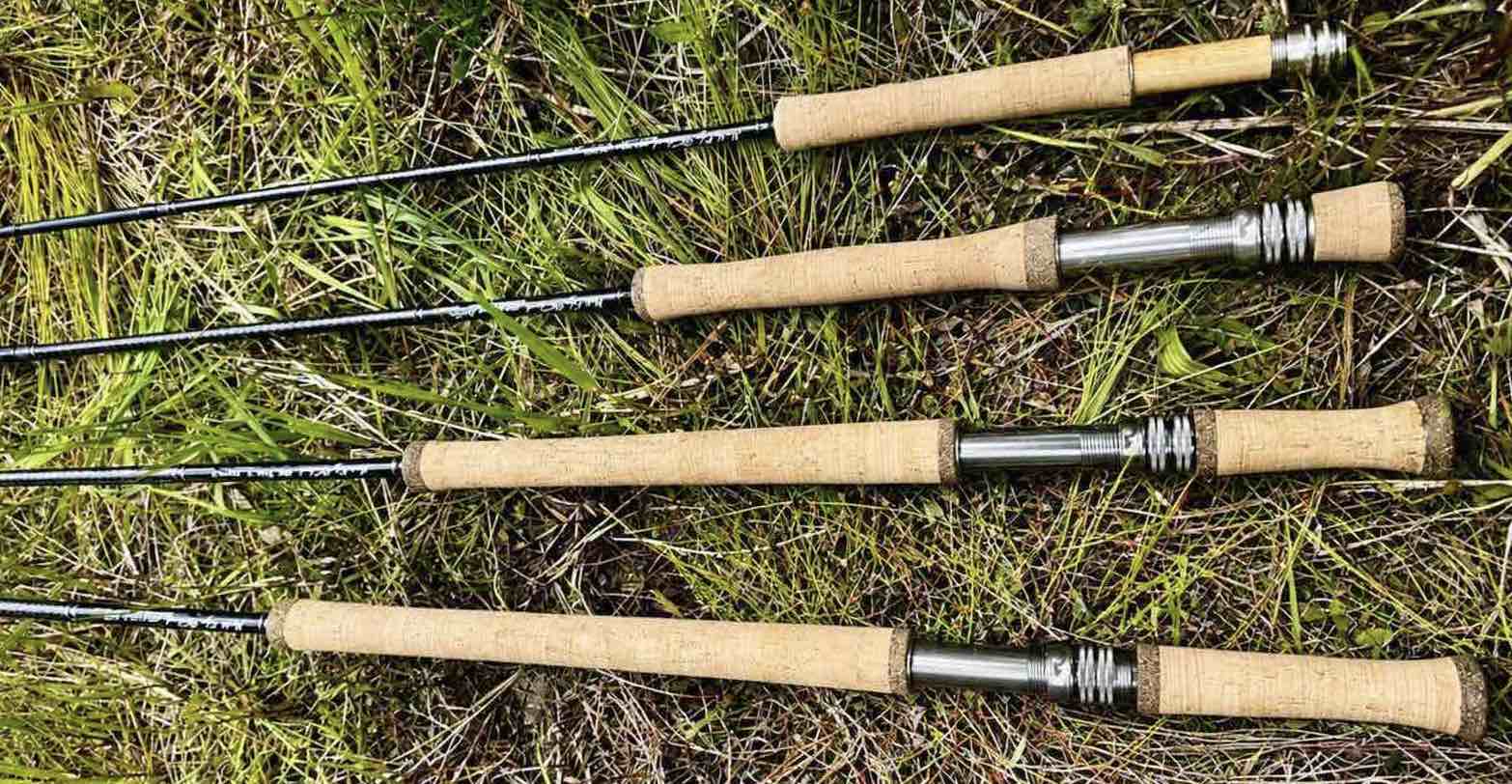

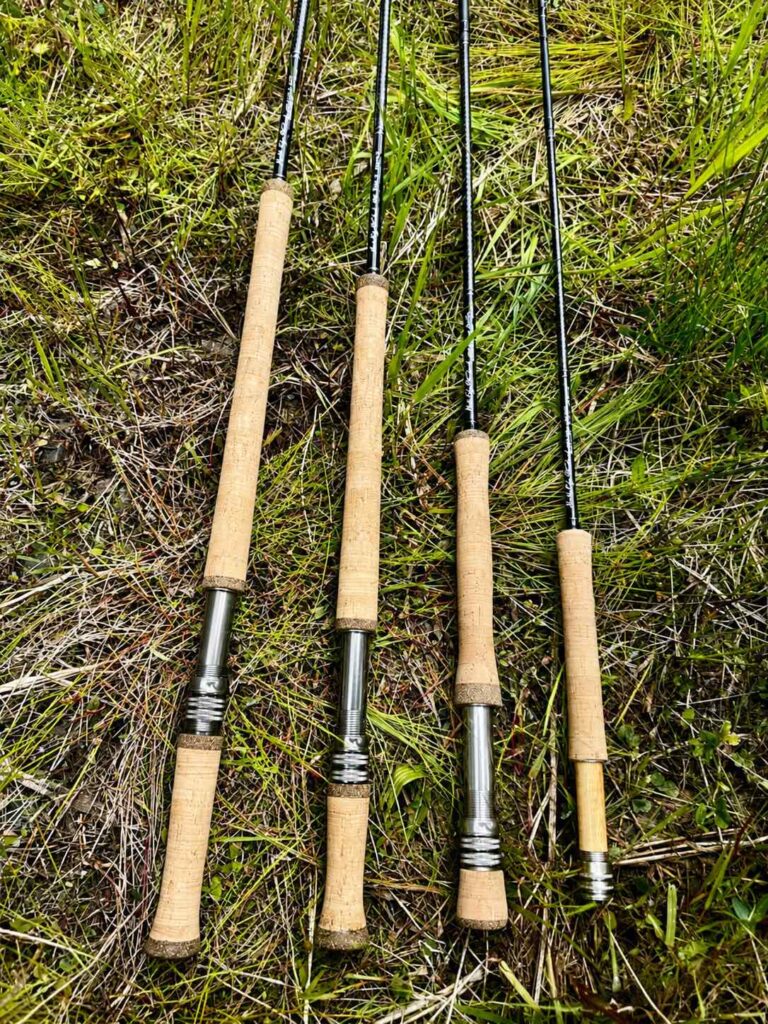
NESのフライロッド。ロッド毎に明確に定義されたミッションのためにそれぞれ専用設計された高性能ギア。プレミアムグレードのパーツがそれぞれのブランクのコアから、そしてバットからティップに込められている。
The North Edge Standard Fly Rods—high-performance gear, each engineered for a dedicated mission. Built with premium-grade components loaded right into the core of the blank, radiating from butt to tip.
September-06-2026 Click here for English
Written and Art by Hiro Masaki
私のフライフィッシャーズライフにおいて、フライロッドに見たゲームチェンジャーは3回あります。
一番最初に買ったフライロッドは、ハーディーのグラスロッドでした。
と言っても当時の私は13歳、ハーディーロッドの完成品を買うだけの持ち合わせはあるはずもなく、東京は京橋にあった「つるや釣り具店」で8フィート3インチ、6番仕様のハーディーの素っぴんのブランクが売られていることを知ると、それを買って自分で組み立てて安上がりのハーディーロッドを手にしたのが始まりです。当時、ハーディーのフライロッドには伝説のフライキャスター、Jon E. Tarantinoモデル、「通称JETシリーズ」と呼ばれるシリーズがあって、タランティーノに憧れていたものだから自分のロッドは勝手にJETモデルと決め込んで、そのロッド一本でがむしゃらにキャスティング練習をやりまくったものです。
そのロッドはその後長いこと私の相棒になり、電車通いの芦ノ湖で釣りをするにもこの一本だけで通したものだから、買った時には6番用だったロッドが高校を卒業する頃には繊維疲労でコシはなくなり、4番ロッドレベルまでにふにゃふにゃにへたっていました。
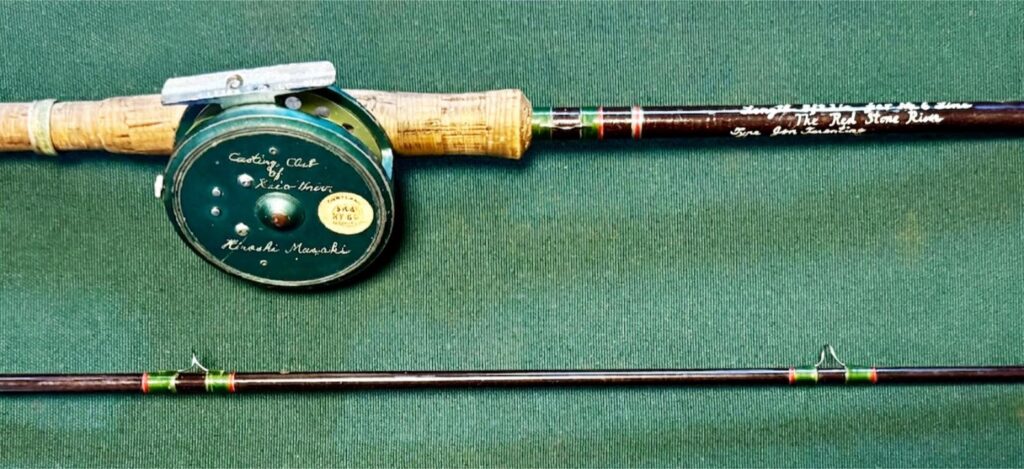
54年前に手にした私にとっての最初のフライロッド。ハーディーのブランクから組み立て、ロッドタイプにJon Tarantinoと表記した。
そんな時分、1974年のこと、マーケットに登場したのが、フェンウィック社がジムグリーンのイニシアティブで打ち出した業界初のカーボンロッド、HMG (High Modulus Graphite) シリーズです。
このカーボンと言う革命的素材の登場こそが、私が体験した一回目のフライロッドのゲームチェンジャーでした。
大人達が自慢げに渓流で使っているのを振らせてもらうと、極端なエキストラファーストのそのロッドは、トラウトロッドにしては過剰とも思える有り余るパワーがあって、しかもそのパワーからは想像できないような軽さも衝撃的でした。私にとってはそのお値段も衝撃的で、50年前の当時は1ドル300円弱の時代、ロッドの価格は8万円代後半。ロッドと同じ重さの当時の “金”の価値とほぼ同等だったと記憶しています。
私にとっての二回目のゲームチェンジャーは、1976年、18歳の時にペゾン・エ・ミシェルのバンブーロッドを初めて手にした時。
日本でのフライフィッシングをリードして来たカリスマ、澤田賢一郎さんは、ペゾン・エ・ミシェル社の技術顧問であったシャルル・リッツから直伝のレッスンを受けるとその時と同じくして、ペゾン・エ・ミシェルの日本総代理店になりました。
国分寺にあったフライショップで澤田さんにお願いしてショーケースに陳列されていた一本を手渡してもらうと、私は学生の身分にはとても高価なそのロッドを恐る恐るショップ内の空間で左右にスイングしてみました。
その時の情景は、いまでもはっきりと覚えています。
そのロッドは惚れ惚れするような美しいパラボリックカーブを描き、加えてそれまで見て来たグラスやバンブーロッドとは異次元のパワー、剛性感を持っていました。このロッドを見てしまってからと言うもの、 “どうしても欲しい!”と言う深刻な熱病に取り憑かれ、ついに清水の舞台から飛び降りたのです。まずはペゾン・エ・ミシェルのPPPシリーズ、7’2” 4/5番用のスーパーマーヴェル、その後すぐにシャルル・リッツ作の珠玉の一品と言われたファリオクラブ(8’5” 5/6番用)を手に入れました。
ファリオクラブは、バンブーでありながら70フィート程度のラインを問題なくフォルスキャストできるパワーを持ち、90フィート程度のフルラインならば簡単にキャストできるロッドでした。
さて、私にとっての3回目のフライロッドのゲームチェンジャーの話に入る前に、まず、現代のフライロッドの分類を整理しておきたいと思います。
マニア向けの内容となりますが、今まで余り語られることのなかったフライロッドのパフォーマンスの深層部に入ってみたいと思います。
ロッドの適合ライン番手ってなんだろう?
フライロッドの適合番手を語る時には、まずその基点となるフライラインの仕様規格がどのように決められているのかを正確に理解しておく必要があります。
フライラインの規格は、元はAFTMA (American Fishing Tackle Manufacturers Association、アメリカ釣具製造業者組合)によって決められ、1933年にその中のフライフィッシング部門がスピンアウトすると、AFFTA (American Fly Fishing Trade Association、アメリカ・フライフィッシング商業者組合)として引き継がれ現在に至っています。
AFFTA規格は、オーバーヘッドキャストを前提とする規格と、ツーハンド・スペイキャストを前提とする規格、の二つに大別されます。
- オーバーヘッドキャストを前提とする規格
AFFTA規格は、主にウェイトフォワード(WF)、ダブルテーパーライン(DT)に対しての規格となりますが、そのライン番手は先端から30フィートの重さ、で決まります。正確に言うとティップ部の重さは含まないことになっていますが、ティップ部は通常1フット(30cm)に満たない長さなので、昨今はこの部分は無視して語られる場合が殆どです。
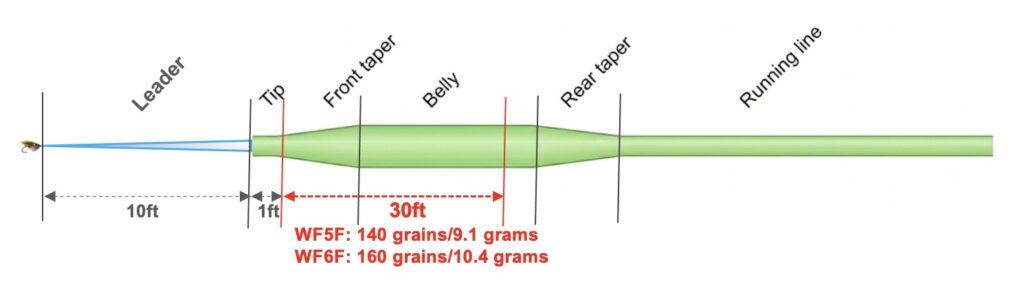
フライライン先端の30フィートの重さのライン番手毎の差ってひじょうに小さくて、例えば5番ライン(140グレイン)と6番ライン(160グレイン)の差の違いはクレジットカード1枚分、20グレイン、1.3グラムしかありません。[図-1]それでもある程度経験あるキャスターならば、この1.3グラムのキャストフィールの違いは明確に感じとることができるものです。
オーバーヘッドキャストの場合、ロッドティップからこのフライラインのAFFTA規格基準の30フィートを出した状態で、ロッド(例えば9フィート)とリーダーの長さ(例えば10フィート)を加えると、ほぼ50フィートとなり、トラウトフィッシングでもフラッツのボーンフィッシングにおいてもズバリ 「実用的な距離」と言うことになります。
この50フィートの距離で、ベストフィットするフライラインの番手、それがそのフライロッドの適合番手です。
では、ここで言うベストフィットのライン番手って、人の感覚に訴えるアバウトなものに聞こえますが、何がどうであったらベストフィットと言えるのでしょうか?
ロッドのアクションを測定する方法としては、2000年代初頭にウィリアム・ハネマン博士(Dr. William Hanneman)によって考案された「コモン・センツ・システム(CCS:Common Cents System)」と呼ばれる測定方法があります。これは、ロッドの長さの3分の1をたわませる荷重をかけたときの、ロッドの曲がり具合を測定するものです。その結果から、ロッドの適正番手(ERN:Effective Rod Number)とアクション・アングル(AA:Action Angle)が導き出されます。AAの数値が高いほど、よりファーストアクション(先調子)のロッドであることを意味します。私はこの数値がメーカーのカタログに書かれているのを見たことがないので、この方式は現在では形骸化しているのかもしれません。
それよりも、フライロッドのアクションを定義するのであれば、フライキャスティング理論を理解していれば、自ずとその最適解は導きだせます。
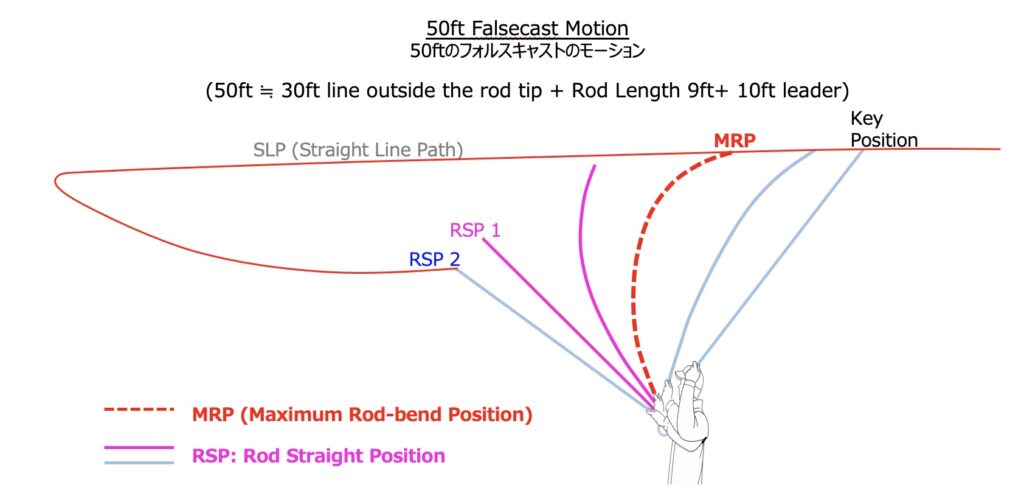
フライリールを基点にリーダー含めて50フィートの長さのラインを、ナローループで投げる時、ストロークの中のMRP (マキシマム・ロッドベンド・ポジション、ロッドが最も曲がるポイント)のロッドのベンディングカーブ、それがロッドデザイナーの狙いに適う時、その時に使われているライン番手がロッドの適合番手。」 とすればいいのです。 [図-2]
オーバーヘッドキャストのフォルスキャストのモーションで言うと、MRPの位置は概ね11:30am (進行方向に15度程度の傾き) に来ます。
ロッドメーカー、あるいはバンブーロッドビルダーは、ロッドの長さとアクション毎にこの理想とするベンディングカーブのデザインを可視化する「基準テーパーシート」を持っています。バンブーロッドビルダーなら定番ロッド毎、あるいはクライアント毎の詳細なブランク径が記録されたテーパーカードを持っています。
では、ここで問題です。
「MRP (マキシマム・ロッドベンド・ポジション)において(図-2)、平均的な6番用のロッドが6番のラインをロッドティップから30フィート出してオーバーヘッドキャストする時(50フィートの距離に相当)のロッドティップがラインを引っ張る荷重は、何グラム位あるでしょうか?」
参考までに、6番ラインの先端30フィートのラインの重さは、AFFTA規格に基づくと160グレイン=10.4グラムになります。
この答えは、だいたい230から300グラム(3500から4500グレイン)です。この数値は、ハイスピードのタイトラインでキャストすればもう少し上がります。
出ているラインの重さが10.4グラムの時に、何とラインの重さの25倍以上の張力でロッドティップはラインを引っ張っているわけです。
フライラインがバックキャストで後方に向かい続けようとする慣性と、フォワードキャストで前方に加速しながら向かう力が引っ張り合って、そのエネルギーはMRP (マキシマム・ロッドベンド・ポジション)のポイントで20倍となって蓄積され、やがてそのエネルギーがフライラインに対して(RSP1の位置)一気に放出されることになります。
フライキャスティングにおいて、コンティニュアス・テンション、つまり常にラインがタイトに張り続けられていることがいかに重要か、と言うことだと思います。
- ツーハンドロッドでスペイキャストを前提とする規格
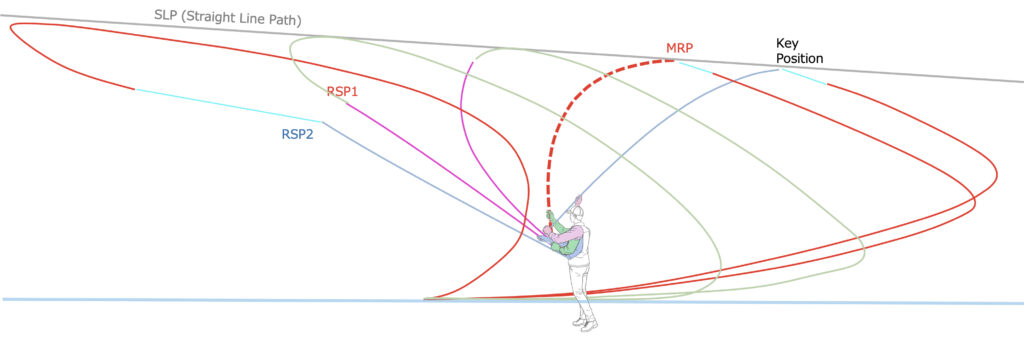
図-3 スペイキャストの時のMRPとベンディングカーブの関係
ツーハンドロッドでスペイキャストを前提とする基本的な考え方も同じです。スペイキャストの場合、MRPは概ね12:00pm(ほぼ垂直)に来ます[図-3]。
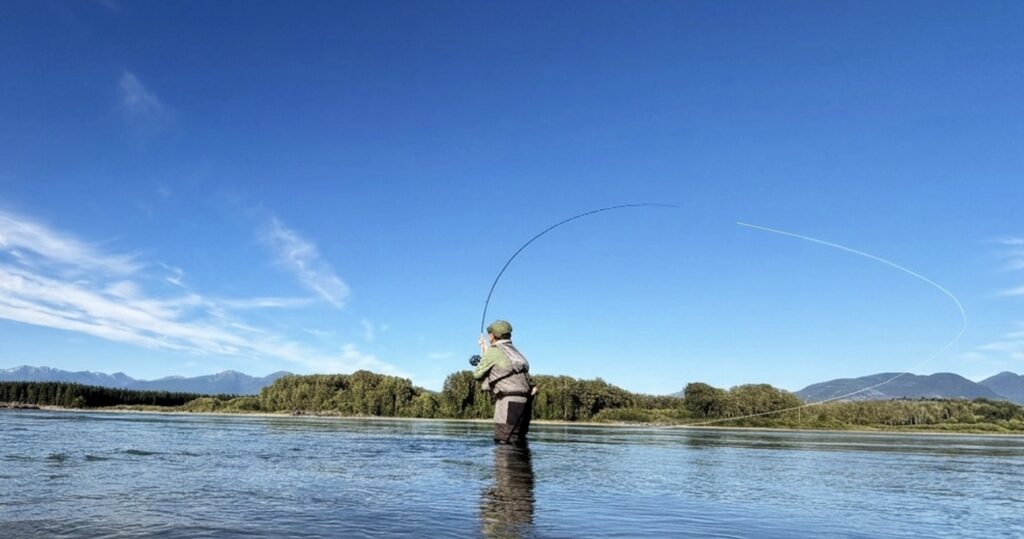
デリバリーキャストのMRPでのロッドのベンディングカーブ、それがロッドデザイナーの狙いに適う時、その時の交換式ティップセクションを含めたラインウェイトがマッチングラインの重さです。因みにラインのパッケージに表示されている重さは、通常交換式ティップ部を含まないヘッドだけの重さで、この重さだけで判断するのは高いお金を出してフィットしないラインを買いかねないので細心の注意が必要です。
「交換式のティップ部分はアンカーになる(水面に留まる)部分だから、ラインウェイトの一部として考慮する必要はない」と主張する人もいるかもしれません。しかし、それは間違いです。交換式ティップがキャスティングに及ぼす影響は、そのライン種、スカンジラインを使っているのか、それともスカジットラインを使っているのかによって大きく異なります。さらに言えば、適合するヘッドの適正な重量も、組み合わせる交換式ティップの重量によって時に変更する必要が出てくるのです。
この時、スペイロッドメーカーと経験あるスペイキャスターはラインタイプと交換式ティップを含むラインシステム全体のグレインウェイトのバランスを見て判断し、AFFTA規格に準ずるライン番手は見ません。
一般アングラーは信頼できるフライショップに足を運び、できれば店長に複数のラインウェイトで試し振りさせてもらった上で、そのお店から購入するのが最も安上がりで間違いのないスマートな方法です。
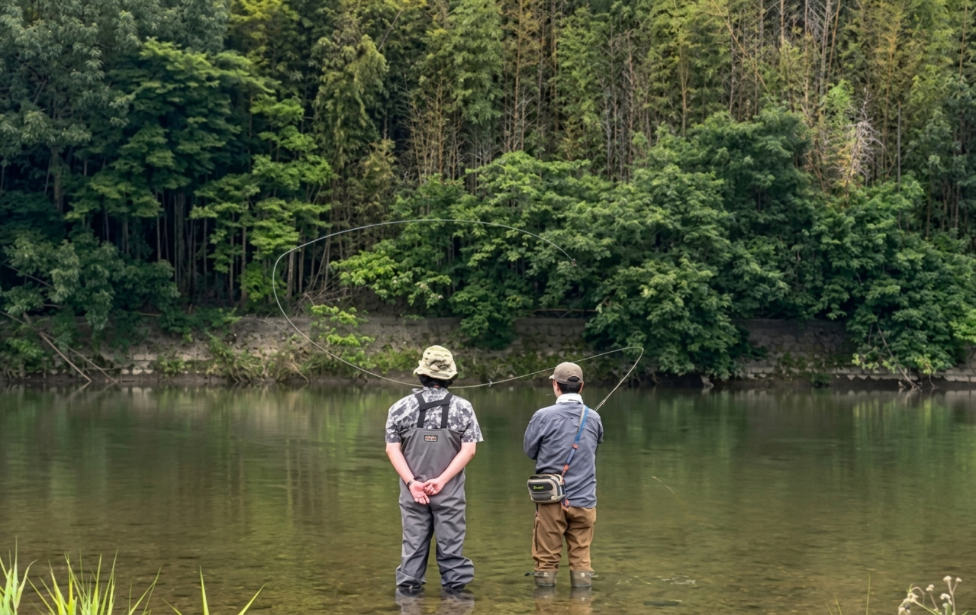
加藤毛ばり店の加藤さんによるツーハンドのグループレッスンは毎週開催されていて、タックルの相談にも対応してくれる。
- ベンディングカーブを楽しむ
ロッドのベンディングカーブを語る時には、アクションとフレックス・タイプの二つの切り口で見ておく必要があります。
- アクションと言う切り口
キャスティングストローク中のMRP マキシマム・ロッドベンド・ポジション)において、ロッドの曲がりの頂点をどこに持ってくるかでアクションの呼び名は決まってきます。
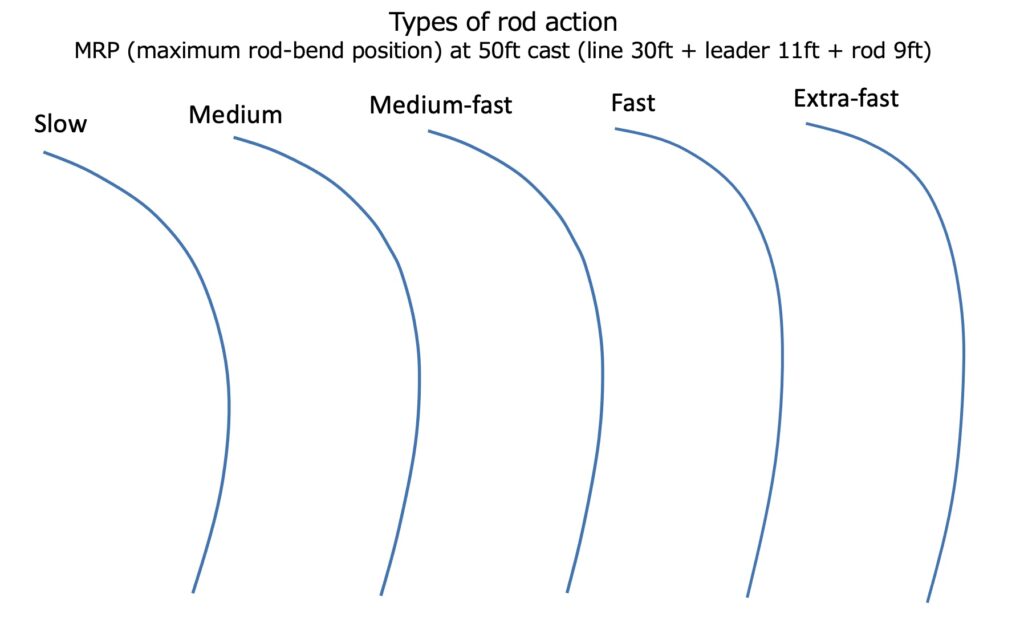
- スロー(胴調子)
- ミディアム(中庸調子)
- ミディアム・ファースト
- ファースト(先調子)
- エキストラファースト
上述のように 「ロッドのアクションは、50フィートにおけるMRP (マキシマム・ロッドベンド・ポジション)の”曲がり”を見て、スローからエキストラファーストの間で5タイプに分類される」 とは言ってはみたものの、50フィートにおけるMRPはラインの長さを徐々に伸ばしながらキャストする過程の中においては、一つの通過点に過ぎません。
6番指定ロッドに7番を乗せるか、あるいは6番ロッドのまま基準となる50フィートよりずっと長いライン、例えば65フィートを乗せれば、ロッドはより曲がり50フィートにおいてはファーストアクションであっても65フィートではスローアクションになりえます。このように意図的に重いラインをロッドに乗せることを、オーバーライニングと言います。逆に6番指定ロッドに5番を乗せれば、あるいは6番のままで20フィートしか乗せなければ、50フィートではスローアクションであったものがファーストアクションになりえます。この場合はアンダーライニングと言います。
通常フライラインは、「5フィートの長さの変化がライン1番手に相当する」と覚えておくと便利です。
ロッドは50フィートの距離でベストパフォーマンスが出るようにデザインされているわけですが、6番指定のロッドに65フィートのラインを乗せれば、その距離でのMRPは9番ライン相当 6+(65-50)/5=9 の荷重がロッドに乗る、と言うことです。
ターゲットフィッシュがクルーズしている距離、ウォーターコラム(遊泳層)、食べているモノ、は場所と時間によって刻々と変化していきます。モダンフライフィッシングにおいては、小河川を除いて、ロッド指定のライン番手のWFラインをデフォルトに据えて、オーバーライニング、アンダーライニング、シンクティップ、フルシンク、シューティングヘッドの中から必要が見込まれる複数のラインで予めシステムを組んでおき、釣り場ではロッドはそのままにその場の状況に応じてこまめにラインチェンジしていくスタイル、これが今どきの最も魚との距離を縮めるスマートなやり方、と言えます。
- フレックス・タイプと言う切り口
上記のアクション(調子)をどのように表現するのか、これをフレックス・タイプと呼びますが、以下の4つに分類できると思います。
イラスト上で見ても、それぞれの違いはあまり感じられないかもしれませんが、実際にキャストしてみるとフレックス・タイプ間の感触の違いはかなりあるものです。

- クラシック・ディープフレックス: スローアクションのみ。ベンドするときにいきなりバット側から入って行くタイプ。元来はブリティッシュ・スタイルでしたが、現在は一部のグラスロッド、バンブー、極一部のカーボンロッドメーカーに見られます。
- パラボリック: スローからファーストアクション。強めのティップを持ち、負荷の強弱に関わらず、ストレスポイントなく全体が放物線状にベンドするタイプ。昨今の多くのスペイロッドはパラボリックがフレックス・タイプとなっています。
- モダン・プログレッシブ: ファーストからエクストラ・ファーストアクション。アメリカ発祥の現在最も普及しているフレックス・タイプ。ロッドティップ側からベンドし始め、負荷を増やすほどにベンドの頂点がバット側に移行していくタイプです。
- ユーロ・ニンフィング: エキストラ・ファーストアクションのみ。ティップは軟調、ティップ以外は強めの張りを持たせることにより、ループを作ってキャストすることを目的とするよりも、水中にあるニンフの操作性に主眼をおいたフレックス・タイプ。
私の好みはパラボリックですが、その澱みなく美しくロッド全体が曲がるそのベンディングカーブを眺めていると陶酔の域に入ってしまう、ほとんどビョウキの領域です。理由づけすれば、パラボリックの曲がりはどのキャスティングレンジにおいてもローディングされたラインウェイトがロッドハンドにダイレクトに感じられ、とりわけその重み感が心地よいこと。そしてトロフィーフィッシュが掛かった時にバット部からディープベンドする放物線は、ティペットとフックの破断を軽減するショックの緩衝材となる効果が高いからです。
この4つの分類の中で、フライラインによるキャスティングに比重を置かない唯一のタイプはユーロ・ニンフィングで、それ以外はフレックス・タイプがキャストのフィーリングにダイレクトに関係して来ます。
自分の好きなタイプにどのようなアドバンテージを見出すかは、理詰めで語るよりもそのアングラーがそれまで築いてきた釣り文化の反映、こだわりの側面が高いと言えるかもしれません。
- リフティングパワー(強度)、モデュラス(弾性率)、ダイナミックレンジ(荷重許容範囲)と言う3つのキーファクター
以上、ロッドアクション(調子)とフレックス・タイプを解説しましたが、キャスティングとトロフィーフィッシュとのやりとり、と言う実質面で語るならこの3つの要素が最も大事と言えると思います。
- リフティングパワー(強度)
リフティングパワーとは、「一点の回転軸を基点にロッドを持ち上げる時に、ロッドが破断するまでどれだけの荷重に耐えられるか」を言います。
6番指定のロッドより12番指定のロッドの方がリフティングパワーが上なのは当たり前ですが、私がここで言うリフティングパワーとは、同じライン番手指定のロッドを使った時にどれだけの荷重に耐えられるのか、をポイントとしています。
リフティングパワーが大きければ、大きく強い魚とファイトしやすい、と言うアドバンテージがあります。
参考までに、信頼できるメーカーは、リフティングパワーは適応ラインナンバーに対応します。これは、4番ロッドなら4ポンド、5番ロッドなら5ポンド、12番ロッドなら12ポンドの重さをリフトしても破断しない、と言うことです。因みにこれをやると折れるロッドもあるので、ご自分のロッドをテストすることはお勧めしませんが。
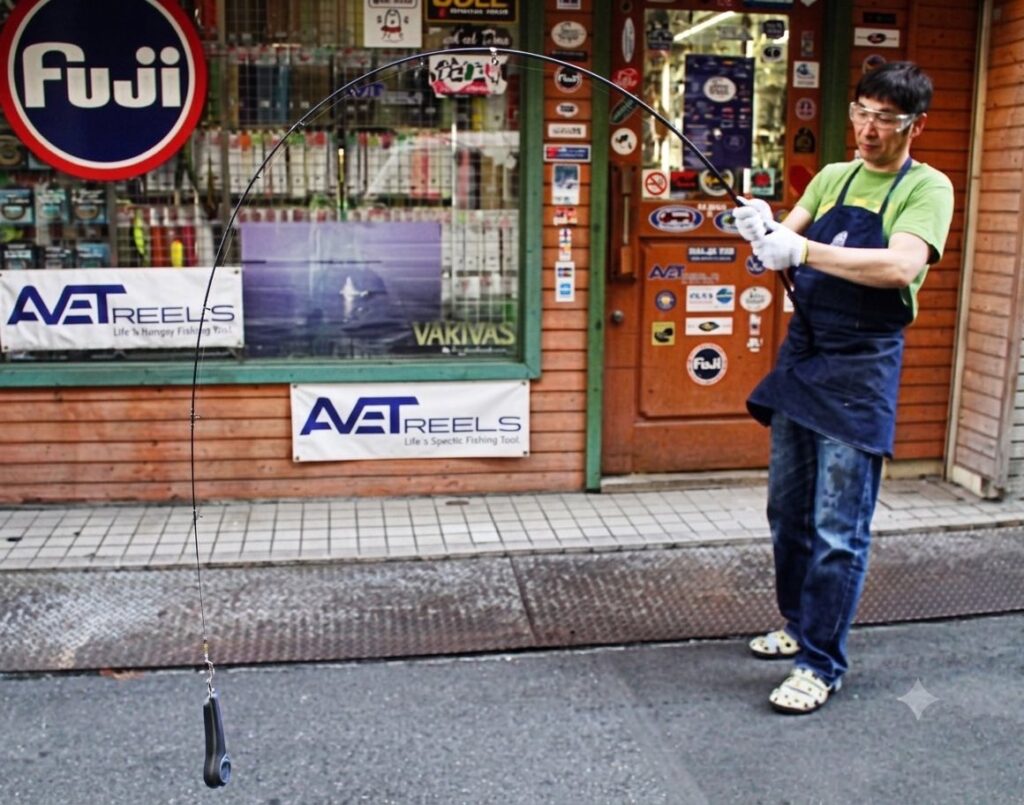
商品になる前にサバロのオリジナルロッド、イクシーク(ICHTHYIC)の破断強度を必ずチェックする店長の助川さん。何番のロッドが何グラムまでリフトできるか、リフティングパワーは、一部のアメリカのロッドメーカーではQA(品質基準)のノウハウにもなっていたりもする。サバロHPより。
私のロッドコレクションの一つに30年以上前に買ったものですが、今でも現役バリバリのビッグゲーム用のお気に入りの一本があります。
それは丸橋英三さんのデザインした、イクシークの12番ロッド。このロッドで私は今まで数多くのターポンやカジキを獲って来ましたが、このロッドは現在の最先端の12番ロッドと比較してもそのハンパないリフティングパワーとレジリエンス(粘り)を持っています。
丸橋英三さんは1984年にIGFA公認のGT世界記録(16ポンドテストクラス)、1989年にはバショウカジキの世界記録を打ち立て、ターポンでは権威ある2大ターポントーナメント、フロリダキーズのダン・ハーリー、ゴールドカップを97年、98年、99年の3年連続同時優勝、と言うとんでもない記録を持つ、名実ともにワールドクラスのトロフィーハンター。私が尊敬する生粋の釣り師の一人です。
このイクシークロッドは、中弾性カーボンにカーボンテープを段巻きにオーバーラップした肉厚ブランク。巨大魚の重さを乗せて思いっきり曲げても破断せずに耐えるロッドです。ソルトウォーターのビッグゲームでは、肉薄のハイモデュラス(高弾性)ロッドは向かない、と言うことを身を持って私に教えてくれたロッドでした。
- モデュラス (弾性率)
モデュラスとは、ロッドの弾性率と言う意味。復元力、反発力と言ってもいいと思います。モデュラスは、日本ではトン数で表現されることが多いですが、これは「断面積1mm² あたりの弾性率、元の2倍の長さに引き伸ばすのに必要な力、をトン単位で言い換えたもの」に基づいています。例えば、2倍に伸ばすのに24トンの力が必要な素材は「24トン カーボン」と呼びます。
高弾性(ハイモデュラス)であるほど硬さを感じることになりますが、硬いと言うことと、リフティングパワーがあると言うこととは別次元の話。この二つの概念はトレードオフの関係にあって、ハイモデュラス(高弾性)になるほど、リフティングパワーは下がることになります。
カーボン素材のモデュラス(弾性率)は10トンから80トン位までありますが、現在のカーボンフライロッドだけに着目した場合、私が目安とするのは、低弾性(20トン以下)、中弾性(21から30トン)、高弾性(31から40トン)、超高弾性(41トン以上)です。私の知る限りモデュラスが41トン以上はフライロッドでは今のところありません。釣り竿全般で見れば鮎竿には65トン以上のカーボンが使われているものもありますが、超軽量化と超感度のためとは言え、ひじょうに高価で折れ易いロッドになります。言い換えると鮎釣りのマニアは、鮎竿はリフティングパワーもレジリエンス(粘り)も低いロッドであることを承知の上で使っているのです。
- ダイナミックレンジ(荷重許容範囲)
フライロッドは、バネのように深く曲げれば曲げるほどに反発力が増すと思われがちですが、そうではありません。
専門用語でこれを説明すると、「ロッドは座屈過負荷の限界点を超えると、ブラジール効果によって反発力の増加が頭打ちになり、やがて急激に反発力が減衰し始める。」と言うことになります。
「なんのこっちゃ!?」と思われると思いますが、これは特にロングキャストを極めたい人、高性能ロッドを求める人にとっては正確に把握すべき大事なポイントです。
ブランクが中空のロッドは、曲がるほどにブランク断面が楕円状に歪みます。そのまま荷重が増して楕円化が進むと、ある時点で断面の剛性が急激に低下し、パワーが抜けてしまうポイントがあって、そこを超えると腰折れ、ヘタリが出ます。これがブラジール効果です。これは特にカーボンロッドに顕著で、グラスロッドではあまり感じられません。
フライキャスティングの特殊性は、フライラインと言う「錘」の質量、ウェイトがキャスティング中に変動すること。一つのウェイトで完結するルアーキャスティングとはこの点が根本的に違なります。
「腰折れ」は長めのライン、例えば65フィートのラインをシュートしようとすると、急にフニャっとロッドのバット部からヘタって、その後にロッドの戻り(リカバリー)がついてこず、ターンオーバーもままならなくなる、と言う現象です。全てのロッドでそうなるわけではありませんが、これは、フライロッドは基本的に適用ラインが50フィートで理想的に投げられるようにデザインされている時に、例えば65フィートのラインレングスだとロッドがオーバーロードしてしまい(ロッドに掛かる負荷は50フィート時よりも3番手分プラス)、ロッドがその負荷に耐えられなくなる場合におこります。 特にハイモデュラス(高弾性)のロッドであってもブランクが肉薄なロッドにロングラインを乗せた時や、取り分け軽量化を狙ったツーハンドのスペイロッドによく見られます。 逆に高番手の強靭なロッドでは「腰折れ」は感じられない場合が多いです。
メーカーによる腰折れ問題でよく見る対策はロッドの腰を強くしてファーストテーパーに仕上げること。でも、このやり方は残念な話かもしれません。フライロッド界隈でよく見られる宣伝文句は、「このロッドは、5番ロッドだけど90フィート(27M)を軽く投げられる高性能」 と言った言い回し。でも、実を見ると、その同じロッドの5番ラインでの50フィートの距離でそもそも硬すぎる場合が多くあります。 これは、遠投性能が高いのではなくて、5番じゃなくて6番のライン用に仕立てられているロッドと言うべきです。
一方キャスターを見ると、ミスキャストがロッドの“腰折れ”のせいなのか、自分のキャスティング問題に起因するのか気づいていない人は多いものです。またこれを「ロッドのパワー不足」と一言で片付ける人もかなり多いのですが、「腰折れ、ヘタリ」の本質はパワー不足の問題とは別のところにあります。
ロッドのダイナミックレンジが狭いロッドで腰折れ、ヘタリは起こります。
ダイナミックレンジの広いロッドとは、幅広いライン番手に対して快適に対応できるロッドを意味します。 例えば7番指定のロッドであれば、8番ラインを乗せても、腰折れを起こすことなく快適にキャストできる一方で、50フィート程度の距離でも硬すぎると感じさせないロッドであるべきです。 言い換えれば、荷重の変化に対する許容範囲が広いロッドということ。すなわち、ロッドの外に出すラインの量が増え、それに伴ってロッドにかかる荷重が大きく変化しても深く曲がったロッドの復元力、リカバリー性能を維持できるロッドです。
これはスペイロッドにも言えます。スカンジまたはスカジットのシューティングヘッドを使用する場合、シュート時のラインの長さは常に一定です。しかし、ダイナミックレンジの広いロッドは極めて重要な特性を備えています。それは、重いシンクティップを水中からリフト(引き抜くこと)ができ、シュート時に重いシンクティップの重さを加えてロッドに最大限の負荷をかけても、ロッドが限界を迎えてへたることがないという点です。
では、ロッドの何がどうであると腰折れしない、ダイナミックレンジが広いロッドになるのか? これはフライロッドの性能を決める上で、ひじょうに大事なポイントなので、あとでもう一度、このテーマに戻って来たいと思います。
- 釣り味
もう一つ、アングラ一によっては、釣り味、が忘れてはならない観点かもしれません。
日本食で言えば「うま味」に相当する部分かな?
釣り味を求める向きには、Sグラス、グラスカーボンコンポジット、低弾性カーボン、そしてバンブーロッドでしょう。
私はフライロッドには道具としての役割しか求めないので、釣り味を目的にしたロッド選びはしませんが、機能性として特に低弾性カーボン、そして何よりバンブーロッドには、道具としてのフライロッドの魅力を大いに見出します。
バンブーロッドはブランクの中心までムクの素材で曲げても歪みが出ないので、究極的にブランクが腰折れしない、ダイナミックレンジの広い素材です。またバンブーは、実はリフティングパワーもあります。但し、反発力はカーボンより低く、かつ素材が重たくなるので総じてカーボンよりロングキャストはできません。その一方で、カーボンより深くまで曲がるのでバラシにくく、同じライン番手ならカーボンよりでかい魚を細いティペットと弱いフックでも獲りやすい、と言う点でも優れています。
おそらく、私にとってバンブーロッドは、カーボンロッドが進化しようとも使い続けていく素材だと思います。
―――――
さて、ここで問題です。
「2本のロッドがあって、どちらも長さは9ft、6番ライン用だとします。
偶然にも、同じ荷重をロッドに乗せた時のMRP (マキシマム・ロッドベンド・ポジション)でのベンディングカーブも同じでした。
但し、一点違う点があります。
それは、それぞれのロッドに使われている素材は違うと言うこと。
片方はEグラス材、もう片方はハイモデュラス(高弾性)カーボン材でした。
この2つのロッドのどちらの方がロングキャストできるでしょうか?」
答えは?勿論 「ハイモデュラス(高弾性)の カーボンロッド」 です。簡単でしたね。
ロングキャストできることがロッドに求める唯一の目的ではありませんが、ロッドの性能を評価する上での一つの重要指標ではあると思います。
Eグラス材はひと昔前のローモデュラス(低弾性)材でカーボン材の弾性率で言えば10トン弱相当です。もう片方の高弾性カーボン材はハイモデュラス材(弾性率で言えば例えば40トン)である時に、MRPでのベンディングカーブを同じにするにはEグラス材はブランクをとんでもなく肉厚にして反発力を確保しなくてはなりません。そうするとかなり重くなる。MRPでのベンディングカーブは同じなのに、キャストフィールはグラス材のロッドはすごくスローアクション、ハイモデュラスカーボン素材のロッドはすごくファーストアクションと感じるはずです。Eグラス材は重くモッタリとレスポンスの遅いロッドになり、キャストパフォーマンスは全く異なる別物になる、と言うことです。
では次の問題です。
「2本のロッドがあって、今回もどちらも長さは9ft、6番ライン用です。
今回も、同じ荷重をロッドに掛けた時のMRP(マキシマム・ロッドベンド・ポジション)でのベンディングカーブは同じ。
但し、ロッドに使われている素材は、片方はミディアムモデュラス(中弾性)、もう片方は最新のハイモデュラス(高弾性)のカーボン材だとします。
この2つのロッドのどちらの方がロングキャストできるでしょうか?」
答えは、「どちらとも言えない」です。
巷に見られるロッドでミディアムモデュラス(中弾性)カーボンを使ったロッドの方が、ハイモデュラス(高弾性)素材を使ったロッドよりもロングキャストできる、と言う例はごく普通に見られる事象です。
まず、ミディアムモデュラス(中弾性)の方はハイモデュラス(高弾性)素材を使ったロッドよりもブランクは肉厚になります。すると、肉厚になる分ロッドは重くなり、ロッドのリカバリースピードは落ちるので、ここまではロングキャストにとってマイナスです。 片や、肉厚になるとブランク壁を支える強度が増すので歪みにくくなり、ダイナミックレンジは広がり、腰折れ、ヘタリは低減、あるいは遅らせることができます。
一方でハイモデュラス(高弾性)素材のロッドは、肉薄にできるのでブランクは軽量になると言うユーザーベネフィットがあります。またロッドの曲がりからのリカバリースピードが早いと言う点で、ここまではロングキャストにとってプラスです。 片や、ブランクは肉薄であることでブランクの歪みは出易くなり、ロングラインで腰折れする”可能性“が出てきます。
以上のプラスマイナスを見た時には、ロングキャスト性能だけを言えばミディアムモデュラスのロッド、ハイモデュラスのロッド、どちらも一長一短あって、どちらの方が飛ぶとは断言できないと言うことです。
ダイナミックレンジについて、考察を進めていきたいと思います。
日本のロッドメーカーは、腰折れ対策に真剣に取り組んでいるところも多く、取り分けツーハンドのスペイロッドでは、キャスティング性能とコストパフォーマンスを両立させているロッドが多く見られる、と私はいつも見ています。
以下、ベンド時のブランクの歪みを減らすことで腰折れを軽減し、ロッドに粘り(レジリエンス)を上げる策を並べてみました。これらの手を加えることでダイナミックレンジは広がり、キャスティングはショートからロングレンジまでより快適性が増すことになります。
いずれもコストアップ要因になりますが、信頼できるメーカーはここに妥協と言う文字はありません。
- 中弾性カーボンシートを多重巻きして肉厚のブランクにする。日本のNorth Edge Standard等。
- バット部にボロン材を使って剛性度を上げる。アメリカのR.L.Winston, 日本のキャプチュード。
- カーボンを斜め、縦、逆斜めの3層巻きするスパイラルX構造。日本製ブランクのShimano/G.Loomisのアスキス。
- 4軸カーボンの使用。日本のNorth Edge Standard。
- グラフェン強化レジンの使用。ニュージーランドのEpic, イギリスのGaleforce、Taylormade、Mackenzie、アメリカのTaylor Fly Fishing、フィンランドのVision, 日本のティムコ。
- 東レのナノアロイ®レジンの使用。日本のNorth Edge Standard。
- 東レのT1100Gカーボンの使用。 ノルウェーのGuideline、フランスのJMC、アメリカのTaylor Fly Fishing、日本のNorth Edge Standard。
上記の中で、最新技術の「ナノアロイレジン」と「グラフェン強化レジン」、そして「トレカ® T1100Gカーボン」に着目してみたいと思います。
カーボンロッドは、カーボン繊維に熱硬化性レジン(樹脂)を含浸させた複合材料シートから製造されます。このシート状の複合材料は「プリプレグ」と呼ばれ、東レをはじめとする炭素繊維メーカーが製造し、各ロッドメーカーへ供給されます。
プリプレグは金属製のマンドレル(芯金)に巻き付けられ、テープで加圧した状態で加熱・硬化されます。加熱によってレジンが流動し、各層の隙間へ均一に浸透した後、硬化してカーボン繊維同士を強固に接着し、一体構造のロッドブランクになります。
レジンはロッドブランクの製造において不可欠なわけですが、問題はそれが重くて、反発力が低い素材であること。
レジンは重量比でカーボンロッドブランクの25%〜35%もあるので、せっかく高性能カーボン素材を使っても、その性能の足を引っ張ることになります。かと言ってレジンを減らせば、軽量化、感度、復元力は向上しても、簡単に割れるロッドになります。
そして、何より見逃せないのは、
このレジンこそが、今までロッドの腰折れヘタリの原因をつくり、ロッドのダイナミックレンジを狭める主犯人の一つであり続けてきたと言うことです。
しかし、今、素材テクノロジーの革新は、レジンそのものが救世主となってレジンのネガティブな側面をプラスに転じ始めている、と言うことです。
近年、この課題を大きく前進させたのが高性能ナノレジン・テクノロジー、 「グラフェン強化レジン」、そして、「東レのナノアロイ®」です。
- グラフェン強化レジン
グラフェンは、炭素原子が一層の六角形格子状に結合したナノ材料で、単層状態で極めて高い引張強度と弾性率を持つことで知られています。グラフェンを分離する技術は英国マンチェスター大学の研究チームが確立し、その成果は2010年のノーベル物理学賞受賞に結実しています。現在、この技術の実用化に向け世界中の材料メーカーや研究機関が開発にしのぎを削っていますが、その中で微細なグラフェン粉末をレジン樹脂の中に均一に分散させるグラフェン強化レジンがフライロッドに使われ始めています。このレジンは、ロッドが大きく曲がってもブランク断面が扁平化したり局所的に座屈したりすることを抑えこみ、これによって腰折れヘタリを抑えることが期待できます。今現在は、製造コストが極めて高いこともあり、4から6ピースロッドの一部のセクションに限定して使われるのが一般的です。
- 東レのナノアロイ®技術
東レは2007年に「衝撃を加えると柔らかくなる高分子材料、ナノアロイ®を発表し実用化に漕ぎ着けました。この技術は、従来のミクロン単位のブレンドでは不可能だったナノレベル(10億分の1メートル)の構造制御によって「硬さと柔らかさ」「耐熱性と耐衝撃性」、と言った相反する特性を両立させることを達成させています。これにより、軽量・高感度・高反発でありながら、しなやかさと耐久性、粘りを兼ね備え、ダイナミックレンジを拡大させたフライロッド設計を可能としています。
このナノアロイ®レジンによってこれまでのハイモデュラス(高弾性)カーボンロッドでは不可能だった強靭さとレジリエンス(粘り)を生むことを達成させています。
- 東レの「ナノアロイ®」と「トレカ® T1100Gカーボン」の合わせ技。
今から45年ほど前のことになります。私があるキャスティングのトーナメントに出た時の話です。
そのトーナメントには、世界チャンピオンのスティーブ・レイジェフも参加していて、スティーブがG.Loomis社にデザイナーとして招聘される以前のこと、当時、彼は会社として立ち上がったばかりのSageのギアでトーナメントに参戦していました。
決してベストとは言えない風向きの中で、スティーブはフライキャスティングのディスタンス種目で63Mと言う圧倒的な距離を出しました。その時は私が彼のキャスティング・アシスタントを務めたのですが、彼の投擲の後、彼が使用していたカスタムのSageのシングルハンド・ディタンスロッドを見せてもらいました。
ロッドのライン番手は、おそらく15番から17番相当。当時私も筋力トレーニングは積んでいましたが、その棍棒のようなロッドは重すぎて、パワフル過ぎて、私の筋力ではとても手に負えるような代物ではありませんでした。
ただ、「両手を使って素振りしてみた時に、ハッとする発見」をしたのです。とんでもなくパワフルなそのロッドの中に「妙に曲がるしなやかさと粘り」を感じたのです。
その不思議な感覚の正体がもっと知りたくて、スティーブに今度はSageの彼のスピニングのルアーアキュラシーのロッドを振らせてもらいました。7グラムのプラグ用のロッドなので、これなら私にも振れます。すると、それまで経験してきたルアーロッドと全く異なる感覚を持ちました。そのスピニングロッドはバット部に荷重を乗せやすく、しなやかさの中に強い粘りがありました。ルアーはゆっくりトロトロと飛んでいるように見えるのに、ルアーがターゲットに対して突き進んで行こうとする推進力(モメンタム)はやたらある感じだったのです。
ロッドの本当のキャスティング性能は、ガチガチのファーストテーパーのハイモデュラス(高弾性)の硬さがもたらすのではなく、例えトーナメント用のロッドであってもロッド全体がベンドしレジリエンス(粘り)のあるロッド、そしてリカバリースピードがあるロッド。このことにこそ真価がある、ということを学んだ瞬間でした。
私がそのロッドに感動していると、スティーブは彼が世界大会でいくつもの優勝を勝ち取ってきたであろうそのスピニングロッドを私にプレゼントしてくれました。
その半年後、私はキャスティングトーナメントに出ると、そのロッドで日本記録タイの記録でスピニングのルアーアキュラシー種目を優勝しました。そのロッドは今でも私の生涯の宝として大事に持っています。
45年前、あの時のスティーブのトーナメントで使っていたロッド、「パワーがあるけど しなやかさと粘りがあるブランク」の素材のレシピは何であったのか?
こればかりは私の想像の域を超えたことはありませんが、あの時の感触がモダンフライロッドに最新のテクノロジーと共に再現されることを私はずっと待ち続けて来たのです。
東レの「トレカ® T1100G」は、33トンの高弾性カーボン。2014年に発表され20年に一度と言われるカーボン技術革新の象徴として話題になった素材です。また2018年にはT1100Gの特性を強化させる#2573/2574ナノアロイ®レジンが発表され、以来、これが東レの提供する最強の組み合わせになっています。
これらの素材をアプリケーションとして最初に採用したのは、ハイエンドのロッド、リールで共に世界最先端を走る日本のルアーロッドメーカーでした。フライロッドメーカーが動き出したのは、それから6年経ってからですが、私はこの素材はフライロッドにこそベストマッチする特性を持っていると確信して長年注目してきました。
それは、この素材は強力な反発力を持ち、極端に深く曲げても破断しないリフティングパワーを持つにも関わらず、硬さが前面に出ず、しなやかさの中に粘りがあったからです。(「トレカ® T1100G」の破断テスト比較)
私が正に45年前にスティーブ・レイジェフのロッドを見て感動した、あの時の印象の再現を予感させるものであったのです。
現在、フライロッドメーカーとして「トレカ® T1100G」を採用しているメーカーは、2022年ノルウェーのGuideline社を皮切りに、フランスのJMC、アメリカのTaylor Fly Fishing(グラフェン強化レジン使用)の3社が続いていますが、日本メーカーは採用してきませんでした。フライロッド業界でまだあまり普及していない最大の理由は素材コストが高いためで、実際採用している多くのロッドメーカーもバット部に限定してT1100Gを使うことでコストセーブするところが多いようです。
またT1100Gは、この素材を単独で使うには反発力が大き過ぎるので、中弾性カーボンとコンポジットにすることが余儀なくされ、これがまたコストアップ要因になります。
そんな中、この数年間、私は北海道発のブティックブランドメーカー、North Edge Standard(以下NES)が「トレカ® T1100G」を使ったフライロッドの開発に取り込む姿を横目で追って来ました。
デザイナーは、北海道の高丸翔平。
彼は年間の250日をフィールドで過ごし、私が40年以上見てきた世界中のトッププロと比較しても全くの遜色のないプロ中のプロ。今の日本で彼ほどフライフィッシングの真髄を理解し、フライロッド、フライラインの本質を理解する人間はいないはずです。 (因みに、私はアマチュアを自負する釣り師であり、フライフィッシングのギアはバイアスなしのニュートラルな目でしか語らないことを絶対の信条としているのでメーカーから便宜を受けることはないし、本稿の出筆にあたり他人の意向は一切入っていません。)
このNES Spirit シリーズは、ブランクのバットからトップまで通しで「トレカ® T1100G」 、レジンは東レの最新ナノアロイ®を使い、これに4軸カーボンをクロスに巻き込み、肉厚に仕立てたカーボンコンポジットブランクです。4軸カーボンは、ブランクの歪みを抑え、リフティングパワーを上げるのにもプラスになるハイエンドのカーボン素材です。
カーボンフライロッドを肉厚に仕立てることは、T1100Gに限らずどの素材であっても、ロッドデザイナーとしての高丸翔平が日頃とりわけ重要視しているポイントで、これによってロッドのダイナミックレンジを広げて粘りを出すことがまず第一の目的。
加えて、彼のホームグランドの北海道厳冬期のイトウやPNW (北太平洋沿岸地域)のウィンタースチールヘッディングのように極めて過酷な使用環境下でもロッドティップが破損しないローバスト性、リフティングパワーの限界を担保できることが翔平にとってのプライオリティー要素となります。
私が釣り場に持ち込んでテストしてきたプロトタイプはNESのSpiritシリーズ から2本。一つは11ft#7番のスイッチロッド。もう一つはツーハンドロッドでした。11ft7番のロッドでオープンウォータのフィールドでオーバーヘッドキャストで36Mキャスト、スペイキャストでの30 Mキャストはごく容易くできますが、私が感銘を受けたのはマックスに曲げても決して硬さが前面に出てこないレジリエンス(粘り)、しなやかさが感じられることです。
これこそが、私が45年前から抱き続けてきた、そして求めてきたドリームロッドでした。
そして、これが私のフライフィッシャーズライフにおいて巡り合った3回目のゲームチェンジャーと呼ぶものです。
私の言葉でこのロッド特性を語ると以下になります。
- フルベンドからのリカバリースピードが極めて速い。それでいて硬さが前面に出ず、しなやかさの中にレジリエンス(粘り)が共存すること。
- ダイナミックレンジが広い。ショートからロングの全レンジで心地よいラインウェイトのロード感があること。
- ベンディングカーブはパラボリックである。パワフルな魚でもバットからのディープベンドで誘導できること。
North Edge Standardがワールドクラスのブランドとして世界に羽ばたき、これから多くのフライフィッシャーと共に成長していくことを期待するものです。
Written and Art by Hiro Masaki. All rights reserved.
The Crux of Fly Rods as seen in “NES Spirit”
The North Edge Standard Fly Rods—high-performance gear, each engineered for a dedicated mission. Built with premium-grade components loaded right into the core of the blank, radiating from butt to tip
Written and Art by Hiro Masaki
In my life as a fly fisher, I have experienced three game-changers when it comes to fly rods.
My very first rod I owned was a Hardy fiberglass rod.
That being said, I was only 13 years old at the time and certainly didn’t have enough money to buy a Hardy rod. However, when I found out that “Tsuruya Fly Fishing Tackle Store” near Ginza, Tokyo, was selling bare Hardy blanks in an 8-foot-3-inch, 6-weight configuration, I bought one to assemble myself. That was the beginning of my budget-friendly Hardy rod. Back then, Hardy offered a lineup known as the “JET Series,” named after the legendary fly caster Jon E. Tarantino. Admiring Tarantino as I did, I arbitrarily decided that my rod was a JET model, and I practiced my casting relentlessly with that single rod. It became my long-time companion, and since I relied solely on this one rod even when commuting by train to fish at Lake Ashi, it took quite a beating. By the time I graduated from high school, the rod—which was a 6-weight when I bought it—had lost its spine due to fiber fatigue. It had gone completely soft and noodle-like, turning into what felt like a 4-weight rod.
My first fly rod from 54 years ago, I built from a Hardy blank and labeled “Type Jon Tarantino”.
Around that time, in 1974, Fenwick introduced the industry’s very first carbon fiber rod, the HMG (High Modulus Graphite) series, developed under the initiative of Jim Green.
The debut of this revolutionary material called carbon was the exact moment I experienced my first true game-changer in fly rods.
When the adults at the mountain streams proudly let me give their rods a wiggle, I was awestruck. Featuring an extreme extra-fast action, the rod possessed an overwhelming amount of power that seemed almost excessive for a trout rod, yet it was shockingly light—something completely unimaginable given that power. The price tag was equally shocking to me. Fifty years ago, back when the U.S. dollar was worth nearly 300 yen, the rod cost in the high 80,000 yen range. I still remember thinking that its price was almost equal to the value of its own weight in gold at the time.
My second game-changer came in 1976, at the age of 18, when I laid hands on a Pezon & Michel bamboo rod for the very first time. Ken Sawada, a charismatic figure who spearheaded fly fishing in Japan, had received direct instruction from Charles Ritz, a technical advisor for Pezon & Michel. Around that same time, Sawada became the official Japanese distributor for the brand. At his fly shop in Kokubunji, I asked Mr. Sawada to hand me one of the rods displayed in the glass showcase. Knowing how exorbitantly expensive it was for a student like me, I timidly swung it back and forth in the shop’s open space.
I can still vividly picture that scene today. The rod flexed into a mesmerizingly beautiful parabolic curve. On top of that, it possessed a level of power and structural rigidity that belonged to an entirely different dimension compared to any fiberglass or bamboo rods I had seen before. From the moment I saw it, I was struck by a severe fever of longing, thinking, “I absolutely must have this!” Ultimately, I took a leap of faith. First, I acquired the Super Marvel from Pezon & Michel’s PPP series, a 7’2″ rod for 4/5-weight lines. Shortly after, I obtained the Fario Club (8’5″ for 5/6-weight lines), which was widely considered Charles Ritz’s crowning masterpiece. Despite being bamboo, the Fario Club had enough power to false-cast around 70 feet of line without a hitch, and it could effortlessly shoot a full line of about 90 feet.
Now, before diving into the story of my third fly rod game-changer, I would first like to organize and break down how modern fly rods are categorized.
This next part gets quite technical for the enthusiasts, as I want to delve into the deeper layers of fly rod performance—a subject that has rarely been discussed until now.
What Exactly Is a Fly Rod’s Line Weight Rating?
When discussing the designated line weight of a fly rod, one must first accurately understand how the underlying standard for fly line specifications is determined.
The standards for fly lines were originally established by the AFTMA (American Fishing Tackle Manufacturers Association). In 1933, the fly fishing division spun off from this association and was carried over as the AFFTA (American Fly Fishing Trade Association), which continues to oversee these standards today.
AFFTA specifications are broadly divided into two categories: standards based on overhead casting, and standards based on two-hand Spey casting.
- Line Standards used for Overhead Casting
The AFFTA standard primarily applies to Weight-Forward (WF) and Double-Taper (DT) lines, and the designated line weight is determined by the weight of the first 30 feet of the line. To be precise, the weight of the level tip section is supposed to be excluded. However, since the tip section is usually less than one foot long, it is almost entirely ignored in modern discussions. The weight difference between each line number for the first 30 feet of a fly line is remarkably small. For instance, the difference between a 5-weight line (140 grains) and a 6-weight line (160 grains) is a mere 20 grains, or 1.3 grams—roughly equivalent to the weight of a single credit card [Figure-1]. Yet, any caster with a reasonable amount of experience can distinctly feel the difference that this 1.3-gram variance makes in the casting sensation.
In the case of overhead casting, when you have the standard 30 feet of AFFTA-compliant fly line out past the rod tip and then add the length of the rod (for example, 9 feet) and the leader (for example, 10 feet), the total comes to roughly 50 feet. This represents the exact “practical fishing distance,” whether you are trout fishing or targeting bonefish on the flats.
The fly line weight that fits best at this 50-foot distance is what determines the designated line weight rating of that particular fly rod.
Now, calling a line size the “best fit” might sound like a vague concept that relies entirely on personal intuition. But what exactly happens to make a line the “best fit”?
As a method for measuring rod action, there is a benchmarking system conceived in the early 2000s by Dr. William Hanneman called the “Common Cents System (CCS).” This method measures a rod’s deflection when subjected to a load that bends it by exactly one-third of its total length. From these results, the Effective Rod Number (ERN) and Action Angle (AA) are derived. A higher AA value indicates a faster-action (tip-flex) rod. However, I have personally never seen these values in any manufacturers’ catalogs, so this system may have largely become obsolete today.
Instead, if we are to define a fly rod’s action, the optimal answer naturally reveals itself as long as one understands the mechanics of fly casting.
“Casting a 50-foot line with a tight, narrow loop drives the rod into MRP—Maximum Rod-bend Position—the point where the rod flexes deepest during the stroke. At MRP when the bending curve aligns perfectly with the rod designer’s original intent, the line weight being used at that exact moment is the rod’s true designated line weight.” This is how it should be defined. [Figure-2]
In the motion of an overhead false cast, the position of the MRP generally occurs around the 11:30 AM angle—meaning a tilt of roughly 15 degrees in the direction of the cast.
Rod manufacturers and bamboo rod builders possess “standard taper sheets” that visualize this ideal bending curve design for each specific rod length and action. In the case of bamboo rod builders, they keep detailed “taper cards” that record the precise blank diameters for each of their staple rod models, or for each individual client.
Now, let me pose a question for you:
“At the MRP (Maximum Rod Bend Position) (Figure 2), when an average 6-weight rod overhead casts a 6-weight line with 30 feet of line out from the rod tip (equivalent to a distance of 50 feet), approximately how many grams (grains) of load does the rod tip pull on the line?”
As a reference, based on AFFTA standards, the weight of the first 30 feet of a 6-weight line is 160 grains, which equals 10.4 grams.
The answer is approximately 230 to 300 grams (3,500 to 4,500 grains). This figure will increase slightly when casting with a high-speed, tight line. This means that when the extended line weighs 10.4 grams, the rod tip is actually pulling it with a tension more than 20 times the line’s own weight!
The inertia of the fly line continuing backward during the backcast and the force accelerating forward during the forward cast pull against each other. This energy is amplified twentyfold and stored at the point of MRP (Maximum Rod Bend Position), before eventually being released all at once toward the fly line at the RSP1 position.
This perfectly illustrates just how crucial “continuous tension”—keeping the line tight at all times—is in fly casting.
- Line Standards used for Two Hand Rod Spey Casting
The same fundamental principle applies to two-handed rods Spey casting. In a Spey cast, the MRP generally occurs around the 12:00 PM angle, which is nearly vertical [Figure-3].
[Figure 3] Relationship between MRP and bending curve during a spey cast
Featuring a rod designed by Shohei Takamaru, head rod designer at NES. Jamey Cloete photo.
When the rod’s bending curve at the MRP of the delivery cast aligns perfectly with the rod designer’s original intent, the combined line weight—including any interchangeable tip section—becomes the matching line weight. Incidentally, the weight printed on the product package usually denotes only the head weight, excluding the interchangeable tip. Relying solely on this printed number is a trap that can easily lead you to spend a lot of money on a line that doesn’t fit your rod.
Some might argue that because the interchangeable tip acts as the anchor, it does not need to be considered part of the line weight. However, that is simply incorrect. The impact exerted by the interchangeable tip varies depending on whether you are using a Scandi or a Skagit line. Furthermore, the appropriate weight of the head occasionally needs to be changed based on the weight of the interchangeable tip. Recognizing this, Spey rod manufacturers and experienced Spey casters evaluate the balance based on the grain weight of the entire line system—including the line type and the interchangeable tip—rather than looking at the line weight number designated by AFFTA standards.
For the average angler, the smartest and ultimately most cost-effective approach is to visit a reputable fly shop. Ideally, you should ask the shop owner to let you test-cast several different line weights, and then purchase your gear right there from that shop.
Two-handed casting group lesson by Riki Kato of Kato Fly Shop are held weekly, and he is happy to provide consultations regarding fishing tackle.
Enjoying the Bending Curve
When discussing a rod’s bending curve, it is essential to examine it from two distinct perspectives: action and flex type.
- The Perspective of Action
- At the MRP (Maximum Rod-bend Position) during the casting stroke, the designation of a rod’s action is determined entirely by where the apex of the rod’s bend is located.
- Slow (Butt-Flex)
- Medium (Mid-Flex)
- Medium-Fast
- Fast (Tip-Flex)
- Extra-Fast
Although it was stated above that “rod actions are classified into five types from slow to extra fast by looking at the ‘bend’ at the MRP (Maximum Rod-bend Position) at 50 feet,” the MRP at 50 feet is merely a single passing point in the process of casting while gradually extending the line length.
If you load a 7-weight line onto a designated 6-weight rod, or if you stick with a 6-weight line but extend it well beyond the 50-foot benchmark to, say, 65 feet, the rod will bend much deeper. As a result, a rod that exhibits a fast action at 50 feet can easily transition into a slow action at 65 feet. Intentionally loading a heavier line weight onto a rod like this is called as “overlining.” Conversely, if you load a 5-weight line onto a designated 6-weight rod, or if you keep the 6-weight line but only extend 20 feet of it, a rod that was a slow action at 50 feet can behave as a fast action. This is called “underlining.”
As a rule of thumb, it is highly useful to remember that “a 5-foot change in extended line length is equivalent to shifting by one line weight.”
While rods are designed for optimal performance at a distance of 50 feet, casting 65 feet of line on a designated 6-weight rod means the MRP at that distance becomes equivalent to a 9-weight line. This means a load equivalent to a 9-weight—6 + (65 – 50) / 5 = 9—is being applied to the rod.
The distance at which target fish are cruising, the water column they hold, and what they are feeding on change from moment to moment depending on the location and time of day. In modern fly fishing—with the exception of small creeks—the smartest and most effective way to close the distance with fish is to establish and choose the rod’s designated line weight of WF line as your default baseline, pre-rig multiple systems from a selection of overlined, underlined, sink-tip, full-sinking, or shooting-head options based on anticipated needs, and then meticulously swap lines right there on the water while keeping the exact same rod.
The Perspective of Flex Type
How these different rod actions are physically manifested and expressed along the blank is what we call the “flex type,” which can be classified into the following four categories. Even if you can’t tell much of a difference from the illustrations, you will feel a significant difference between the flex types once you actually cast.
A) Classic Deep-Flex: Slow action only. This type flexes deeply, loading straight into the butt section right from the start. While it originated as a classic British style, today it is found only in select fiberglass and bamboo rods, as well as a handful of specialized carbon rod manufacturers.
B) Parabolic: Ranging from slow to fast action. Featuring a relatively stiff tip section, the entire rod bends into a seamless, uninterrupted parabolic curve regardless of the load’s intensity, without any distinct stress points. The majority of modern Spey rods utilize this parabolic design as their core flex type.
C) Modern Progressive: Fast to extra-fast action. Originating in the United States, this is currently the most widely adopted flex type in the market. It begins to flex from the rod tip first, and as the load increases, the apex of the bend progressively transitions further down toward the butt section.
D) Euro-Nymphing: Extra-fast action only. Engineered with a highly supple, soft tip section paired with a stiff, powerful backbone through the rest of the blank. Rather than being designed to form and cast clean line loops, its primary focus is maximizing the control, tracking, and sensitivity of nymphs drifting underwater.
My personal preference leans heavily toward the parabolic. Staring at that flawless, fluid bending curve as the entire rod flexes is so intoxicating that it borders on a borderline obsession—frankly, it’s a beautiful sickness. If I were to rationalize it, a parabolic flex allows the loaded line weight to be transmitted directly and tactilely to my rod hand across any casting range, and that sensation of weight is uniquely satisfying. Furthermore, when you hook a trophy fish, the deep parabolic bend from the butt section functions as a highly effective shock absorber to prevent tippet and hook failure.
Among these four classifications, Euro-Nymphing is the sole type that does not place heavy emphasis on casting with the fly line itself; for the other three, the flex type directly dictates the entire casting feel. In the end, the advantages an angler discovers in their preferred flex type may have less to do with cold, logical rationale, and more to do with a reflection of the deep-rooted fishing culture and personal philosophy they have built over a lifetime.
The Three Key Factors: Lifting Power, Modulus, and Dynamic Range
While I have broken down rod action and flex type above, when it comes to the practical realities of casting performance and battling trophy fish, these three elements are arguably the most critical.
Lifting Power
Lifting power is defined as “the maximum amount of load a rod can withstand when lifted from a single pivotal axis before reaching its breaking point.”
It is obvious that a 12-weight rod has more lifting power than a 6-weight rod. However, the “lifting power” I am focusing on here is how much load a rod can handle within the same line-weight rating.
A higher lifting power grants an angler a massive tactical advantage, making it significantly easier to control and fight large, powerful fish.
For reference, with trustworthy manufacturers, the lifting power corresponds to the adaptive line number. This means that a #4 rod won’t break even if it lifts 4 pounds, a #5 rod for 5 pounds, and a #12 rod for 12 pounds. By the way, some rods will break if you try this, so I do not recommend testing your own rod.
Before any of Sabalo’s “ICHTHYIC” rods go on sale, the store manager, Sukegawa, makes it a strict rule to test their breaking strength. Determining exactly how many pounds each rod weight can lift—which represents its lifting power—is actually part of the proprietary QA (Quality Assurance) expertise for certain US rod manufacturers. (Source: Sabalo Official Website)
Among my rod collection, there is one particular favorite for big-game fishing that I bought over 30 years ago, which is still active and performing at the absolute top of its game today.
It is the 12-weight ” ICHTHYIC ” rod designed by Eizo Maruhashi. With this single rod, I have brought down countless tarpon and billfish over the years. Even when compared to the absolute latest, cutting-edge 12-weight rods of today, this blank possesses an unbelievable amount of lifting power and resilient backbone.
Eizo Maruhashi is a world-class trophy hunter in both name and reality. He holds extraordinary records: in 1984, he set the IGFA-certified GT (Giant Trevally) world record in the 16-lb test class, and in 1989, he established a world record for sailfish. In tarpon fishing, he achieved the incredible feat of winning two prestigious tournaments—the Dan Hurley Florida Keys Tarpon Tournament and the Gold Cup Tarpon Tournament—simultaneously for three consecutive years in 1997, 1998, and 1999. He is one of the genuine, lifelong anglers whom I deeply respect.
This ICHTHYIC rod features a thick-walled blank made of mid-modulus carbon, reinforced with carbon tape applied in a distinct, overlapping flag-wrapping style. It is a rod built to withstand the punishing weight of giant fish, enduring maximum flex without ever reaching its breaking point. It was the exact rod that taught me, through firsthand experience, that thin-walled, high-modulus rods are simply unfit for the brutal realities of saltwater big-game fishing.
Modulus
Modulus” refers to the elastic modulus of a rod, which can also be described as its restoring force or rebound resilience. In Japan, modulus is commonly expressed in tons. This is based on the force in tons required to stretch a material with a 1 mm² cross-sectional area to twice its original length. For example, a material that requires 24 tons of force to stretch twofold is called “24-ton carbon.”
The higher the modulus, the stiffer the rod will feel to the touch. However, stiffness and lifting power belong to entirely different dimensions. In fact, these two concepts exist in a trade-off relationship: as the modulus increases, the ultimate lifting power (tensile durability) tends to decrease.
The modulus of carbon materials ranges broadly from about 10 tons to 80 tons. Looking strictly at modern carbon fly rods today, the benchmarks I use are: low-modulus (under 20 tons), mid-modulus (21 to 30 tons), high-modulus (31 to 40 tons), and ultra-high modulus (41 tons and above). As far as I know, there are currently no fly rods on the market utilizing a modulus of 41 tons or higher. Looking at fishing rods as a whole, some traditional Japanese Ayu (sweetfish) rods do utilize carbon rated at 65 tons or more. However, while this achieved ultra-lightweight performance and extreme sensitivity, it results in an incredibly expensive and highly fragile rod. To put it another way, hard-core Ayu anglers use Ayu rods with the full understanding that they lack both lifting power and structural resilience.
Dynamic Range
It is a common misconception that a fly rod will continuously increase its rebounding force the deeper it is bent like a spring. In reality, it does not work that way.
To explain this in technical terms: “Once a rod exceeds its limit for buckling overload, the increase in rebounding force plateaus due to the Brazier effect, and shortly after, the force begins to decay rapidly.”
You may be thinking, “What on earth does that mean?!” But this is a critical point to understand, particularly for anglers who want to master long-distance casting or are looking for high-performance rods. Because the blank of a hollow rod is tubular, its cross-section becomes progressively distorted into an elliptical shape as the rod bends. As the load continues to increase and the ovalization becomes more pronounced, there comes a point at which the stiffness of the cross-section drops sharply. At that point, the rod loses power, and beyond it, the blank begins to suffer from buckling and loss of backbone. This is the Brazier effect. It is particularly noticeable in carbon-fiber rods and is much less apparent in fiberglass rods.
One of the unique characteristics of fly casting is that the mass, or “weight,” of the fly line being cast changes depending on how much line is carried outside the rod tip. This is fundamentally different from lure casting, where the cast is essentially built around a single, fixed lure weight.
“Buckling” or “collapse” becomes apparent, for example, when trying to shoot a longer length of line—say, 65 feet. The rod may suddenly become soft and collapse from the butt section, and its subsequent recovery fails to keep up, making proper turnover difficult. This does not happen with every rod. However, it can occur when a fly rod has essentially been designed to cast optimally with 50 feet of a particular line, but is then loaded with 65 feet of line. The additional line length (15 feet) can increase the load on the rod by roughly three line weights, causing the rod to become overloaded and unable to withstand the additional load.
This phenomenon is particularly common with thin-walled, high-modulus rods when loaded with a long length of line. It is also seen, in particular, in lightweight two-hand Spey rods. Conversely, with powerful, higher-line-weight rods, the sensation of the rod “collapsing” is often much less noticeable.
How do manufacturers address this issue? One common approach is to strengthen the lower section of the rod and give it a fast action. Unfortunately, this can lead to a somewhat misleading result. A common marketing claim in the fly-rod industry is something along the lines of: “This is a 5-weight rod that can easily cast 90 feet.” But in practice, that same rod can often feel excessively stiff when casting 50 feet of a true 5-weight line. In other words, rather than being an exceptionally high-performance 5-weight rod, it would be more accurate to say that the rod is essentially designed to handle a 6-weight line.
Looking at the caster, however, many anglers do not realize whether a failed cast is caused by the rod “collapsing” or by a problem in their own casting technique. Quite a few people simply dismiss the problem as “a lack of rod power.” But the fundamental nature of buckling and loss of backbone is different from simply having insufficient power.
Buckling and collapse can occur in a rod with a narrow dynamic range.
A rod with a “wide dynamic range” means one that can comfortably handle a broad spectrum of line weights. For example, a designated 7-weight rod should be able to cast an 8-weight line effortlessly without its backbone collapsing, while still not feeling too stiff at a distance of around 50 feet. In other words, it is a rod with a high tolerance for varying loads. Simply put, even as you extend more line and the load on the rod shifts significantly, it retains its exceptional restoring force and recovery performance even under a deep bend.
This also applies to Spey rods. When using Scandi or Skagit shooting heads, the line length during the shoot is always constant. However, a rod with a high dynamic range possesses a highly crucial characteristic: The key point is that it can lift heavy sink tips out of the water and, even when the added weight of the sink tip places the rod under maximum load during the shoot, the rod does not reach its limit and collapse.
So, what exactly about a rod’s construction determines whether it will resist collapse and have a wide dynamic range?
This is an extremely important point when evaluating the performance of a fly rod, so I would like to return to this subject again later.
The “Flavor” of the rod when a fish is on
For many anglers, there is another perspective that simply cannot be overlooked: Flavor, or the rod taste when a fish is on. In the realm of Japanese cuisine, you could say it is equivalent to Umami. Those who chase after this distinct flavor naturally gravitate toward S-glass, fiberglass-carbon composites, low-modulus carbon, and, of course, bamboo rods.
Personally, I demand nothing more from a fly rod than its performance as a tool, so I do not choose a rod based on Flavor alone. That being said, from a purely functional standpoint, I still find immense charm in low-modulus carbon, and above all, bamboo rods as essential angling tools.
Because bamboo features a solid blank all the way through to its core, it does not suffer from cross-sectional distortion when bent. This makes it a material with an exceptionally wide dynamic range—one that, in the ultimate sense, will never collapse. Furthermore, bamboo actually possesses a surprising amount of lifting power. However, its recovery rate is lower than that of carbon, and because the material itself is heavier, it generally cannot match carbon for long-distance casting.
On the flip side, because a bamboo rod flexes much deeper than carbon, it offers superb hook-holding performance, reducing the chances of losing a fish. Line weight for line weight, it excels at landing larger fish on finer tippets and smaller, weaker hooks compared to carbon. This is likely why I will continue to fish with bamboo rods, no matter how far carbon rod technology continues to evolve.
―――――
Now, let me present another question:
“Imagine two rods, both 9 feet long and rated for a 6-weight line.
By coincidence, when subjected to the exact same load, their bending curves at the MRP (Maximum Rod-bend Position) are completely identical.
However, there is one major difference: the materials used to construct them are entirely different. One is made from E-glass, and the other is made from high-modulus carbon fiber. Which of these two rods will be able to cast a longer distance?”
The answer? Of course, it is the “high-modulus carbon rod.” That was an easy one.
While achieving a long distance is certainly not the sole purpose of a fly rod, it remains a vital key performance indicator when evaluating a rod’s overall capabilities.
E-glass is a low-modulus material from a bygone era, roughly equivalent to a carbon material with elasticity rating of just under 10 tons. Conversely, the high-modulus carbon rod features an elasticity rating of, say, 40 tons. In order to achieve the exact same bending curve at the MRP, the E-glass rod must be built with an unbelievably thick blank wall to secure enough rebounding force. Consequently, this makes the rod significantly heavier. Despite sharing the exact same bending curve at the MRP, the casting feel will be worlds apart: you would perceive the fiberglass rod as having a sluggish, slow action, whereas the high-modulus carbon rod would feel like a crisp, fast action. The E-glass rod becomes a heavy, slow-responding tool, resulting in a completely different beast in terms of casting performance.
Now, let us move on to the next question:
“Again, imagine two rods, both 9 feet long and rated for a 6-weight line.
Once more, under the exact same load, their bending curves at the MRP are completely identical.
This time, however, one rod is constructed from mid-modulus carbon, while the other is built from the latest high-modulus carbon material. Which of these two rods will be able to cast a longer distance?”
The answer is: “It depends.”
In fact, it is a very common phenomenon in the market to find a rod made from mid-modulus carbon that can easily outcast a rod utilizing high-modulus materials.
First, let us look at the mid-modulus rod. Compared to its high-modulus counterpart, its blank requires a greater wall thickness to achieve that same bend. This added thickness makes the rod heavier, which slows down its recovery speed—a definitive negative when it comes to long-distance casting. On the flip side, a thicker wall inherently provides stronger support to the structural shape of the blank, making it highly resistant to cross-sectional distortion. This widens its dynamic range, effectively mitigating or delaying the onset of a rod collapse or flattening out.
A high-modulus carbon rod, on the other hand, can be engineered with a much thinner wall, offering the user the massive benefit of an incredibly lightweight blank. Furthermore, the material boasts a faster recovery rate from its bent state, which is a significant plus for distance casting. However, because the blank walls are so thin, the structure becomes far more susceptible to cross-sectional distortion, creating a distinct risk of the rod collapsing when loaded with a long line.
When you weigh these pros and cons against one another, it becomes clear that from a pure distance-casting perspective, both mid-modulus and high-modulus rods have their own distinct advantages and flaws. Therefore, it is impossible to definitively declare which one will cast farther.
Let’s dive deeper into the concept of dynamic range.
Many Japanese rod manufacturers tackle the issue of rod collapse with immense seriousness. In fact, I have always observed that when it comes to two-hand Spey rods in particular, many Japanese brands excel at balancing exceptional casting performance with outstanding cost-effectiveness.
Below, I have outlined the various engineering methods implemented to mitigate rod collapse by reducing the cross-sectional distortion of the blank during flex, thereby increasing the rod’s overall resilience. Applying these methods widens the rod’s dynamic range, ensuring a significantly higher level of comfort and performance across all casting spectrums, from short to long range.
While each of these techniques inevitably increases manufacturing costs, reputable makers never allow the word “compromise” into their lexicon.
a. Multi-wrapping mid-modulus carbon sheets to create a thick-walled blank.
- North Edge Standard (Japan), etc.
b. Incorporating Boron material into the butt section to maximize structural rigidity.
- R.L. Winston (USA), Captured (Japan).
c. Utilizing a three-layer spiral construction, wrapping carbon fiber diagonally, longitudinally, and in a reverse-diagonal pattern.
- Shimano/G. Loomis “Asquith” series (utilizing Japanese-made blanks).
d. Applying 4-axis carbon weave technology.
- North Edge Standard (Japan).
e. Infusing graphene-reinforced resins into the blank.
- Epic (New Zealand), Galeforce (UK), Taylormade (UK), Mackenzie (UK), Taylor Fly Fishing (USA), Vision (Finland), Tiemco (Japan).
f. Utilizing Toray’s Nanoalloy ® resin technology.
- North Edge Standard (Japan).
g. Utilizing Toray’s Torayca® T1100G carbon.
- Guideline (Norway), JMC (France), Taylor Fly Fishing (USA), North Edge Standard (Japan).
Among the advancements outlined above, I would like to focus closely on the cutting-edge technologies of Nanoalloy ® resin, graphene-reinforced resin, and Toray’s Torayca® T1100G carbon fiber.
Carbon fiber rods are manufactured from composite sheets consisting of carbon fibers impregnated with thermosetting resin. These composite sheets are known as “prepregs,” which are manufactured by carbon fiber giants like Toray and supplied to various rod manufacturers. The prepreg is wrapped around a metallic mandrel, pressurized with wrapping tape, and then heated to cure. Under heat, the resin liquefies, distributing itself uniformly into the gaps between each layer. As it cures, it binds the carbon fibers together with immense strength, forming a unified, one-piece rod blank.
While resin is absolutely indispensable in the manufacturing of a rod blank, the underlying problem is that it is inherently heavy and possesses poor rebounding force. In fact, resin accounts for 25% to 35% of a carbon rod blank’s total weight. Consequently, even when high-performance carbon materials are used, the resin acts as a heavy anchor, dragging down the material’s latent potential. On the flip side, simply reducing the resin content may improve lightweight handling, sensitivity, and recovery rate, but it ultimately creates a fragile rod that shatters far too easily.
And above all, what we simply cannot overlook is this:
For the longest time, this very resin has been the prime culprit behind a rod’s collapse and flattening out, continuously narrowing the rod’s overall dynamic range.
Today, however, a revolution in material technology is transforming this very resin into a savior, turning its historical negatives into overwhelming positives.
In recent years, the two breakthroughs that have propelled this challenge forward are high-performance nano-resin technology—specifically, “graphene-reinforced resin” and “Toray’s Nanoalloy ®.”
Graphene-Reinforced Resin
Graphene is a nanomaterial composed of a single layer of carbon atoms tightly bound in a hexagonal honeycomb lattice. In its single-layer state, it is renowned for possessing extremely high tensile strength and elasticity. The technology to isolate graphene was established by a research team at the University of Manchester, a monumental achievement that culminated in the 2010 Nobel Prize in Physics. Today, material manufacturers and research institutes worldwide are locked in a fierce race to commercialize this technology. Amid this competition, graphene-reinforced resin—which uniformly disperses microscopic graphene powder throughout the resin matrix—has begun to emerge in fly rods.
This advanced resin suppresses the cross-sectional ovalization and localized buckling of the blank, even when the rod is subjected to an extreme bend. Consequently, it holds high promise for eliminating rod collapse and flattening. At present, due to exceptionally high manufacturing costs, its application is generally limited to specific sections of 4- to 6-piece premium fly rods.
Toray’s Nanoalloy ® Technology
In 2007, Toray introduced and successfully commercialized Nanoalloy ®, a revolutionary polymer material that becomes flexible and energy-absorbent under impact. By controlling the material’s structure at the nano-level (one-billionth of a meter)—a feat completely impossible with conventional micron-scale blending—this technology achieves a simultaneous balance between opposing characteristics, such as “stiffness and flexibility,” or “heat resistance and impact resilience.”
As a result, it enables a fly rod design that boasts an expanded dynamic range—combining lightweight handling, high sensitivity, and crisp recovery with supple flexibility, durability, and deep resilience. Thanks to this Nanoalloy ® resin, manufacturers have successfully infused high-modulus carbon rods with a level of toughness and resilient backbone that was previously thought to be physically impossible.
The Ultimate Synergy: Toray’s Nanoalloy ® and Torayca® T1100G Carbon Material
This story goes back about 45 years, to a time when I competed in a casting tournament.
Steve Rajeff, the reigning world champion, was also participating in that event. This was before Steve was recruited as a designer for G. Loomis; at the time, he was competing with gear from Sage, a company that had only recently been established.
Facing wind conditions that were far from ideal, Steve executed an overwhelming distance of 63 meters (210 feet) in the fly casting distance event. I had the privilege of serving as his casting assistant for that round, and after his throws, he graciously let me examine his custom Sage single-hand distance rod.
The rod’s line rating was likely equivalent to a 15- to 17-weight. Although I was heavily into weight training back then, that club-like rod was far too heavy and excessively powerful—an absolute monster that my muscle strength could not handle.
However, when I tried to give it a test swing using both hands, I made a startling discovery. Deep within that unbelievably powerful rod, I sensed a strange, supple flex and a deep, resilient backbone.
Desperate to uncover the secret behind this enigmatic sensation, I asked Steve if I could try wiggling his Sage spinning rod used for the lure accuracy event. Since it was a rod rated for 7-gram plugs, it was a tool I could actually manage. The moment I swung it, I experienced a sensation entirely different from any lure rod I had ever touched before. That spinning rod allowed me to load the weight into the butt section with effortless ease, displaying a profound resilience wrapped within its suppleness. When cast, the lure appeared to travel through the air at a slow, leisurely pace, yet it carried an incredible amount of momentum, relentlessly driving its way toward the target.
It was a defining moment for me when I realized that true casting performance is not about the unforgiving stiffness of a fast-action, high-modulus rod. Even under tournament conditions, the real value lies in a rod’s ability to flex completely through the blank, maintaining a resilient bend combined with a fast recovery speed.
Seeing how profoundly moved I was by the rod, Steve generously gifted me that very spinning rod—the one he had undoubtedly used to secure multiple world championship victories.
Six months later, I entered a casting tournament and won the spinning lure accuracy event with that rod, tying the standing Japanese record. Today, that rod remains one of my most cherished lifelong treasures.
What was the exact material recipe for the tournament rods Steve used 45 years ago—blanks that possessed immense power, yet maintained such suppleness and resilience?
To this day, the answer has never gone beyond the realm of my imagination. Yet, I have spent years waiting for that exact feel to be brought back to life in a modern fly rod, infused with today’s latest technology.
Toray’s “Torayca® T1100G” is a 33-ton modulus carbon fiber. Announced in 2014, it made waves as the hallmark of a material revolution said to occur only once every twenty years. Furthermore, in 2018, Toray introduced the #2573/2574 Nanoalloy ® resins, specifically engineered to maximize and enhance the unique properties of T1100G carbon. Since then, this has stood as the most powerful material pairing Toray has to offer.
The very first to deploy these materials into real-world applications were high-end Japanese lure rod manufacturers, companies that operate at the absolute global forefront of both rod and reel technology today. It would take another six years before fly rod manufacturers finally began to make their move.
However, I have kept a close eye on this material for years, firmly convinced that its distinct characteristics make it a match made in heaven specifically for fly rods.My conviction stemmed from the fact that while this material boasts an incredibly powerful rebounding force and the sheer lifting power to endure extreme bends without fracturing, it never forces stiffness to the forefront. Instead, it exhibits a profound, resilient backbone wrapped within an organic suppleness. (Tensile Fracture Testing Comparison: TORAYCA® T1100G)
For me, it was a striking premonition—a replication of the exact impression that had moved me so deeply when I examined Steve’s rod 45 years ago.
Currently, the vanguard of fly rod manufacturers adopting “Torayca® T1100G” begins with Guideline of Norway in 2022, followed by JMC of France and Taylor Fly Fishing of the United States (which pairs it with graphene-reinforced resin). Surprisingly, Japanese fly rod makers have yet to adopt it. The primary reason this material has not yet seen widespread proliferation across the fly fishing industry comes down to its exorbitant material cost. In fact, most rod manufacturers who do utilize it choose to save on costs by limiting the application of T1100G strictly to the butt section.
Furthermore, because T1100G possesses an almost excessively violent rebounding force when used entirely on its own, rod designers are practically forced to blend it into a composite formulation with mid-modulus carbons. This intricate engineering requirement serves as yet another factor that drives production costs even higher.
Amid this landscape, over the past few years, I have been keeping a close eye on North Edge Standard (hereafter NES)—a boutique brand originating from Hokkaido—as they poured their efforts into developing a fly rod utilizing “Torayca® T1100G.”
The designer behind this project is Shohei Takamaru of Hokkaido.
He spends 250 days a year in the field. He is a true professional among professionals, fully on par with the top global experts I have observed over the past 40 years. In Japan today, no one understands the true essence of fly fishing, or the core nature of fly rods and fly lines, better than he does. (As a self-proclaimed amateur angler, I make it an absolute rule to remain completely neutral and unbiased when reviewing fly-fishing gear. I accept no favors or benefits from any vendors or manufacturers, and no outside influence has played any part in the writing of my articles.)
This “NES Spirit” series features a carbon composite blank utilizing “Torayca® T1100G” running uninterrupted from the butt section straight through to the tip, bound by Toray’s latest Nanoalloy ® resin, cross-wrapped with 4-axis carbon, and engineered with a thick-walled construction. The 4-axis carbon plays a vital role in suppressing cross-sectional distortion and bolstering lifting power.
Regardless of the material used—T1100G or otherwise—engineering a carbon fly rod with thick blank walls is a design philosophy that Shohei Takamaru has always prioritized above all else. His primary objective in doing so is to widen the rod’s dynamic range and extract a profound, resilient backbone. In addition, high priority for Shohei is ensuring a level of robustness that prevents rod tip breakage, while guaranteeing ultimate lifting power, even under the brutal conditions, such as winter steelheading in the Pacific Northwest (PNW) or targeting Japanese taimen during the dead of winter in his home waters of Hokkaido.
I have taken two prototypes from the NES Spirit series out into the field for rigorous testing: an 11-foot 7-weight switch rod, and a two-handed rod. With the 11-foot 7-weight rod, achieving a 120-feet overhead cast or a 100-feet Spey cast in open water is effortlessly simple. However, what truly left me awestruck was its profound resilience and suppleness; even when flexed to its absolute maximum, the rod never forces stiffness to the forefront.
This is the very dream rod that I have chased for 45 years.
Indeed, this is what I would call the third game-changer to ever grace my fly-fishing journey.
If I were to put the characteristics of the NES Spirit series rods into my own words, it would be as follows:
- An exceptionally rapid recovery rate from a full bend, yet, it achieves this without forcing stiffness to the forefront, offering a deep, resilient backbone within its suppleness.
- An incredibly wide dynamic range, providing a uniquely satisfying tactile sensation of the line loading across all ranges, from short to long distance.
- A beautifully seamless parabolic bending curve, allowing an angler to guide and control powerful fish through a deep bend that engages all the way into the butt section.
May North Edge Standard soar as a world-class brand, growing together with many fly fishers across the globe.
Written and Art by Hiro Masaki. All rights reserved.