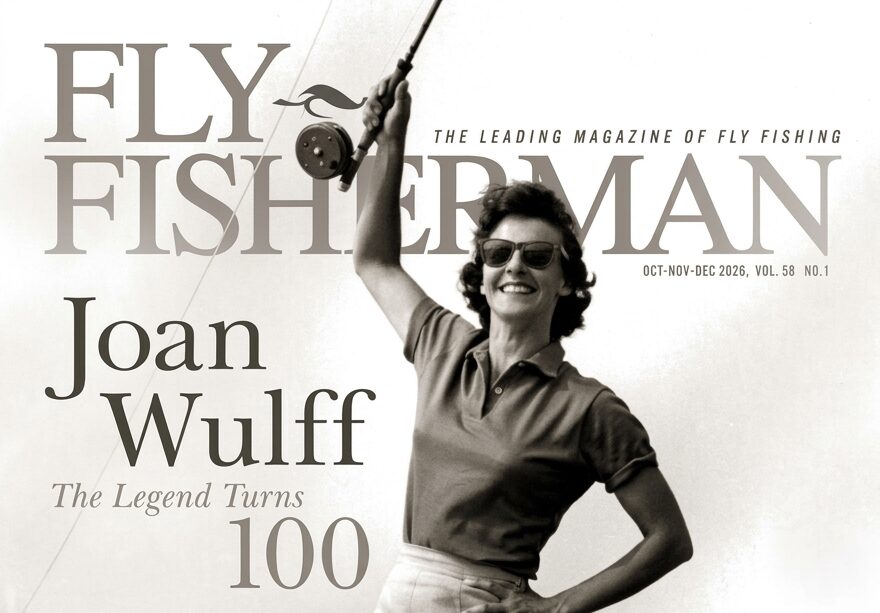

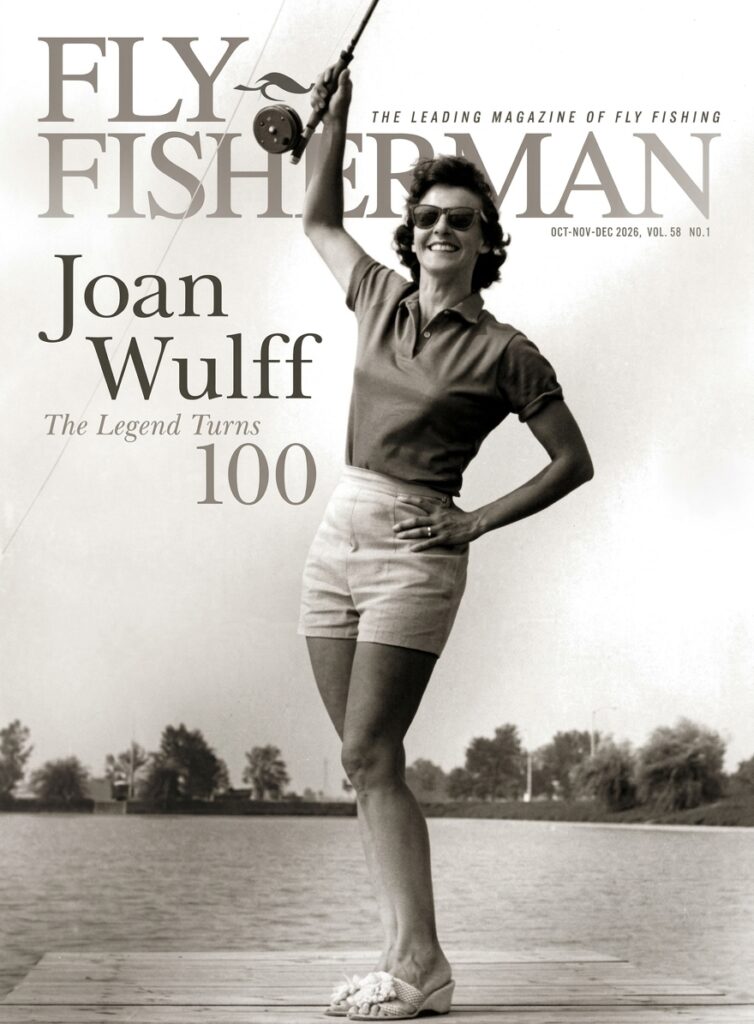
伝説のフライキャスター、ジョウン・ウルフがこの10月に100歳の誕生日を迎える。 アメリカの『Fly Fisherman』誌の粋な計らいで、、キャスティング競技会でのジョウンの姿を表紙にあしらった特別版 秋号が同誌の定期購読者限定で用意された。写真はAmerican Fly Fishing Museumの提供。
Legendary fly caster Joan Wulff will celebrate her 100th birthday this October. Fly Fisherman magazine has prepared a special autumn edition exclusively for its subscribers, featuring Joan at a casting competition on the cover. The photograph is courtesy of the American Fly Fishing Museum.
October-05-2026 Click here for English
Written by Hiro Masaki
今月10月18日、フライフィッシング界の至宝、ジョウン・ウルフが100歳という記念すべき節目を迎える。
私にとって彼女はあまりにも偉大で、そしてあまりにもチャーミングな女性の存在だ。
何か彼女を形容する気の利いた言葉を探そうと頭を回してはみたのだけれども、なまじっかの表現ではジョウンの前では色褪せてしまいそうなので、賛辞の言葉を並べるのはやめておこうと思う。
ただ一つ確かなことは、彼女という存在が、私の人生においてそれほどまでに、途方もなく大きな光を放ち続けているということだ。
初めて彼女と出会ったのは1989年、私が30歳の時だった。
今も大して変わらないのだけど、当時の私は自信過剰で、身のほどをわきまえない青二才だった。
ある日、突然思い立った私は、セオドア・ゴードン・フライフィッシャーズのメンバーから、どうにかジョウンの電話番号を聞き出した。そして、面識さえないというのに、何のためらいもなく電話をかけた。
「是非お会いさせてください!」
今思えば、ずいぶん厚かましい申し出である。
ところがジョウンは、突然電話をかけてきた見ず知らずの日本人に、身構えることなく、実にあっさりとこう答えた。
「いいわよ。9月の第二週の土曜日を空けておくわ。その日ならリーもいるし……」
「リーもいるし……」
その一言を聞いた瞬間、私は息を呑んだ。
それはつまり、ジョウンのご主人であり、フライフィッシング界の偉大なる巨匠、リー・ウルフにも同時に会えるということだった。
まったく、自分の身のほどを知らないにもほどがある。
それでも、アメリカの二大巨匠に会って話をしてみたいという、ただそれだけの、ひたむきでハングリーな情熱だけが私を突き動かしていた。
昨今、世界がアメリカという国に対して、これまでとは違った眼差しを向け始めているのは確かだ。それが良い方向なのか、あるいは憂慮すべき方向なのか、ここでその是非を語るつもりは毛頭ない。
けれど、これだけは言っておきたい。
私がかつて愛したアメリカには、目を輝かせ、まだ見ぬ世界の扉を開こうとしている若者を、どこかで静かに待ってくれている人たちがいた。それがどこの誰なのかさえ知らない遠い日本からやって来た若者に対してさえ、扉を開き、両手を広げて迎え入れてくれる懐の広さ。
でも、開かれているが、甘くはない。
懐が深いが、寄りかかることは許さない。
チャンスは与える。しかし、その扉を自分の手で開くのは、自分しかない。
アメリカには、そんな二つの顔があった。
そして、あの30歳の夏の終わり、見ず知らずの私に「いいわよ」と言ってくれたジョウン・ウルフという人は、私にとって、まさにそのアメリカそのものだったのかもしれない。
それこそが、私の愛した、本来のアメリカの姿だった。
1989年の9月中旬、私はジョウンとリー・ウルフの家を訪問した。
彼らは、アメリカのフライフィッシングの聖地、キャッツキルのビーバーキル川沿いのシューシャン(Shushan)と言う所に家を構えていた。その家は、彼らが結婚する前からリーが住んでいた家だ。
広大なお屋敷で、その家の庭には彼らのセスナ飛行機のためのプライベートの飛行場があって、きっと、そこからいつもリーの運転で飛び立ち、彼らのホームグラウンドともいうべきニューファンドランドのアトランティックサーモンの釣り場へ、何度となく通ったのだろう。
そんな暮らしが、私にはまるで映画の一場面のように思えた。
実際にその家を訪ねてみると、ジョウンもリーも、そんな特別な場所に住んでいる人たちとは思えないほどの自然体で接してくれたのだった。
「Hiro、私の巻いたフライを君にあげよう。」とリーが言った。
すると彼は彼のシグネチャーパターンであるロイヤルウルフを私に差し出してくれた。それは何と14番のフックにバイスを使わずにハンドタイで巻きあげたロイヤルウルフであった。
フライフィッシングの歴史そのもののような伝説的フライフィッシャーの生きる映像の一コマ一コマを自分の目に焼き付けながら。彼らとの時間はあっと言う間に過ぎて行った。
あれは、本当に楽しい時間だった。
しかし、
この時が私がリー・ウルフと会い、言葉を交わした最初で最後の時間になった。
その一年半後、リーはこの世を去った。
自ら操縦する飛行機が滑走路へ進入する直前に操縦席で突然、息を引き取ったのだという。セスナはそのまま滑走路脇の木に激突し、同乗していたマックス・フランシスコ氏は幸いにも一命を取り留めたが、リーは帰ることはなかった。
ジョウンとはその後も会う機会があった。
ある日のことだ。彼女とトーナメントキャスティングの話題で盛り上がっていると、ジョウンが急に真剣な面持ちで切り出してきた。
「来週、キャッツキルでキャスティング大会があるの。あなたも参加しなさい」
私は一瞬怯み、言い訳を並べた。
「ニューヨークに住み始めてからは仕事が忙しくて、トーナメント用のキャスティング練習なんて、最近はまったく手が回っていないんです。だから、今は無理です……」
しかし、ジョウンは私の言葉を遮るように、力強く言った。
「ディスタンス種目のロッドなら、私がクラブロッドをあなたのために用意しておくわ。あなたはアキュラシー用のロッドだけ持ってきなさい。いいわね? 言い訳はナシ!」
「で、でも……その大会に出るキャスターたちは、みんなエキスパートばかりですよね? フライショップのスタッフや、オービスのインストラクターとか、本当にキャスティングを知り尽くした連中ばかりで……」
なおも食い下がる私に、彼女は悪戯っぽく、しかし絶対の自信を込めてこう返したのだ。
「そんなことは関係ないわ。私があなたのディスタンス種目のアシスタントをやってあげる。だから、必ず出るのよ!」
―そして翌週、私は本当にそのキャスティング大会の舞台に立っていた。
それまでの1週間、毎晩ロングアイランドのオフィスで夜の12時まで仕事をしていたので、練習はただの一度もしていなかった。
渡されたロッドは、それまで触ったこともないクラブロッドだった。しかし、そのコルクのグリップに手をかけた瞬間、自分の中で眠っていた馴染み深い何かがうずき始めた。かつて身体に焼き付けられた競技への本能が、ゆっくりと蘇ってきたのだ。
何より、フライキャスティングの最高峰であるジョウン・ウルフが、その日の私のディスタンス種目のアシスタントについてくれるのだ。これ以上の名誉が、この世のどこにあるだろうか。
水上のプラットフォームに立つと、私の胸の奥に眠っていた闘志が、一気に燃え上がった。
ディスタンス種目の持ち時間は5分。すでにキャストを開始してから4分が経過していた。風向きは芳しくなく、それまでの記録はまだ50メートルをわずかに超えた程度。焦りが生じかけたその時、風が一瞬だけその表情を変えた。
ジョウンがすかさず、鋭い声を放つ。
「Hiro!今、風が右のボーダーラインギリギリに向けて吹き始めたわ。あの風に乗せることができればチャンスがある。今よ!」
「Okay, ジョウン!」
私は全神経をロッドハンドに集中させ、次の一投を鋭くシュートした。放たれたシューティングヘッドは、まさにジョウンの指し示した右のボーダーラインギリギリの軌道を描き、見事に風の気流を捉えて伸びていく。
まだフライラインが空中を走っている最中で、水面に落水すらしていないその刹那、背後からジョウンの歓喜の叫びが響き渡った。
「He made it!」
確信に満ちたその一投は、ウイニングショットとなった。正確な数字は記憶の彼方だが、60メートルは飛んでいたはずだ。勢いに乗った私は、その後のアキュラシー種目でも2位に食い込んだ。
それは他でもない、ジョウン・ウルフという偉大な存在から、目に見えない大いなる力を授かったからこその奇跡だった。
今でも思い出す。黄金色の光が水面を照らす、あの美しい初秋のインディアン・サマーの一日のことを。
私のフライキャスティングは、ティーンエージャーの頃から、スローからミディアムアクションのパラボリックアクションのロッドにシャルルリッツの確立したHS/HLのキャスティング理論をベースに積み上げて来たものだ。
かたやアメリカでは多くのフライフィッシャーがファーストアクションのロッドにこそ美徳を見出し、当時多く見られたウェスタンスタイルの力ずくのロッドを振り回し方に、自分の中で少なからず抵抗があったのが正直なところだ。
ところが、ジョウン・ウルフのキャストを目にした瞬間、その傲慢さは木端微塵に打ち砕かれたのだ。
彼女のキャスティングは、まさに私が理想とし、追い求めていたスタイルの、その究極の到達点だった。
まだ重いグラスロッドが主流だった時代。彼女は「ナショナル・フィッシャーマンズ・ディスタンス・フライ・チャンピオンシップ」において、並み居る男性コンペティターを相手に136フィートという当時としては驚異的なロングキャストを決め、女性初の優勝を飾った。さらにトーナメントキャスターとしてのキャリアの終盤には、非公式ながら161フィートという女子世界記録さえ打ち立てている。その実力は、まさに「異次元」と言うほかなかった。
私の目から見て、周囲のキャスターのほとんどがセミクォーターでロッドプレーンを斜めに倒して投げる中、彼女のオーバーヘッドキャストが描くスイングプレーンは、まるで剃刀の刃のように完璧な垂直面を切り裂いていた。
そして何より私を深く共鳴させたのは、彼女が体現する「パワースナップ」―すなわち加速時におけるスピードの極め方だった。
彼女は、「ラインスピードとは、”急激なストップモーション”によって生み出すと言う古今の主流となる表現方法とアプローチには主眼を置いていない。言い換えれると、ストップとは停止する地点を意味するのであって、 ”ストッピング”と言う行為を目指しているのではない。
ラインスピードとは、キャスティングストロークの最終盤における劇的な加速、すなわちパワースナップによって生むものであり、それに続くフォロースルー(ドリフト)で完全に脱力することによってこそ成立する。」
彼女のこの論理は、私がこれまで培ってきたキャスティングの概念と、寸分の狂いもなく一致していた。
私にとって命とも言えるこの基礎概念を、ジョウン・ウルフは、私が知る遥か以前からすでに完璧な形で具現化していたのだ。
私がどうしても彼女に会ってみたいと思い立ったのは、他でもない。この偉人と同じ空間で、同じ言葉で語り合いたいという、ただ一点の純粋な憧憬からだった。
ジョウン、お誕生日おめでとう。 心から最高の敬意と共にお祝い申し上げます。
私のフライフィッシャーとしての人生を、ここまで豊かで色彩に満ちたものにしてくれたのは、間違いなくあなたのお陰です。
これからもどうか、あなたの輝かしい威光でフライフィッシングの世界を照らし続けてください。
心からの敬意と、深い感謝を込めて。
Joan Wulff, The Legend Turns 100
Legendary fly caster Joan Wulff will celebrate her 100th birthday this October. Fly Fisherman magazine has prepared a special autumn edition exclusively for its subscribers, featuring Joan at a casting competition on the cover. The photograph is courtesy of the American Fly Fishing Museum.
Written by Hiro Masaki
This October 18, Joan Salvato Wulff, a true icon of the fly-fishing world, will reach the milestone of her one hundredth birthday.
To me, she is a woman of extraordinary stature—and, at the same time, one of the most utterly charming women I have ever known.
I have racked my brain trying to find some clever words with which to describe her. But any ordinary compliment, I fear, would pale in Joan’s presence. So I think I would rather leave the praise unsaid.
There is, however, one thing of which I am certain:
Joan has continued to cast an extraordinarily large and enduring light across my life.
I first met her in 1989, when I was thirty years old.
Not that I have changed all that much since then, but in those days I was young, overconfident, and utterly oblivious to my own limitations—a brash young man who had yet to learn his place in the world.
One day, on a sudden impulse, I somehow managed to obtain Joan’s telephone number from a member of the Theodore Gordon Flyfishers. Despite never having met her, I picked up the phone and called her without the slightest hesitation.
“I’d like to meet you!”
Looking back, it was an astonishingly bold thing to say to a complete stranger.
Yet Joan did not put up the slightest resistance to this unexpected call from a complete stranger—a Japanese man she had never met. Instead, she answered with disarming ease.
“Of course. I’ll keep the second Saturday in September open. Lee will be here that day, too…”“Lee will be there, too…”
The moment I heard those words, I caught my breath.
She meant, of course, that I would have the opportunity to meet Lee Wulff as well—the towering figure who, alongside Joan, stood among the great masters of fly fishing.
The audacity of it all was almost laughable. I had absolutely no sense of my own place.
And yet, at that moment, none of that mattered.
I was driven by nothing more—and nothing less—than the wholehearted, hungry desire of a young man to meet and talk with two of the greatest figures in American fly fishing.
That passion, naïve perhaps, but utterly sincere, was all that carried me forward.
There is no denying that, in recent years, the world has begun to look upon America with eyes different from those of the past. Whether that change is for the better or something to be concerned about is not for me to judge here.
But there is one thing I want to say.
The America I once loved was a country where, somewhere, there were people quietly waiting for young men and women with a light in their eyes, eager to open the doors to worlds they had never yet seen. There was a breadth of heart in that country that would open its doors even to a young man arriving from distant Japan—a stranger from a place they knew nothing about—and welcome him with open arms.
But it was open, and yet it was never indulgent.
It was generous, but it would not let you lean upon it.
It would give you the chance. But opening that door with your own hands—that was something only you could do.
America had those two faces.
And perhaps, for me, the woman named Joan Wulff, who said simply, “Of course,” to a complete stranger at the end of that summer when I was thirty, was America itself.
That was the America I loved—the America as it was meant to be.
In mid-September 1989, I went to visit Joan and Lee Wulff at their home.
They lived in a place called Shushan, along the Beaverkill River in the Catskills—the sacred ground of American fly fishing.
The house was one that Lee had lived in even before he and Joan were married.
It was an expansive estate, and on the grounds was a private airstrip for their Cessna. I imagined that they must have taken off from there countless times, flying themselves north to the Atlantic salmon waters of Newfoundland, which had become something of their home waters.
To me, that life seemed almost like a scene from a movie.
And yet, when I actually arrived at their home, Joan and Lee greeted me with such unaffected warmth and ease that it was difficult to imagine that these were people living in such an extraordinary place.
There was nothing formal about them. No sense of ceremony.
We simply talked about fly fishing.
At one point, Lee turned to me and said,
“Here, Hiro. I want you to have a fly I tied,” Lee said.
With that, he handed me a Royal Wulff, his signature pattern. To my amazement, it was a size 14 Royal Wulff, tied entirely by hand—without the aid of a vise.
As I watched, trying to etch into my memory every fleeting frame of this legendary fly fisherman in motion—as though I were watching a living piece of fly-fishing history—the time I spent with them seemed to pass in the blink of an eye.
It was, truly, a wonderful time.
And then—
That turned out to be the first and last time I would ever meet Lee Wulff, or exchange a word with him.
A year and a half later, Lee passed away.
He died suddenly in the cockpit of his own plane, just moments before he was about to taxi onto the runway. The aircraft went on to crash into a tree beside the runway. Max Francisco, who was aboard with him, was fortunate enough to survive. But Lee never came home.
I continued to have occasional opportunities to see Joan after my visit to their home.
One day, we were deep in conversation about tournament casting when Joan suddenly became serious.
“There’s a casting tournament in the Catskills next week. You’re going to enter.”
For a moment, I froze.
Then I began offering excuses.
“Since I moved to New York, work has been keeping me so busy that I haven’t had any time at all to practice tournament casting. I haven’t even been able to pick up a rod lately. So, I’m afraid I can’t…”
But Joan cut me off with a firm voice.
“I’ll have a club rod ready for you for the distance event. You just bring your accuracy rod. All right? You’re going to enter. No excuses!”
“But… the casters in that tournament are all experts, aren’t they? Fly-shop staff, Orvis instructors, guys who really know how to cast…”
I kept trying to make my case.
Joan looked at me with a mischievous smile, but there was absolute certainty in her voice.
“None of that matters. I’ll be your assistant for the distance event. So, you’re going to enter. Do you understand?”
And so—
the following week, I found myself standing on the platform at that very casting tournament.
For the entire week before that, I had been working at my Long Island office every night until midnight, leaving me no opportunity to practice—not even once.
The rod I was given was a club rod I had never even touched before. Yet the moment I wrapped my hand around its cork handle, something familiar began to stir within me—the instincts of competition that had once been burned into my body, slowly coming back to life.
More than anything, Joan Wulff—the very pinnacle of fly casting—was going to be my assistant for the distance event that day. Where in the world could there have been a greater honor?
The moment I stepped onto the platform over the water, the fighting spirit that had been lying dormant deep within me suddenly burst into flame.
The allotted time for the distance event was five minutes. Four minutes had already passed since I began casting. The wind was far from favorable, and my best cast so far had barely gone beyond fifty meters. I could feel the first stirrings of panic.
And then, for just an instant, the wind changed its character.
Joan immediately called out in her sharp, commanding voice.
“Hiro! The wind is starting to shift, right toward the edge of the boundary line. If you can get your cast into that wind, we’ve got a chance. Now!”
“Okay, Joan!”
I focused every nerve in my body on my rod hand and drove the next cast forward with a sharp, powerful stroke.
The shooting head flew out, tracing a trajectory almost exactly along the right-hand boundary Joan had pointed out. Then, beautifully, it caught the moving air and began to carry.
In that fleeting instant, while the fly line was still racing through the air and had not yet even touched the water, a cry of triumph rang out from behind me.
“He made it!”
That cast, delivered with absolute conviction, became my winning shot.
I no longer remember the exact distance, but it must have gone sixty meters or more. Carried by that momentum, I went on to place second in the accuracy event as well.
It was nothing short of a miracle—a miracle made possible because I had received some invisible, immeasurable force from the great presence of Joan Wulff.
Even now, I can still see it.
That beautiful Indian Summer day in early autumn, when golden light fell across the water.
My fly casting had been shaped since my teenage years around Charles Ritz’s established HS/HL casting theory, developed primarily with slow- to medium-action, parabolic-action rods.
By contrast, in America, I had often felt a certain resistance within myself toward the prevailing preference for fast-action rods and the forceful, almost muscular way in which Western-style casting was commonly practiced at the time.
Then I saw Joan Wulff cast.
In an instant, my arrogance was shattered.
What I witnessed was nothing less than the ultimate expression of the very style I had always regarded as ideal, the style I myself had been striving to understand and master.
This was in an era when heavy fiberglass rods were still the norm.
Yet at the National Fisherman’s Distance Fly Casting Championship, Joan defeated a field of formidable male competitors with an astonishing cast of 136 feet—an extraordinary distance for its time—and became the first woman to win the championship.
Later, toward the end of her career as a tournament caster, she would unofficially set a women’s world record of 161 feet.
Her ability was, quite simply, on another plane altogether.
From where I stood, most of the casters around me were casting from a semi-quarter position, angling the rod plane diagonally across the body.
Joan was different.
In her overhead cast, the swing plane seemed to cut through an absolutely vertical plane with the precision of a razor blade.
But what resonated with me most deeply was what I would call her mastery of the “power snap”—the extraordinary refinement of speed during the acceleration phase of the cast.
[She does not focus her approach on the mainstream, age-old idea that line speed is created through a “abrupt stopping motion.” In other words, to her, the stop simply means the point where the movement ends; it is not the act of “stopping” itself that one should strive for.
Instead, she believes that line speed is generated by a dramatic acceleration at the very end of the casting stroke—the power snap—and is fully realized only through complete relaxation during the subsequent follow-through, or drift.]
This logic of hers aligned perfectly, down to the smallest detail, with the casting concepts I had developed over the years.
That fundamental logic was almost exactly identical to the casting principles I had spent my own life developing and refining.
The very concept that I regarded as fundamental—almost as essential as life itself—had already been embodied by Joan Wulff in its most complete form, long before I even knew her name.
That, more than anything else, was why I became so determined to meet her.
I wanted nothing more than to stand in the same space as this extraordinary person and speak with her in the same language of fly casting.
It was not ambition.
It was not the desire to meet a celebrity.
It was pure admiration—the simple, almost childlike longing to meet someone whose work had shown me a possibility I had been searching for all my life.
Happy Birthday, Joan.
I celebrate this remarkable milestone with my deepest respect and admiration.
There is no doubt in my mind that it is because of you that my life as a fly fisherman has become as rich, vivid, and full of color as it has.
May you continue to illuminate the world of fly fishing with your extraordinary grace, your enduring spirit, and the light you have so generously shared with generations of anglers.
With all my admiration and heartfelt gratitude.