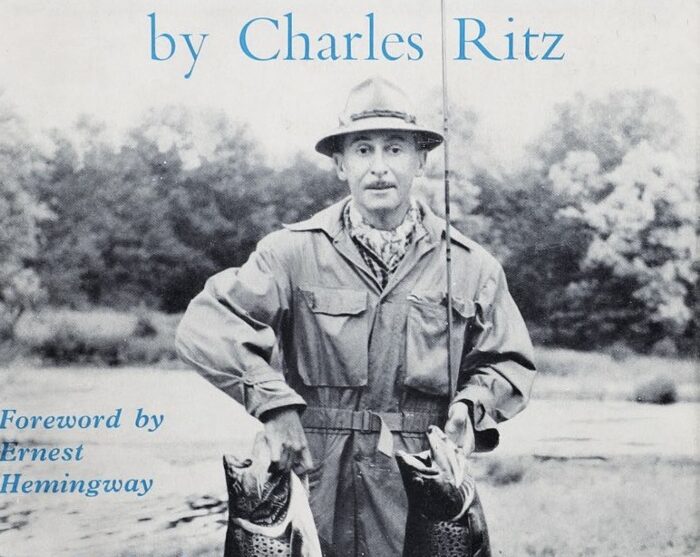

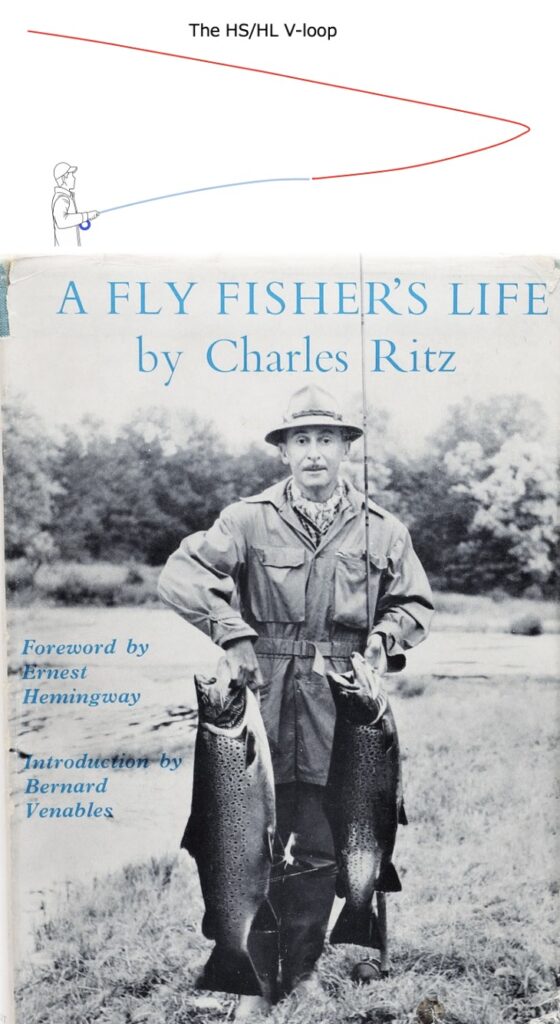
シャルル・リッツ著 「A Fly Fisher’s Life」1959年英語版・初版。 その序文は、アーネスト・ヘミングウェイ。 パラボリック・ロッドとHS/HLテクニックの先駆者による歴史的一冊。
The 1959 first English edition of A Fly Fisher’s Life by Charles Ritz, with a foreword by Ernest Hemingway. Ritz pioneered the parabolic-action rod and the HS/HL technique.
Mar-20-2026 Click here for English
先日、私はシャルル・リッツを知る澤田賢一郎さんに以下の質問をしました。
「シャルル・リッツの著書、“A Fly Fisher’s Life”、の中で明言してはいないですけれど、リッツの言う
HS/HL(ハイスピード/ハイライン)でキャストすると、ループ形状はVループと言うことになるように思いますが、実際はどうでしたか?」 澤田さんは一つ返事で、
「まさに、その通り」 と返してくれました。
はたしてシャルル・リッツがこのHS/HLによる「Vループ」と言うループ形状に到達するまでにどのような旅路を辿ったのか?
本稿、”Part 1”では、シャルル・リッツが「パラボリック」 と呼ぶロッドアクションを見つけ、更にHS/HLと言う特出したキャスト法に至るまでの道のりを。
そして次回”Part 2”では、HS/HLテクニックとは何か、をFFI(Fly Fishing International)の最新説明技法を用いて説明したいと思います。
以前、FFIきっての論客の一人であるブルース・リチャーズ氏と話していた際、彼が面白いことを言いました。
「Hiro、前から感じていたのだけど、日本のフライキャスティングは他の国とは何か違うユニークな道を辿って来ているようだね。」
それを聞いて、彼が何を言わんとしているのか直ぐに察しがつきました。
日本のフライフィッシングの歴史は、鮎毛針、テンカラの時代から勘定すると共に誇るべき400年以上の歴史を持っていますが、こと西欧式フライフィッシングで言うとその歴史は、1889 年にイギリスのトーマス・グラバーが日光中禅寺湖で釣りをしたのが記述上の元年とされています。
日本で一般に広まり出したのは、1955年にアメリカ人弁護士のトーマス・L・ブレークモアが「養沢毛鉤専用釣場」を創設したのが事実上の起点とされていますから、70年前が日本のフライフィッシング聡明期の始まりと言っていいでしょう。
マーケットがバンブーに代わって、グラス製のフライロッドが出始めたのは60年ほど前です(1960年代中頃)。
私が最初にフライロッドを握ったのは54年前ですが、その頃、日本の西欧型フライフィッシングは未だ聡明期の真っ只中にありました。 当時ルアーもフライフィッシングも共に日本のアングラーは、今に比べるとずっとヨーロッパ製のギアに傾倒していました。ルアーの世界で言えばそれはスウェーデンのAbu社やフランスのミッチェル社であり、フライの世界では、ロッド、リール共にイギリスのハーディーのプレゼンスが高かった時代で、アメリカのロッドとしてはガルシア、フェンウィック、ブラウニングのグラスロッドがようやく登場し始めた時代です。
日本のフライフィッシャーの多くは、自然の流れで当時は見るからに腰がなく投げにくいクラシック・ブリティッシュスタイルのロッドを使ってフライキャスティングを覚えたものです。
この時代背景の中で、強烈なイニシアティブで日本のフライフィッシングを牽引したのが澤田賢一郎さんでした。
ロンドンのハーディーキャスティングスクールの公認インストラクターとなった澤田さんは、1972年日本で初めてのキャスティングスクールを開設します。
その澤田さんが、1974年の夏、パリにシャルル・リッツに会うべく凱旋門をくぐると、澤田さんの体の中に爆発的化学反応が起き、それは瞬く間に日本のシリアスなフライフィッシャーに類焼しました。私もその一人、高校1年の時でした。
澤田さんがパリに入城してリッツ氏との面会を直前に控えるとパリの街は大雨に見舞われ、一日目のレッスンはお流れに。
翌日も雨は依然として止む気配はみせず再度足止めをくらい、三日目にとうとうその日がやってきました。
ホテル・リッツ・パリを出発したリッツ氏は、氏のアシスタントと供に澤田さんをピックアップするとボローニュの森に隣接するティール・オー・ピジョン池に向かいました。
澤田さんには、リッツ氏に会う前から、どうしても自分の目で確かめたかった二つの目的を明確に見据えていました。
一つは、シャルル・リッツによる一枚のキャスト写真の真実を現認すること。その写真は6.5フィートのバンブーロッドが繰り出す50フィートを越えるフォルスキャストで、ロッドレグ(ループの下側)にスラックがなくしかもかなり直線に近いタイトで、それまでの常識ではあり得ないような鋭いループ形状の一瞬を切り取っているものでした。
もう一つは、その鋭いループを形成するには余りにも不釣り合いに思える位置にロッドとロッドハンドが位置していて、このポジショニングとあの鋭いループがどう言う因果関係で成立するのか?を確かめることでした。
多くのトップクラスのエリートキャスターがそうであるように、リッツもフライキャスティングを教えることへの並々ならぬ情熱と才能、手法を持ち合わせていました。そして澤田さんは短時間のうちに、リッツのキャスティングの要を理解し、当初の目的を完遂することができたのです。
リッツの澤田さんに強調した点は、ラインスピードを上げるためのポイント。それは 「日本の武術に例えた手首の動き」 であったそうです。
この時シャルル・リッツから教わったこと、そのエッセンスがリッツの著書 「A Fly Fisher’s Life」 に述べられていた 「ハイスピード・ハイライン(HS/HL)」と呼ばれるキャスティングテクニックでした。
澤田さんは、シャルル・リッツの遺作となり、HS/HLキャスティング理論の完結編となった 「A Fly Fisher’s Life第3版」 が1972発刊されてから2年後、リッツがHS/HLのテクニックを完結させてまだ間もない熱い魂の息吹が感じられる時に、リッツ本人から直接レッスンを授かったことになります。
そしてその2年後1976年、リッツは他界されました。
リッツにとってもしかすると澤田さんが最後の生徒であったのかもしれません。
澤田さんはそのテクニックを完全に自分のものとすると、その後、日本国内でこれからHS/HLテクニックの伝承者となっていくキーとなるフライフィッシャー達にそのテクニックを教えることになります。
50年後の今、日本ではシャルル・リッツの遺産がキャスティング文化の一つとして根付くまでに昇華することになり、この歴史と文化の一片をブルース・リチャードは氏の鋭い嗅覚で嗅ぎ取っていた、と言うわけです。
さて、アメリカに目を向けてみると、澤田さんがシャルル・リッツの門を叩く更に50年前、つまり今から約100年前に、シャルル・リッツはアメリカでのプレゼンスを既に確立し始めていました。
パリの名門、ホテル・リッツ・パリの御曹司であったリッツは、ホテル業の研鑽を積むために1916から1927年にニューヨークのリッツ・カールトンホテルに身を置く傍ら、週末はアメリカのフライフィッシングの聖地、ニューヨーク近郊のキャッツキルで過ごすようになります。
その日々の中、1922年のある日、リッツはヒラム・レナードと並んでスプリットケーンロッド・ビルダーの最高峰と称された名工、フレッド・ペインとキャッツキルで出会います。リッツはペインに懇願して、それ以来、毎週末欠かさず土曜日はハイランド・ミルズにあったペインのアトリエでロッドビルディングを学び、日曜日をキャッツキルでの釣りにあてるようになります。
ニューヨーク、マンハッタンのリッツ・カールトンホテルの地階に居所を構えたリッツは部屋の一つをロッドルームに据えて、そこでニューヨークの質屋で手に入れたバンブーロッドをチューンナップしては、それを当時、米国内で最も名声のあるスポーツ用品店の一つであったアバクロンビー&フィッチで売るまでにロッドビルディングに入れ込んでいました。
後にリッツとも交友関係を持つことになる伝説のフライフィッシャーマン、リー・ウルフが1927年にパリでの美術の修行を終えてアメリカ東海岸に戻って来たのもその時分でした。
フーバー大統領やアイゼンハワー大統領も所属していたAngler’s Club of New Yorkのメンバーや、バンブーロッドビルダー達との時間を通して、幾多の芳醇な果実をものにしながら次の高みへ向け脱皮して行ったのがこの頃のリッツであったのだと思います。
私が言うのはおこがましいですが、私もリッツがニューヨークに住んでいたのと同じ歳頃の時分にニューヨークに住んでいて、毎週のように自分が所属していたセオドアゴードン・フライフィッシャーズ・クラブのメンバーなどとキャッツキルなどに通いながら、リー・ウルフやジョウン・ウルフなどのレジェンドに会う機会を持ち、リッツが目にしていたであろう同じ景色と人々を見てきたので、その時の氏の高揚感が目に浮かぶような気がします。
パラボリック・アクションの誕生
やがてリッツは、それまで温めてきたパラボリック・アクションの構想をフレッド・ペインの息子、ジム・ペインの助けを借りて具現化することになります。
リッツの言うパラボリック・アクションとは、いかなる加重が掛かってもロッドのトップからバットまでストレスポイントがなく、ロッド全体が曲がること、そして、そのアクションに硬性感がある、つまりハイトルクであることが絶対の条件でした。
よくある誤解は、パラボリック・アクションはロッドはバット部から曲がるスローテーパー(ディープフレックス)の象徴と思われがちですが、それは違います。リッツのデザインしたパラボリック・アクションにもファーストテーパーから、スローテーパーまで存在します。
ジム・ペインのスプリットケーンロッドは、父親でありロッドビルディングの師匠であったフレッド・ペインのケーンロッドより、竹に強めの火入れを施していました。竹竿の火入れは、和竿では何百年も前から確立していた技術ですが、火入れによって素材を少し炭化させることでロッドに硬性感を出すテクニックがリッツの求めるハイトルクに近かったのだと想像できます。
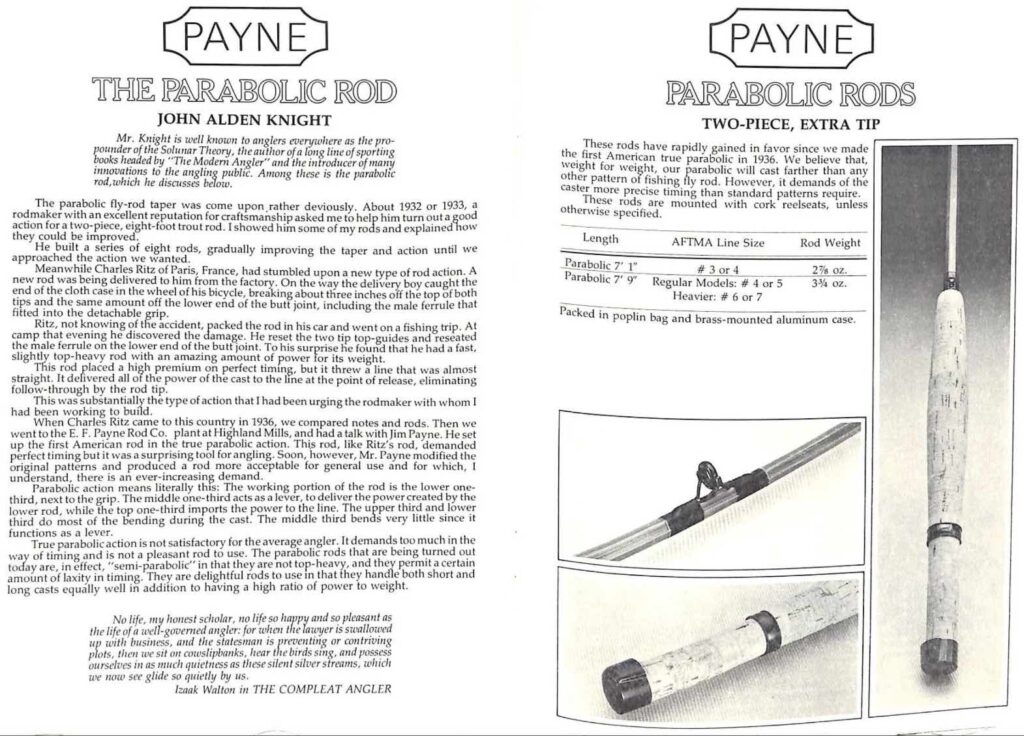
上記のペインのカタログの説明文にも書かれていますが、リッツのパラボリック、ハイトルクロッドの原点にまつわる、よく知られた逸話があります。
「ホテル・リッツ・パリに滞在していたある銀行家が、リッツにフライロッドの注文をしました。リッツはその注文に応じて、完成したロッドをデリバリーボーイに託して届けさせました。
しかし、その道中でアクシデントが起こります。
デリバリーボーイが自転車で走行中に転倒して、預かっていたロッドを折ってしまったのです。よく見るとティップ先端とバット部の両方がそれぞれ7.5cmほど折れていて、バット側のジョイント部も破損していました。彼はロッドティップ側の2個のガイドを装着し直し、ジョイント部も応急処置をすると、それでキャストしてみました。すると本来の設計よりもバット部がより曲がり、中間部が硬い独特のアクションに変様していることに気づくのです。驚いたことに、そのロッドはややトップ側の調子が強くなったことで、ラインスピードが増し、ロッドの軽さからは想像もつかないほどのパワーを持つロッドになっていたのです。この「偶然の産物」による独特の粘りとパワーに強いインスピレーションを得たリッツは、このコンセプトを追求して、遂にハイトルクのパラボリック・アクションを確立させた。」 と言う話です。
上記のストーリーには多少マーケティング目的で美化されている節も匂いますが、これはこれで微笑ましいとして、このエピソードには補足的な裏話があります。
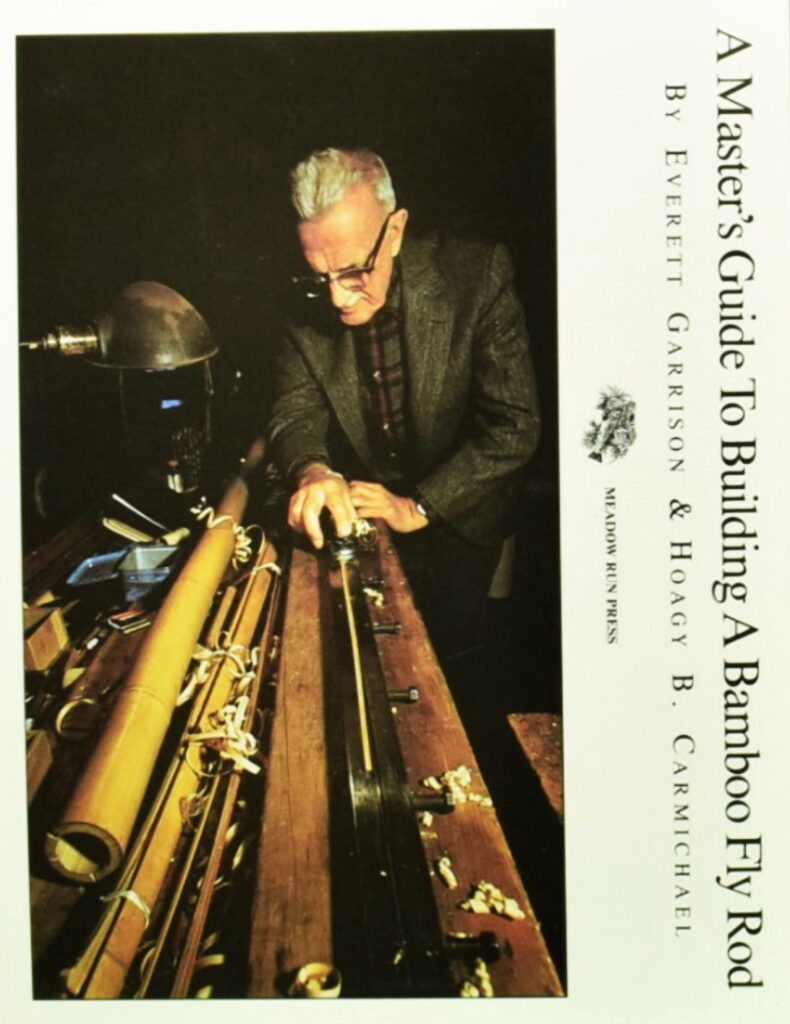
生粋のエンジニアであったケーンロッドビルダーのエヴェレット・ギャリソンは、応力曲線やロッドが荷重下でどのように曲がるかを彼の物理学の知見を用いて線密に計算してロッドビルディングする、そんな筋金入りの技術屋でした。
リッツが例の折れてチューンアップしたロッド全体が間断なく曲がると言うロッドをギャリソンに見せると、彼は「荷重の掛け方を調整すれば、ホウキだってパラボリック (放物線)状のカーブを描くものですよ、、、」と技術者としてのちょっと皮肉混じりの見解を言いました。するとリッツが、
「今、何と言いました?! なるほど!」 と 膝を打って”パラボリック” と言う言い回しを心にしたためました(ホーギー・カーマイケル談より)。
以上は、エヴェレット・ギャリソンが”パラボリック”命名の起源であると言う逸話ですが、以来リッツは「パラボリックと言う呼び名は、ロッド全体が滑らかに曲がることを象徴する比喩としての言葉です」 と妙に説明がましく、恐らくその中にギャリソンへのリスペクトの含みを持ってパラボリックを語る姿勢が見受けられます。
パラボリック・アクションロッドの普及
そのパラボリック・アクションのロッドは、フレッド・ペイン、ジム・ペイン、ポール・H・ヤング、ファーロー&シャープス、アブ・ガルシア、ブラウニング社のシラフレックスのブランドで流通しました。
1938年になるとリッツはPezon et Michelの技術顧問に就き、同社は「パラボリック」を直ちに商標登録して量産化を開始し、パラボリックをマーケティング的にフィーチャリングしてプロモートすることになります。
理にかなう正確な表現を取り分け重んじたリッツは、実際には、パラボリック曲線の物理学上の論理に乗じたテーパーではないアクションのロッドに「パラボリック」と言う呼び名を与えるのは気にいっていなかったそうで、彼は、それよりも “プログレッシブ” と言う言葉を好んで使ったとのことです。
リッツにとっての一番の誇りは、最高に選りすぐった素材とテーパーのPezon et Michelのトップラインに
PPP:Puissance Progressive Parfait (Progressive Pendulate Power、プログレッシブ分散調子) を命名したことでした。
当時PPPシリーズのベストセラーモデルのFario Club, Master, Power Plusの3本だけで1万本近いPPPテーパーのケーンロッドを生産し、その半分がアメリカに輸出されたと言いますから、アメリカのフライフィッシャーにも極めて大きなインパクトがあったのは間違いありません。
この時代、10フィート級でそれも腰のないロッドに慣れていた多くのアングラーにとって、そのロッドの切れ味、リズム感の素晴らしさは驚きに満ちた発見であったに違いありません。その衝撃はそれまでグラスロッドだけを使っていた釣り人が初めてグラファイトロッドを試した時の感動と近かったはずです。私自身がそうであったように。
因みに現在マーケットの主流になっている「プログレッシブ・アクション」と呼ばれるロッドは、リッツの名付けたプログレッシブ・アクションに由来しているのかは不明です。但し、アメリカ発のモダン・プログレッシブ・アクションはリッツの追求したパラボリック・アクションとは明らかに異なるものである、と言っていいと思います。
HS/HLの誕生
シャルル・リッツと言う名前を聞くと、「パラボリック・アクションとHS/HLテクニック」 と言う言葉を思い浮かべる人は多くおられますが、パラボリック・アクションのロッドはHS/HL投法を意識して誕生したロッドデザインではありませんでした。
HS/HLのテクニックが完成形として発表されたのは、Pezon et Michelがパラボリック・アクションのロッドを誕生(1938年)させてから25年後の1963年、リッツが72歳の時のことです。
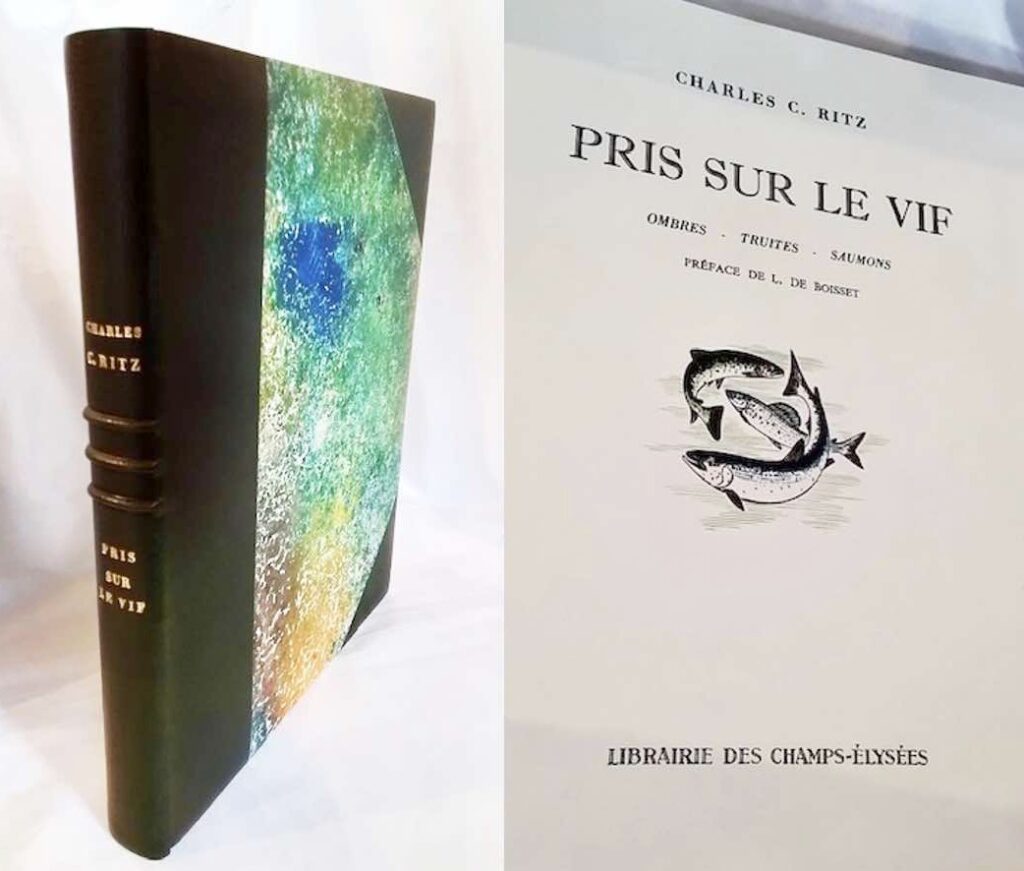
A Fly Fisher’s Life のフランスでの原本 「Pris Sur Le Vif」 は1953年に発刊され、英語版初版は「A Fly Fisher’s Life 」 として1959年に出版されましたが、その時点ではHS/HLについてはまだ語られていませんでした。
それでも、私はいつも確信的に思います。図らずとも、パラボリック・アクションはHS/HLテクニックを最高に引き立たせるテーパーであった、と言うことです。
以下は、リッツの盟友でありエスクアイア誌の創設者であったアーノルド・ギングリッチによる、「シャルル・リッツのHS/HLキャスティング理論」を完結づけるにあたってのトリガーとなったエピソードです。
時は1960年代後半のこと。
「この文章を書いている数週間前、私はペンシルベニア州ポコノスでチャールズ(シャルル・リッツ)と共にいました。
彼は、FFF (Federation of Fly Fishers) の会合に参加するため、三週間にわたる大陸横断ツアーの締めくくりにそこを訪れたのです。馬でさえ音を上げそうなほどの過密日程をこなしながら、彼は炎天下のキャスティング会場の芝生の上を何時間も飛び回り、まるで彼の故郷のスイス、ヴァレーの山岳を駆け回る山羊さながらの軽やかな身のこなしを見せていました。
1960年代の中頃、彼が70代半ばのことですが、チャールズは、まるで新しい宗教に改宗したかのように一夜にしてキャスティングスタイルを変えてしまったのです。
彼にその着想を与えたのは、自分の倍ほどの体格を持ちながら年齢は半分、しかも世界選手権を幾度も制してきたジョン・タランティーノという男でした。チャールズは彼からまったく新しいキャスティングスタイルのヒントを得ると、それを「ハイスピード/ハイライン(HS/HL)」と呼ぶテクニックとして体系化したのでした。」
以上は、1972年版の 「A Fly Fisher’s Life」 の序章でアーノルド・ギングリッチが語っていることですが、実はリッツ本人が語っていたことをつぶさに追っていくとニュアンスは異なっていて、HS/HLの発表には綿密に計算されたシナリオが背景にあったように私には見えます。
リッツ自身がHS/HLと言う言葉を最初に文書にしたのは、1963年にイギリスのFly Fisher’s Club of Londonのクラブ誌『Flyfishers’ Journal』で、上述のペンシルヴァニア州のポコノスでタランティーノに会う数年前のことになります。 HS/HLの完結編と言える詳細版が発表されたのは、1964年のフランスの 『Plaisirs de la Pêche』 誌の2/3月号においてです。そこでは数多くの図、ダイアグラム、英語のキーワードを伴った解説がなされています(以下添付)。
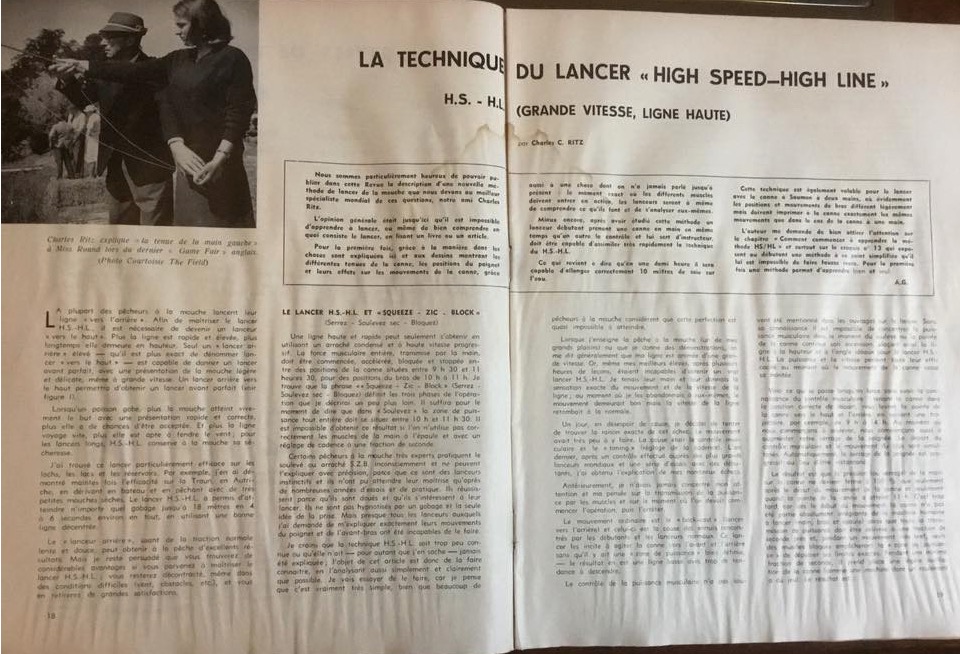
シャルル・リッツが、HS/HLの完結編を初めて文章にした、1964年2/3月号の『Plaisirs de la Pêche』の記事。この雑誌の編集者にはアーネストヘミングウェイ、アーノルドギングリッチなど錚々たるメンバーが名を連ねていた。Jacques Bordenave氏、Pezon et Michel-Cordel 提供。
リッツ本人は要約すると以下のように語っています。
「1960年にチューリッヒで開催された国際フライキャスティング選手権で、私はジョン・タランティーノのキャスティングを解析するために撮影機を持って臨みました。その時のスローモーション映像と自分のキャスティングを比較すると、タランティーノのディスタンス競技でのキャスティングは、まさにHS/HLそのものだったのです。
その後、私はタランティーノを、自分のホームグランドのノルマンディーのチョークストリーム、リスルに招待し、そこで彼にPezon et MicheのPPP 『ファリオ・クラブ』を一日使ってもらい実釣でのキャストを観察しました。
結果は、彼は他の誰にも真似できないほど素晴らしいパフォーマンスを見せてくれたのです。
私にとって、その日こそが、HS/HLという技術が理想的なキャスティング・メソッドであるという確信の証となった日でした。
とは言え、タランティーノのHS/HLを親友のトーナメントキャスターピエール・クリューズヴォーと完全に自分達のものとして動きのメカニズムを正しく理解し、自分達で再現しできるようになるまで9ヶ月を要しました。そして、漸く教書と図解して発表できるところまで漕ぎ着けたのです。」
上述のペンシルヴァニア州のポコノスでジョン・タランティーノと再会することになったFFFのイベントに参加したのは、この後のことになります。
タランティーノの驚くべきキャストから生まれた一つのアイデアが、ポコノスに訪れた時には、すでにフライキャスティング史の中で静かに歩みを始めていたと言うことになります。
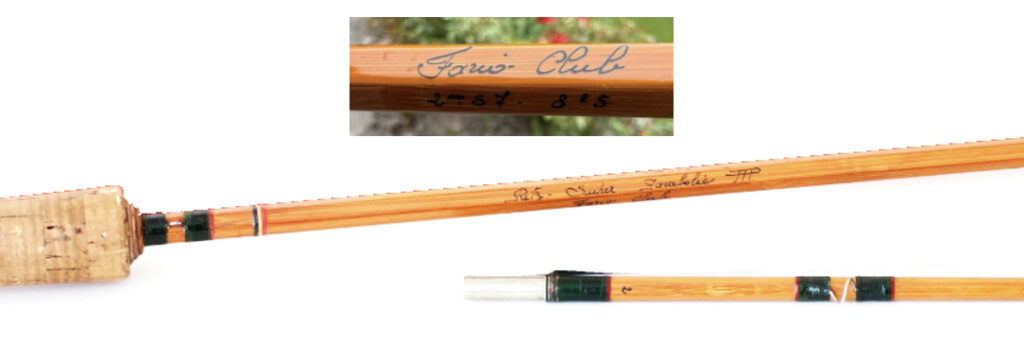
リッツが初めてタランティーノのキャスティングを目にした際、彼を覚醒させた「真の洞察」とは、一体何だったのでしょうか。
これに対する、私の推察は以下です:
リッツが目撃したのは、驚異的なラインスピードと力強い推進力を伴う「Vループ」だったはずです。
その鍵となる要素としてリッツが気付いたのは、次の3点にあったと私は考えています。
(1)高度に制御された可変回転軸の移動
(2)ストローク中におけるMRP(マキシマム・ロッドベンド・ポジション)の緻密なポジショニング、そして
(3)最高速度のラインスピードを生み出すためのグリッピング・テクニックです。
これらについては、次回の”Part 2″ で解説したいと思います。
サンフランシスコのゴールデンゲート・アングリング&キャスティングクラブに所属していたタランティーノは、1957年から1973年、自分の精肉店で強盗に射殺されると言う非業の死を遂げるまでのトーナメントライフにおいて、12個もの世界記録を保持するまさに当代随一の天才キャスターでした。
その後リッツは、1963年に彼の40年に渡る盟友であり、共にロッドを作り上げてきたトーナメントキャスターのピエール・クルーズヴォーが、タランティーノとの出会いをきっかけに完成したHS/HL理論でキャストすることによってプロ部門ツーハンド・サーモンディスタンス種目での世界記録を更新した、と記しています。
リッツは親友のダーモット・ウィルソンに以下のように語っています。
「私のまとめたHS/HLは、優れたキャスターたちが長年やってきたことを、分かり易い形で説明したにすぎないと言うことだ。」
(参:ダーモット・ウィルソンは、英国ウィンチェスター近郊のネザー・ウォロップ・ミルの所有者。ネザー・ウォロップ・ミルは、チョークストリーム、テストリバーの支流に隣接するネザー・ウォロップにあり、その歴史的な建造物含めてフライフィッシングの聖地とされている。)
1960年代から現在に至るまで、歴代のトップトーナメントキャスター達が、 “HS/HL” と言う言葉を意識しているかいないかは別にして、オーバーヘッドキャスト、ツーハンド・スペイキャスト共に、キャスティングトーナメントで世界のトップグループに入るためにはHS/HLは絶対不可欠なテクニックであり、シャルル・リッツはこのことを強く意識していたと言うことになります。
このことは今日においても全く同じことが言える、と私は考えます。
1977年プレシーズン号の『Fly Fisherman』誌には、1976年7月に亡くなったリッツへの追悼記事が掲載されており、ドン・ザーナー、ベン・フォンテーヌ、そしてA.J.マクレーンらのフライフィッシング界における錚々たるレジェンド達が寄稿していました。
その中で共通するシャルル・リッツを称うキーワードは「創造性」「寛大さ」、そして「友情」でした。
リッツと言う人間は、キャスティング理論への極めて深い情熱と愛情を持ち、人にキャスティングを教え、技術を分かち合うことを心からの悦びとして捉え、人生を子供のような純粋さで駆け抜けていった人物であった、と言うことだと思います。
シャルル・リッツがもしあと5年長く生きていれば
「A Fly Fisher’s Life」 は、HS/HL理論の大幅改訂を伴った1972年発刊の第3版が同書の最終稿となりました。
私は、50年間HS/HLを追求してきて、いつも思って来たことがあります。
もしシャルル・リッツが10年、いや、あとせめて5年長生きしてくれていれば、常にイノベーティブであったリッツが、リッツの逝去に前後してフライキャスティング界に起こった三大エポックを見逃したはずはなく、新しい見地が 「A Fly Fisher’s Life」 夢の第4版として加わったであろう、、と言うことです。その三大エポックとは以下です。
- カーボンロッドの誕生。
- 世紀のキャスター、スティーブ・レイジェフの誕生。
- シューティングヘッド・スペイライン・システムの誕生とそれに伴うスペイキャスティングの進化。
- カーボンロッドの誕生。
シャルル・リッツが逝去したのは1976年ですが、丁度その前後にまずフェンウィック、ハーディー、Orvis, R.L.Winston、Scottが競うように初のカーボンフライロッドを打ち出し、続いてSage、G. Loomisが参入しました。
この時リッツは80歳を越えていましたが、カーボンと言う新素材を認識していたことは間違いないと思います。
しかし、リッツがその開発に乗り出す時間的猶予は残念ながら残されていなかったようです。
Scottのようにフルフレックスをフィーチャリングするメーカーもありましたが、基本的には現在主流のファーストテーパーのモダンプログレッシブアクションのロッドが巨大なうねりと共に世界を席巻し始めたのもこの頃からと言っていいと思います。
この荒波の中で、当時の東レの最新カーボンクロス材を随時使いながら、リッツの魂を引き継いだハイトルクのパラボリック・アクションのカーボンロッドを精力的に打ち出していたのが、やはり澤田賢一郎さんでした。
そして澤田さんは、1982年になると、今度はツーハンドのハイトルクのパラボリック・アクションロッドを投入しました。
現在、スペイオラマを始めとするスペイキャスティングのトーナメントでは、CND、Galeforce、Bruce&Walker、LTS、Guideline等々、いずれも100%ハイトルクのパラボリック・アクションのロッドを使い、選手達が意識しているかいないかは別として、上位入賞のためにはHS/HLのモーションでキャストするのが必須要件と言っていいと思います。
果たしてリッツだったら、カーボン材をどう料理したことでしょうか?
恐らく、リッツが実釣用のスペイロッドをデザインしたとしても、現在ヨーロッパと日本で主流のハイトルクのパラボリックロッドに帰結していたことと私は思います。
一方でシングルハンドによるオーバーヘッドキャストについては、リッツは違う流れを見出していたかもしれません。ライン番手が8番以上のロッドでオーバーヘッドキャストをする時、主にソルトウォーター用ロッドになりますが、スローテーパー(ディープフレックス)のパラボリック・アクションはさまざま面で実用的ではなく、現在主流のファーストテーパーのモダン・プログレッシブアクションにその価値をリッツは認めたはず、と私は考えます。
- 世紀のキャスター、スティーブ・レイジェフの誕生。
1973年にイギリスのスカボローで開催されたキャスティング世界選手権にスティーブ・レイジェフは16歳でデビューし、いきなり複数の種目で優勝し、総合優勝のタイトルを獲得しました。以降、スティーブ・レイジェフは、世界大会で合計14回の総合優勝の戦績を持っています。
彼は、フライのディスタンス種目で、シングルハンド243 feet (74m)、ツーハンドオーバーヘッドキャスト306ft (93M)と言う、驚異的なワールドレコードを打ち立てています。彼はフライキャスティングだけでなく、ルアー、サーフキャスティングにおいても圧倒的な強さを発揮するオールラウンドの総合世界チャンピオンでもありました。
グラスロッド時代のスーパースターがジョン・タランティーノとするならば、スティーブ・レイジェフはカーボンロッド時代のスーパースターであり、どちらも世紀を代表する百年に一度の逸材であったことは間違いないと思います。
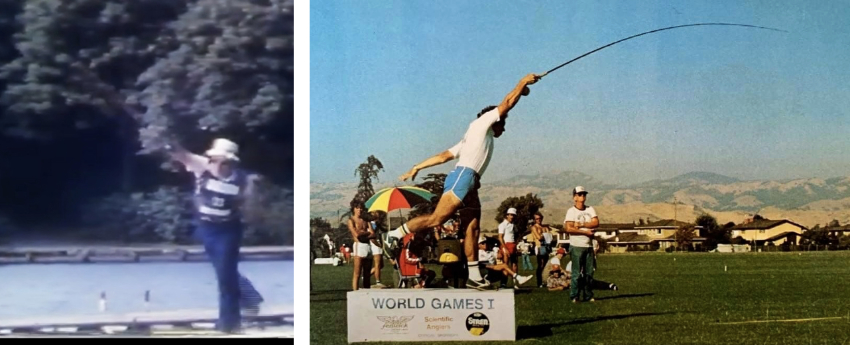
私は、学生時代からずっとスティーブを見て来ましたが、シングルハンドのフライディスタンスキャスト種目では、推定17番相当の9’6″のモダン・プログレッシブテーパーのロッドに、ラインはT38(38g、586グレイン)シューティングヘッドと言う重いラインを使用し、これをフォルスキャストはアンダースラングループでキャスト、シューティングでは圧巻のハイスピード・ハイラインで超人的なスピードで振り抜くその様は異次元のものでした。彼のピーク時はオリンピックのやり投げ選手並の鍛え上げられた体格とパワーを持っており、究極なまでに研ぎ澄まされたキャスティングフォームを有していました。
偶然なのか、必然なのか、スティーブはジョン・タランティーノと同じ、ゴールデンゲート・アングリング&キャスティングクラブ(GGACC)に所属しています。 ジョン・タランティーノをロールモデルに、早朝5時から開放されている広大な3つのキャスティングプールが敷設されていると言う、これ以上ない練習環境が提供されているGGACCの近所に住み、9歳の頃からメルクリーガーをコーチにつけて高効率のキャスティング練習ができる環境。これに彼の天性と並外れた努力、恵まれた肉体が加わったので、いくら頑張ってもICSFの競技ルール下においては常人には所詮手が届くレベルのキャスターではありませんでした。
シャルル・リッツがもし、このスティーブ・レイジェフのキャスティングを見たのならば、彼がタランティーノを見て感激した時と同じ以上のマグニチュードで衝撃を受けたはずです。
おそらくリッツが見て感じ取ったのは、以下のようなことであったのではないでしょうか。言葉使いがちょっと専門的過ぎて理解し難いとは思いますが、これを私の言葉で要約すると以下になります。
ハイスピード/ハイラインの再定義: 可変回転軸の移動を、タランティーノの時代よりも更に前後に拡張したこと。 ローテーション・フェーズでのキャスティングアークを限界まで広げるグリッピングを進化させたこと。(HS/HLテクニックにおいて、キャスティングアークを広げることは、推進力低下にはつながりません。)
ハイトルクを持つカーボンは不可能を可能にした: ロッドティップにも強力なトルクを有するカーボン材は、それまでの不可能を可能にした。その一つが、ロングラインでもリメリック形状、あるいはアンダースラングループでレーザーシャープなナローループが作れるようのなり、エリート・キャスターにとっての、ループの選択肢が増したこと。
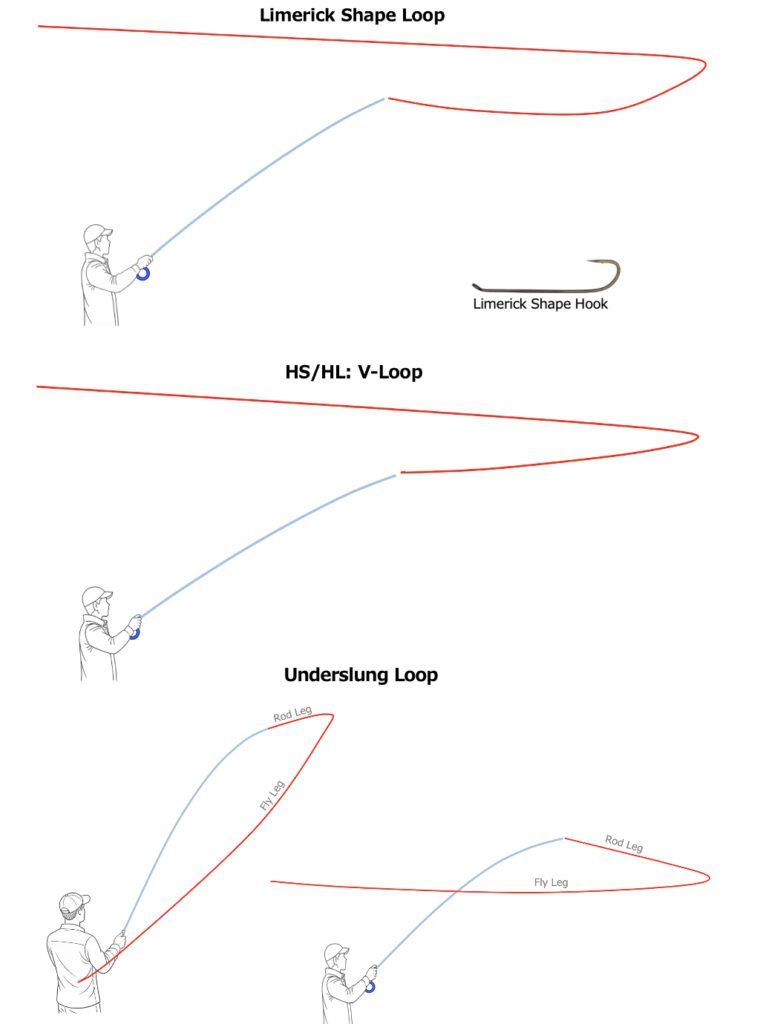
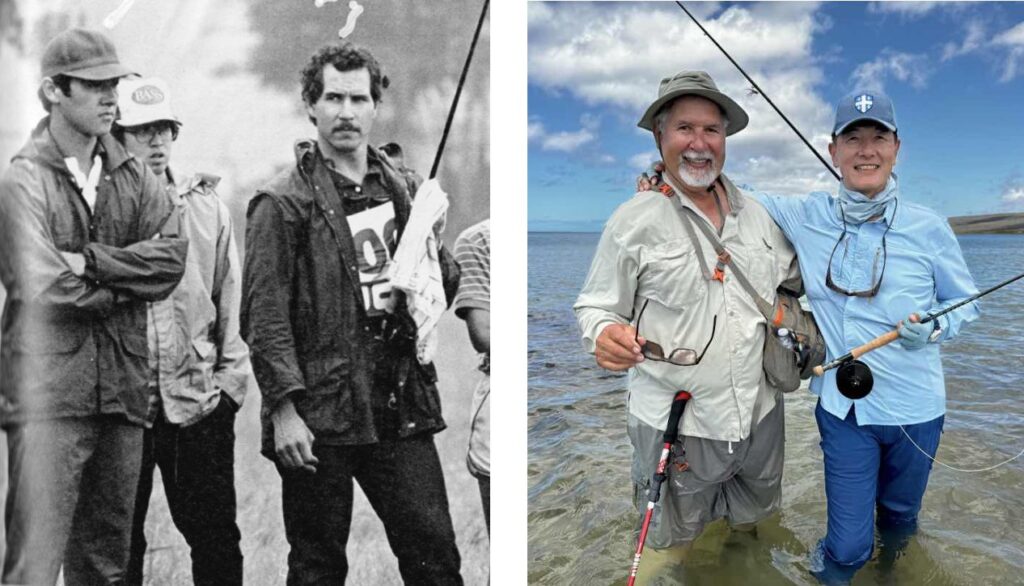
私にとってスティーブ・レイジェフは、学生時代からのかけがえのない友人です。
高校時代以来、私はトーナメント・キャスティングに打ち込み、常にスティーブが到達していた卓越した高みを目標にしてきました。リッツの「HS/HL」テクニックを使って、シングルハンドによるキャスティングで、日本人として初めて200フィート(約60メートル)の大台を突破することもできました。アメリカ在住時には東海岸リージョン大会に出場し、ある大会ではジョーン・ウルフに背中を押されて、圧倒的な差をつけて優勝を果たしたこともあります。
彼が私のフライフィッシング人生をどれほど豊かにしてくれたかは、言葉では到底言い尽くせません。
歴史が示しているように、スポーツの真の頂点に立つ人々は、並外れた努力だけでなく、卓越した人格によっても形作られています。
彼を特徴づける資質は、シャルル・リッツと同じ、「創造性」「寛大さ」、そして何よりも「友情」にほかなりません。
- シューティングヘッド・スイングフィッシング・システムの誕生、スペイ・キャスティングの進化。
私が初めてスペイキャスティングを行なったのは1979年で、最初に入手したギアは、ロッドはロンドンのハーディーショップで買った15’4”のカーボンロッド、ラインはダブルテーパーのフローティングライン(DT10F)。キャスト法はロンドンのハーディースクールで習っていたダブルスペイの一択でした。
その頃は、マーケットにスカジットやスカンジ・シューティングヘッドはあるはずもなく、スペイ用のラインは手持ちのラインを切りはりして自作していた時代です。
〜シューティングヘッド・スイングフィッシング・システムの誕生〜
ここでまた澤田賢一郎さんの名が、革命的なシステムのオリジネーターとして登場します。
1980年代初頭、沢田さんは、「パワーウェット」と言うシステムを通じて、スウィング・フィッシングにゲームチェンジをもたらしました。
ツーハンドロッドに、澤田さんのブランド「サセックス」のシューティングヘッド、そしてフラット・モノフィラメント・ランニングライン「フラットビーム」を組み合わせることで、従来のスウィング技法では不可能と考えられていた30〜40メートル先の流心や対岸までもをスイングの射程に収めてしまうシステムを開発、発表したのです。 そしてこのスイングフィッシング・システムが日本の大河でのサクラマス、海外のスチールヘッドやアトランティックサーモン・リバー、例えばトンプソン川やスカンジナビアの河川において、圧倒的な効果を発揮することを示しました。 澤田さんが始めたスイング手法は今や主流のテクニックとなっていますが、日本の多くのフライフィッシング・タックルメーカーに見られるように、日本発のシステムが商業的に海外市場に積極展開されることなされませんでした。それでも私はこのシステムが、現代のスイングフィッシングのベースとなった可能性は高いと考えています。
飛距離とスウィング・コントロールにおけるこれほどまでに類を見ない飛躍をあのシャルル・リッツが目にしたならば、一体どのような反応を示したでしょうか。想像せずにはいられません。
〜スペイ・キャスティングの進化、スカンジナビアン・スタイル、アンダーハンド・キャスト法〜
一方でシャルル・リッツがおそらく一目置いたのは、スエーデンのヨラン・アンダーソンが生み出した、シューティングヘッド・スペイラインを使って、アンカード(スペイ)キャストを最効率でキャストする、スカンジナビアン・スタイル、アンダーハンド・キャスト法だと思います。
このキャスト法のエッセンスは、「デリバリーキャストのスピードを得る上でロッドハンドの回転軸を下方に可変移動させ、ローテーションのフェーズでテコの原理で急激にラインをローンチさせる(パワースナップ)」 もので、これは正にHS/HLのエッセンスを究極の形にまで圧縮させた形である、とリッツは見たはずだと私は思います。
このキャスト法は、ハイトルクのカーボンロッドの特性を限りなく引き出すもので、リッツ存命の時代には考えにくいキャスト法であったとも思います。極端に狭いキャスティングアークでキャストするアンダーハンド・キャストが作り出す、ハイスピードで飛行する「Vループ」をもしシャルル・リッツが見たならば、どのようなコメントがあったのか、是非聞いてみたかったところです。
シャルル・リッツは当然、この澤田さんのシューティングラインとフラットモノシステムによるスイング手法と、ヨラン・アンダーソンのキャスト法の両方に目を見開いたはずです。
さて、今回は、HS/HLと言うテクニックを、シャルル・リッツの辿った旅路を踏まえてまとめてみました。
このHS/HLのキャスト手法を、私のように一つの特出したキャスティングスタイル(style)として捉えるキャスターがいる一方で、現代においては、これはすでにフライキャスティングの基礎(substance)の中に消化吸収されて溶け込んだものである、と捉えるキャスターもおられます、私は、それはそれで一つの立ち位置だと思います。
ただ私はHS/HLは他のキャストと違う点を意識して取りに行かないと手に入らない技術であり、その独自性の存在に目を瞑ってしまう時には、その宝は知らずに目の前を通り過ぎて行くものであると考えます。
HS/HLの技術のエッセンスについて、次回の 「HS/HLの真実。To V, or Not to V, That Is the Question (Part 2)」 で紹介したいと思います。
本稿を出筆するにあたり、澤田賢一郎さん、
フランスのPezon et Michel-CordelのJacques Bordenave氏、Reeb Marc氏
のご協力をいただきました。ここに深く感謝申し上げます。
無断転載・複製を禁ず
HS/HL Revealed: To V, or Not to V, That Is the Question-Part1
The 1959 first English edition of A Fly Fisher’s Life by Charles Ritz, with a foreword by Ernest Hemingway. Ritz pioneered the parabolic-action rod and the HS/HL technique.
Recently, I had the chance to ask a question to Mr. Ken Sawada, a man who possesses a deep understanding of Charles Ritz.
I asked him: “In his book, A Fly Fisher’s Life, Charles Ritz doesn’t explicitly state it, but when casting with his HS/HL (High Speed / High Line) technique, wouldn’t the resulting loop naturally take the shape of a ‘V-loop’? I’ve always wondered if that was the reality.”
Without a moment’s hesitation, Mr. Sawada replied: “That’s exactly right.”
What kind of journey did Charles Ritz undertake to arrive at this specific shape, the “V-loop” born from the HS/HL technique?
In this article, Part 1, I will explore the journey that led Ritz to discover the rod action he called “Parabolic,” and the path that brought him to the exceptional casting method known as “HS/HL”.
Then, in the upcoming Part 2, I will explain the HS/HL technique itself, incorporating instructional concepts from Fly Fishers International (FFI).
Some time ago, when I was speaking with Bruce Richards, one of the most respected fly-casting theorists, he said something interesting:
“Hiro, I’ve always felt that fly casting in Japan has followed a very different unique path which I don’t see in other countries.”
The moment he said it, I knew exactly what he meant.
Japan’s fly fishing heritage stretches back more than 400 years if we include traditional methods such as Ayu-kebari and Tenkara.
However, the history of Western-style fly fishing in Japan is relatively recent.
The earliest recorded instance dates back to 1889, when the British merchant Thomas Blake Glover fished at Lake Chuzenji.
Fly fishing did not begin to spread widely in Japan until 1955, when the American attorney Thomas L. Blakemore established the Yozawa Fly Fishing Area, a dedicated fly-fishing-only stream. In many ways, this marked the true beginning of modern fly fishing in Japan, roughly seventy years ago.
It was about sixty years ago, around the mid-1960s, when the fly rod market began to shift from traditional bamboo to the new era of fiberglass.
I first picked up a fly rod fifty-four years ago. At that time, Western-style fly fishing in Japan was still very much in its infancy. Japanese anglers, both lure and fly fishermen alike, were far more inclined toward European gear than they are today.
In the lure fishing, companies like ABU and Mitchell were widely admired.
In fly fishing, rods and reels from Hardy Brothers held a dominant presence in both rods and reels.
American rods had only just begun to appear, with fiberglass models from companies such as Garcia, Fenwick, and Browning entering the market.
Naturally, many Japanese fly fishers learned to cast using what were essentially classic British-style rods—rods that today might seem very soft and somewhat difficult to cast by modern standards.
Within this historical context, one man played an extraordinary role in shaping Japanese fly fishing: Ken Sawada.
After becoming a certified instructor at the Hardy Brothers “London School of Casting”, in 1972 Sawada established the country’s first fly casting school in Japan.
Then, in the summer of 1974, he traveled to Paris to meet Charles Ritz.
When Sawada passed beneath the Arc de Triomphe on his way into the city, he could not have imagined that this visit would trigger a chain reaction that would later spread among serious fly fishers throughout Japan.
I was one of them. At the time, I was just a first-year high school student.
When Mr. Sawada arrived in Paris and prepared for his long-anticipated meeting with Charles Ritz, the city was struck by heavy rain, forcing the cancellation of the first day’s lesson.
The following day, the rain showed no sign of relenting, delaying their plans once again. It was not until the third day that the long-awaited moment finally arrived.
Departing from the Hôtel Ritz Paris, Ritz, accompanied by his assistant, picked up Sawada and headed toward the Étang de Tir aux Pigeons, adjacent to the Bois de Boulogne.
Even before meeting Ritz, Sawada had clearly defined two objectives that he was determined to verify with his own eyes.
The first was to confirm the authenticity of a photograph of Charles Ritz demonstrating a fly cast. The image depicted a false cast exceeding 50 feet, executed with a 6.5-foot bamboo rod. What made it extraordinary was the loop: the rod leg, the lower leg of the loop, was completely free of slack, forming a tight, nearly straight, capturing a fleeting moment of an impossibly sharp loop that defied the conventional understanding of the time.
The second objective was to understand how such a sharp loop could be produced despite what appeared to be an incongruous positioning of the rod and rod hand. Sawada sought to uncover the causal relationship between this unusual positioning and the resulting loop formation.
Like many elite casters at the highest level, Ritz possessed not only exceptional skill but also a profound passion, talent, and methodology for teaching fly casting. In a remarkably short time, Sawada grasped the essence of Ritz’s casting technique and succeeded in achieving his initial objectives. What Ritz emphasized to Sawada as the key to increasing line speed was “a wrist movement analogous to that found in Japanese martial arts, Bujutsu.”
What Sawada learned directly from Charles Ritz at that time embodied the essence of the casting technique described in Ritz’s book A Fly Fisher’s Life, known as the “High Speed / High Line (HS/HL)” method.
Two years after the publication of the third edition of A Fly Fisher’s Life in 1972—Ritz’s final work and the culmination of the HS/HL casting theory—Sawada had the rare opportunity to receive direct instruction from Ritz himself, at a moment when the technique still carried the vivid, almost palpable energy of its recent completion.
Two years later, in 1976, Ritz passed away.
It is possible that Sawada was among his last students.
Having fully mastered the technique, Sawada would go on to teach it to key fly fishers in Japan—individuals who would become the next bearers of the HS/HL tradition.
Half a century later, Charles Ritz’s legacy has taken root in Japan, evolving into an established element of the country’s casting culture. It was this very fragment of history and culture that Bruce Richards, with his keen intuition, perceptively recognized.
Looking Toward America
If we turn our eyes to the United States, we find that Charles Ritz had already begun establishing his presence there about fifty years before Ken Sawada knocked on his door, nearly a century ago from today.
Ritz, the son of the famous Parisian hotel family that owned the Hôtel Ritz Paris, spent the years from 1916 to 1927 at the Ritz-Carlton New York in order to learn the hotel business.
On weekends he would escape the city and travel to the Catskills, the spiritual home of American fly fishing near New York.
During those years, one particular encounter would prove decisive.
In 1922, while in the Catskills, Ritz met Fred Payne, a legendary craftsman considered, alongside Hiram Leonard, to be one of the greatest split-cane rod builders of all time.
Ritz was fascinated. He implored Payne to teach him rod building. From then on, he spent nearly every weekend in the same routine: Saturdays at Payne’s workshop in Highland Mills learning the craft of rod making, and Sundays fishing the rivers in the Catskill.
Back in Manhattan, Ritz lived in the basement quarters of the Ritz-Carlton. One of the rooms he turned into a rod room. There he would refine and tune bamboo rods he had found in New York pawn shops, eventually becoming so absorbed in rod building that he even sold these rods through Abercrombie & Fitch, which at that time was one of the most prestigious sporting outfitters in the country.
Around this same period another legendary fly fisherman returned to the American East Coast. In 1927, after finishing his art studies in Paris, Lee Wulff came back to America—a man who would later form a profound bond with Ritz.
Through time spent with members of the Anglers’ Club of New York, a club that counted figures such as Herbert Hoover and Dwight Eisenhower among its members, and through relationships with bamboo rod builders of the era, Ritz was exposed to a remarkable circle of people and ideas. One can imagine how these experiences catalyzed his transformation, preparing him for the next stage of his evolution.
It may sound presumptuous for me to say so, but I once had a similar experience in my own life. When I was about the same age Ritz had been during his years in New York, I also lived there for a time. I often traveled to the Catskills with members of the Theodore Gordon Flyfishers, the club to which I belonged then.
During those years I even had opportunities to meet legends such as Lee Wulff and Joan Wulff. Because of that, I feel I can imagine, at least a little, the excitement Ritz must have felt. I had the chance to see many of the same rivers, landscapes, and people that he once experienced.
The Birth of the Parabolic Action
Eventually Ritz began turning a concept he had long been developing into reality, the idea of the parabolic rod action.
To achieve this, he worked together with Jim Payne, the son of Fred Payne.
For Ritz, the “parabolic action” had to meet two essential conditions: first, no matter how much load was applied to the rod, there should be no single stress point. The rod should bend smoothly from tip to butt. Second, the action must possess firmness, or more precisely, having high torque was an absolute requirement.
A common misunderstanding is that a parabolic rod must bend deeply from the butt and therefore represent a slow taper or deep-flex action.
This is not necessarily true.
Even among rods designed by Ritz, parabolic actions existed across a range of tapers from fast to slow.
The split-cane rods built by Jim Payne were made with stronger heat treatment than those produced by his father Fred Payne. Heating bamboo to strengthen it was, of course, a technique that had already been practiced for centuries in traditional Japanese bamboo rods. By partially carbonizing the bamboo through heat treatment, rod builders could increase the firmness of the material.
It seems likely that this characteristic, the resulting high-torque, was close to what Ritz was seeking in his vision of the parabolic rod.
As mentioned in the Payne catalog quoted above there is a well-known anecdote often talked about the origin of Ritz’s parabolic, high-torque rods.
One day, a banker staying at the Hôtel Ritz Paris placed an order with Charles Ritz for a fly rod. When the rod was completed, Ritz entrusted it to a delivery boy to take it to the customer.
But on the way, an accident happened.
While riding his bicycle, the delivery boy fell and broke the rod he was carrying. When Ritz examined the damage closely, both the tip and the butt had snapped—each by about three inches and the ferrule on the butt section was also damaged.
Ritz repaired the rod as best he could. He replaced the two guides near the tip and made a temporary repair to the ferrule. Then he tried casting the rod.
Something unexpected happened.
The rod now bent more deeply into the butt than in its original design, while the midsection felt relatively firm, creating a very unusual action.
Surprisingly, the rod produced faster line speed than before. The slightly firmer tip section, combined with the rod’s light weight, resulted in a rod with far more power than its size suggested.
Ritz was strongly inspired by this “accidental creation,” with its distinctive combination of resilience and power. Pursuing the concept further, he eventually developed what became known as the parabolic action.
The story above may contain a certain amount of marketing embellishment, but it is charming enough that most anglers accept it with a smile. There is, however, an additional side story connected to this episode.
Everett Garrison, the legendary cane-rod builder, was an engineer to the core. Drawing on his profound knowledge of physics, he meticulously calculated stress curves and rod deflection; he was a technician in every sense of the word.
When Charles Ritz showed Garrison his ‘once-broken, yet tuned-up’ rod—one that flexed seamlessly from tip to butt—Garrison offered a dry, slightly ironic remark typical of a man of science:
“With the right application of load, even a broomstick will describe a parabolic curve.”
At that, Ritz struck his knee in a moment of pure revelation:
“What did you just say?! That’s it! Exactly!”
From that moment on, Ritz adopted the term “parabolic” and made it a cornerstone of his vocabulary. (From an account by Hoagy Carmichael.)
The anecdote mentioned above is often cited as the origin of the term ‘parabolic’ in relation to Charles Ritz. I have always felt that from that point on, Ritz became quite deliberate in how he explained the word, often saying:
‘The term parabolic is simply a metaphor to describe the smooth bending of the entire rod.’
Listening to his explanations, one cannot help but sense a subtle respect for Garrison behind his choice of words.
The Spread of the Parabolic Action Rods
Rods built with this parabolic action were later produced or marketed by several makers and brands, including EF Payne, Jim Payne, Paul H. Young, ABU Garcia, Farlow & Sharpes, and the Silaflex series produced by Browning.
In 1938, Charles Ritz became a technical adviser to the French rod manufacturer Pezon et Michel. The company quickly registered Parabolic as a trademark and began producing rods based on the concept. From that point forward, the term parabolic was strongly featured in their marketing.
Ironically, Ritz himself—who valued precise and logical terminology—was not entirely comfortable with using the word parabolic for rods whose tapers were not literally derived from the mathematical logic of a parabolic curve.
In fact, he preferred the word “progressive.”
For Ritz, one of his proudest achievements was naming the top tier of Pezon et Michel rods:
PPP — Puissance Progressive Parfait (Progressive Pendulate Power).
The PPP series became extremely successful.
It is said that nearly 10,000 bamboo rods with PPP tapers were produced from just three popular models—Fario Club, Master, and Power Plus—and about half of them were exported to the United States.
There is little doubt that these rods made a considerable impression on American fly fishers.
At that time many anglers were accustomed to long rods of around ten feet that were very soft in action. For them, the crispness and rhythm of these rods must have been a revelation.
The experience was probably similar to what anglers felt decades later when they first tried graphite rods after fishing only fiberglass rods.
I know the feeling well—because I experienced it myself.
Incidentally, the rods commonly described today as “progressive action” may or may not trace their origin directly to Ritz’s terminology. That point is not entirely clear.
However, it seems safe to say that the modern American progressive action differs from the parabolic action that Ritz pursued.
The Birth of HS/HL
When people hear the name Charles Ritz, many immediately think of two things: parabolic action rods and the HS/HL casting technique.
But the parabolic rod design was not originally created with HS/HL casting in mind.
The HS/HL technique was formally presented much later.
Pezon et Michel introduced parabolic rods in 1938.
The HS/HL method did not appear until 1963, when Ritz was already seventy-three years old—twenty-five years later.
The original French version of Ritz’s famous book, Pris Sur Le Vif, was published in 1953. The English edition, A Fly Fisher’s Life, appeared in 1959. At that stage, however, HS/HL had not yet been mentioned.
Even so, I have always felt that this was more than coincidence.
Whether intentionally or not, the parabolic taper turned out to be an ideal partner for the HS/HL technique, allowing its strengths to be expressed at their fullest.
The Trigger Behind HS/HL
The following episode was told by Ritz’s close friend Arnold Gingrich, founder of Esquire magazine. It describes what eventually triggered the completion of Ritz’s HS/HL casting theory.
The story takes place in the late 1960s.
Gingrich wrote:
“A few weeks back, as this is written, we were together in the Poconos, when Charles was taking in a Federation of Fly Fishermen’s meeting by way of winding up a three-week cross-continent tour with a schedule that would have taxed the endurance of a horse, and he was bounding around under a broiling sun out on the casting green, for hours on end, with all the agility of a mountain goat from his ancestral Valais.
Along toward the mid-sixties, which were of course his own mid-seventies, Charles Ritz embraced a new religion, so to speak, and changed his casting style overnight. From Jon Tarantino, a man twice his size and half his age, and several times a world champion, Charles got the inspiration for a wholly new casting stance, which he proceeded to systematize into a technique called High Speed/High Line.”
While Gingrich shares this account in the introduction to the 1972 edition of A Fly Fisher’s Life, a closer look at Ritz’s own words suggests a different nuance. To me, it appears there was a meticulously calculated scenario behind the unveiling of HS/HL.
Ritz himself first documented the ‘HS/HL technique’ in 1963 within the Flyfishers’ Journal, the publication of the Fly Fishers’ Club of London, several years before the Pocono encounter with Tarantino described above.
The complete explanation of HS/HL was published the following year, in 1964, in the French fishing magazine Plaisirs de la Pêche. In that article Ritz presented numerous diagrams, illustrations, and explanatory notes—many accompanied by English keywords—to describe the techniques in detail.
This article, from the Feb/March 1964 edition of “Plaisirs de la Pêche,” marks the first time Charles Ritz put the conclusion of HS/HL into words. The magazine was overseen by a legendary editorial board, including the likes of Ernest Hemingway and Arnold Gingrich. Courtesy of Jacques Bordenave, Pezon et Michel-Cordel.
Ritz’s own words can be summarized as follows:
“At the 1960 International Fly Casting Championship in Zurich, I used a motion-picture camera to capture and analyze Jon Tarantino’s casting. When I compared the slow-motion footage of his movements with my own, I was struck by a remarkable realization:
Jon’s technique in the distance event was, in essence, the very embodiment of the HS/HL.
Sometime later, I invited him to my home waters, the chalk stream of the Risle in Normandy, where he spent a full day fishing with a Pezon et Michel PPP ‘Fario Club’ while I observed his casting under real fishing conditions.
To my great satisfaction Jon performed magnificently, better than anyone else could have.
This was the final proof that HS/HL technique was an ideal casting method.
Even so, it took nine months before I fully elucidated the mechanics behind it. Together with my close friend, tournament caster Pierre Creusevaut, we studied the movement again and again until finally we could reproduce it by ourselves.
Only then were we able to present the method clearly in written form, with established explanations and illustrations.“
It was after this that the FFF event in the Poconos of Pennsylvania, where Ritz would meet Jon Tarantino again, took place.
This means that a single idea, born from Tarantino’s incredible casting, had already begun its quiet journey through the history of fly casting by the time he visited the Poconos.
With that rod I have created many memories while fishing in different parts of the world.
What exactly was the “true insight” that awakened Ritz when he first saw Tarantino’s casting?
Here is my own hypothesis.
I believe what Ritz witnessed was the “V-loop”—a phenomenon characterized by phenomenal line speed and powerful, concentrated propulsion.
I assume Ritz identified three critical elements that make this possible:
(1) a highly controlled shift of the variable rotational axis
(2) the precise positioning of the MRP (Maximum Rod-bend Position) during the stroke, and
(3) a gripping technique designed to generate maximum line speed.
Since it is difficult to fully convey these concepts through text alone, I would like to explore them in more detail in the next installment, “Part 2.”
Tarantino, who belonged to the Golden Gate Angling and Casting Club in San Francisco, was truly one of the greatest casting talents of his time.
Between 1957 and 1973 he set twelve world records in casting tournaments. His remarkable career ended tragically when he was shot and killed during a robbery at his butcher shop.
Later, Ritz also wrote that in 1963, his trusted friend and longtime associate of over forty years, the tournament caster Pierre Creusevaut, who had worked alongside him in developing rods, set a new world record in the professional two-handed salmon distance event by using the HS/HL technique, which had been completed following his encounter with Tarantino.
Ritz once told his close friend Dermot Wilson something very revealing:
“What I call HS/HL is simply an attempt to explain clearly what great casters have been doing for many years.”
(For reference, Dermot Wilson was the owner of Nether Wallop Mill near Winchester in England. The mill stands beside a tributary of the famous River Test chalk stream and is widely regarded as one of the historic centers of fly fishing.)
From the 1960s to the present day, the world’s top tournament casters—whether they consciously think about the term HS/HL or not—have relied on its principles.
In both overhead casting and two-handed Spey casting, the ability to generate high line speed and maintain a high line path is essential for reaching the top level of casting tournaments.
Ritz clearly understood this.
And in my opinion, that truth remains just as valid today.
In the 1977 pre-season issue of Fly Fisherman Magazine, an obituary tribute to Charles Ritz—who passed away in July 1976—was published.
The article included contributions from several prominent figures in the fly-fishing world, including Don Zahner, Ben Fontaine, and A. J. McClane.
Among these writers, several words appeared again and again when describing Ritz:
creativity, generosity, and friendship.
From their recollections, one gets the impression that Charles Ritz was a man driven by a deep passion for casting theory—someone who found genuine joy in teaching others and sharing knowledge.
In that sense, he seems to have lived his life with a kind of childlike purity, running through it with boundless curiosity and enthusiasm.
If Charles Ritz Had Lived Five More Years
A Dreamed Fourth Edition of A Fly Fisher’s Life.
For more than fifty years I have pursued the ideas behind HS/HL casting.
During those decades, one thought has returned to me again and again.
What would have happened if Charles Ritz had lived just a little longer?
A Fly Fisher’s Life reached its final form in 1972 with the publication of its third edition, which included Ritz’s major revision of HS/HL theory. But if he had lived another ten years, or even just five, I am convinced that the ever-innovative Charles Ritz would not have missed the three great revolutions that appeared in the fly-casting world around the time of his passing.
Had he witnessed them, I believe they would have found their way into a dreamed-of fourth edition of A Fly Fisher’s Life.
Those three revolutions were:
- The birth of the carbon fly rod
- The emergence of Steve Rajeff, the caster of the century.
- The birth of shooting head Spey line systems, and the subsequent evolution of Spey casting.
- The birth of the carbon fly rod
Charles Ritz passed away in 1976.
Around that same time, companies such as Fenwick, Hardy, Orvis, R.L. Winston, and Scott began introducing the first carbon-fiber fly rods, almost as if competing with one another. Soon afterward Sage and G. Loomis entered the field as well.
Ritz was already over eighty years old then, but it is difficult to imagine that a man of his curiosity would not have recognized the potential of this remarkable new material.
Unfortunately, time did not allow him to explore it fully.
Some manufacturers,Scott, for example, continued to feature full-flex designs. But it was during this period that the fast-taper, modern progressive-action rods that dominate today began sweeping across the world with enormous momentum.
Yet within this wave there was one rod designer who continued pursuing the parabolic philosophy inspired by Charles Ritz.
That was Ken Sawada.
Using the most advanced carbon cloth then available from Toray Industries, Sawada produced a series of high-torque parabolic-action rods that carried forward the spirit of Charles Ritz into the carbon era.
Then, in 1982, he introduced something even more remarkable: a series of two-handed high-torque parabolic rods.
Today, in Spey-casting tournaments such as Spey-O-Rama, competitors use rods from manufacturers such as CND, Galeforce, Bruce & Walker, LTS, and Guideline. All of them feature strong high-torque parabolic actions.
Whether competitors consciously realize it or not, casting with HS/HL motion has essentially become a requirement for reaching the top ranks.
If Ritz had lived long enough to design Spey rods using carbon materials for fishing (not for competition), I believe he would have arrived at a similar conclusion: the high-torque parabolic rods that today dominate in Europe and Japan.
However, in single-hand overhead casting he might have reached a different answer.
When casting rods that carry #8 or heavier lines, especially in saltwater fishing, a slow-taper deep-flex parabolic action is not always practical. In this area, I believe Ritz would have recognized the value of the fast-taper modern progressive rods that are widely used today.
- The emergence of Steve Rajeff, the caster of the century.
In 1973, at the ICF World Casting Championships held in Scarborough, England, a sixteen-year-old American named Steve Rajeff appeared for the first time on the world stage.
He immediately won multiple events—and captured the overall championship.
It was the beginning of one of the greatest careers in casting history.
Over the years that followed, Rajeff won fourteen overall world titles.
In fly-distance events he set astonishing world records:
243 feet (74 m) with a single-hand fly rod, and 306 feet (93 m) in two-hand overhead casting.
Distances that still make anglers shake their heads in disbelief.
But Steve Rajeff was more than just a fly caster. He was an all-around world champion who dominated lure casting and surf casting as well.
If the great star of the fiberglass-rod era was John Tarantino, then Steve Rajeff must be considered the superstar of the carbon-rod era. Both were once-in-a-century talents.
Coincidence—or perhaps destiny—placed them in the same place: the Golden Gate Angling & Casting Club (GGACC).
At his peak, Steve possessed the physique and explosive power of an Olympic javelin thrower, combined with a casting form refined to an extraordinary level of efficiency.
I also competed in all nine ICSF events, always chasing his back—but he was always light-years ahead of me.
In the single-handed fly distance event, he used a modern 9’6″ progressive taper rod—equivalent perhaps to a 17-weight—paired with a T38 (38g / 586-grain) shooting head. His false casts were executed with an underslung loop, controlled and efficient. Then, in the final shoot, everything changed: the line exploded forward in a breathtaking, high-speed, high-line trajectory, forming a perfect V-shaped loop.
The way he drove the cast through at such extraordinary speed felt almost beyond human. Yet it was not power alone. His movement carried a remarkable precision, combined with a form that was both refined and beautiful.
What I witnessed was not just technique, but something on an entirely different level.
Steve grew up near the Golden Gate Angling & Casting Club, where three large casting ponds open at five in the morning. With Tarantino as his role model and Mel Krieger as his coach from the age of nine, he enjoyed perhaps the finest training environment any young caster could hope for.
Combined with his natural talent, relentless dedication, and exceptional physical strength, it is no surprise that under ICSF competition rules he became a caster far beyond the reach of ordinary competitors.
If Charles Ritz had seen Steve Rajeff cast, I believe he would have felt a shock even greater than when he first watched Jon Tarantino.
What Ritz likely perceived may be summarized as follows.While the terminology might seem highly technical and somewhat difficult to follow, the essence, expressed in my own words, is this:”
A Redefinition of High-Speed / High-Line concept:
the extension of the variable rotational axis shift further both forward and backward than in the pre-Tarantino era. Additionally, the evolution of gripping mechanics that allow the casting arc during the rotation phase to be expanded to its practical limits. (Within the HS/HL technique, widening the casting arc does not result in a loss of propulsive efficiency.)
High-Torque Carbon: Turning the Impossible into Reality:
The advent of carbon fiber, which provides immense torque even in the rod tip, has redefined what is possible. For the elite caster, this technological leap expanded the repertoire of loops; it enabled the creation of razor-sharp narrow loops, even with long lines, whether in a Limerick shape or an under-slung loop configuration.
Steve Rajeff and I go back to my student days.
From high school on, I devoted myself to tournament casting, always chasing the extraordinary standards Steve had set. By using Ritz’s HS/HL technique, I became the first in Japan to surpass the 60-meter (200-foot) mark in single-handed fly casting.
During my time in the U.S., I competed in some East Coast tournaments. In one particular event, with encouragement from Joan Wulff, I secured a decisive victory, winning by an overwhelming margin.
Yet, in time, I came face to face with an undeniable reality: no matter how much dedication and effort I poured into tournament casting, I would never reach the realm in which Steve resides.
Even so, words cannot fully express how profoundly he has enriched my life in fly fishing.
As history has shown, those who stand at the true pinnacle of sport are shaped not only by extraordinary effort, but also by exceptional character.
The qualities that define him are the very same that defined Charles Ritz:
creativity, generosity, and above all, friendship.
- The birth of shooting head Swing fishing system, and the evolution of Spey casting.
The first time I performed Spey casting was in 1979.
The first gear I obtained was a 15’4″ carbon rod that I purchased at the Hardy Bros shop in London, along with a double-taper floating line (DT10F). As for casting technique, the only method I knew at the time was the Double Spey, which I had learned at the Hardy School of Casting in London.
In those days there were no Skagit or Scandi shooting heads available on the market. Spey lines were something anglers often built themselves by cutting and splicing the lines they already owned.
- 〜The birth of shooting head Swing fishing system〜
Here again the name Ken Sawada appears, this time as the originator of a revolutionary Swing fishing system.
In the early 1980s, Ken Sawada brought a game-changing shift to swing fishing through his revolutionary ‘Power Wet‘ system.
By combining a two-handed rod with Sawada’s brand “Sussex” shooting head and the flat monofilament running line known as the “Flat Beam,” a system was developed and introduced that made it possible to reach, with a swing technique, distances of 30 to 40 meters, areas such as the main current or even the opposite ban, that had previously been considered unaccessible with conventional swing methods. Furthermore, this swing fishing system demonstrated overwhelming effectiveness for targeting cherry salmon in Japan, as well as steelhead and Atlantic salmon in overseas rivers such as the Thompson and rivers in Scandinavia. The modern swing system pioneered by Sawada has now become a mainstream technique. However, as seen with many Japanese fly fishing tackle manufacturers, systems developed in Japan were not actively promoted or commercialized in overseas markets. Nevertheless, I believe there is a strong possibility that this system laid the foundation for modern swing fishing.
One can only wonder how Charles Ritz would have reacted to such an unprecedented leap in distance and swing control.
- 〜Evolution of Spey casting, Scandinavian Underhand Casting〜
On the other hand, I believe Charles Ritz would have held a profound respect for the Scandinavian Underhand Casting style, pioneered by Sweden’s Göran Andersson. This method achieves maximum efficiency in anchored (Spey) casting using shooting heads.
The essence of this technique lies in shifting the rotational axis of the rod hand downward to gain delivery speed, combined with a “power snap” that launches the line through leverage during the rotation phase. I am convinced Ritz would have recognized this as the ultimate compression of the HS/HL essence.
This casting style extracts the near-limitless potential of high-torque carbon rods—a leap in technology and technique that would have been almost inconceivable during Ritz’s lifetime. I can only imagine what Ritz would have said if he had witnessed the high-speed, razor-sharp “V-loop” generated by the Underhand Cast’s incredibly narrow arc.
There is little doubt in my mind that Ritz would have opened his eyes wide at both developments:
Both represent remarkable advances in the continuing evolution of fly casting.
In this article I have attempted to summarize the technique known as HS/HL by tracing the path that Charles Ritz himself followed.
Some casters, like me, view HS/HL as a distinct and exceptional casting style.
Others in the modern era believe that it has already been absorbed into the basic substance of fly casting—that it has become part of the foundation itself.
I think that is also a valid perspective.
However, I personally believe that HS/HL is a technique that cannot be obtained unless one consciously reaches for the elements that distinguish it from other casting methods.
If we close our eyes to its unique character, the treasure may pass right in front of us without ever being recognized.
I would like to explore this subject further in the next article:
“HS/HL Revealed: To V, or Not to V, That Is the Question (Part 2)”
In preparing this article, I received generous assistance from:
Ken Sawada, Japan
Jacques Bordenave and Marc Reeb of Pezon et Michel – Cordel, France
I would like to express my sincere gratitude to them.
All rights reserved.