
April-26-2026 Click here for English
Written and Art by Hiro Masaki
前回のPart 1では、シャルル・リッツがパラボリックアクションとHS/HL (High Speed/High Line) テクニックに行き着くまでの軌跡を取り上げました。
今回、Part 2では、HS/HLとは何か?について ”そのほんのさわり“ を探って行きたいと思います。
内容はフライキャスティングの上級者を対象とするものになります。
(これからFFI認定、キャスティングインストラクター資格を目指される方は、まずは現在取り組まれていることを優先されることをお勧めします。 念のため。)
シャルル・リッツは、その著書 「A Fly Fisher’s Life」 の中でHS/HLテクニックを詳説していますが、多くのキャスティングスタイルがそうであるように、文章を読んだだけでキャスト法を正しく会得できるほどフライキャスティングは易しくはありません。
しかし、幸いなことにリッツの活躍した時代以降、 FFI (Fly Fisher International)は、フライキャスティングの解析と教授法をより合理的に説明する手法を確立することに大きく貢献して来ました。
今回は、このFFIの最新の手法を使って、このHS/HLテクニックの最深層部を明らかにしていきたいと思います。
本稿では、シャルル・リッツ自身の書で述べられている主旨は一切曲げていないつもりですが、私自身が気付いて来た新しい見地は多く取り入れています。それらに対して、おそらくリッツは全面的に賛同してくれるのではないか、と思っています。
例えば、リッツは、「HS/HLをもってVループを形成するキャスト法」、なんて一言も言っていません。
でも、私は、HS/HLにとってVループは、表裏一体のものであると考えています。
私にとって、
「 Vであるか、Vでないか、それが問題だ。 To V, or not to V, that is the question.」 なのです。
それでは、進めることとしましょう。
本稿で使用しているフライキャスティング専門用語は、基本的にFFIの公認用語を使用しています。ご不明なキャスティング用語がありましたら、キャスティング用語集 「Castapedia」 を覗いてみてください。
- 1. HS/HLのアドバンテージ
まず、テクニックに入る前に、HS/HLの 「アドバンテージ」 を明確にしておく必要があると思います。
- ラインの速度をブーストできる。これは、ロングキャストにも有利であることを意味します。
- ループの推進力が強化される。これは向かい風に強く、ペイロード(運搬能力)の高いループを意味します。
- ループのフライレグ、ロッドレグ、共により直線状になる。これはハイラインを意味します。
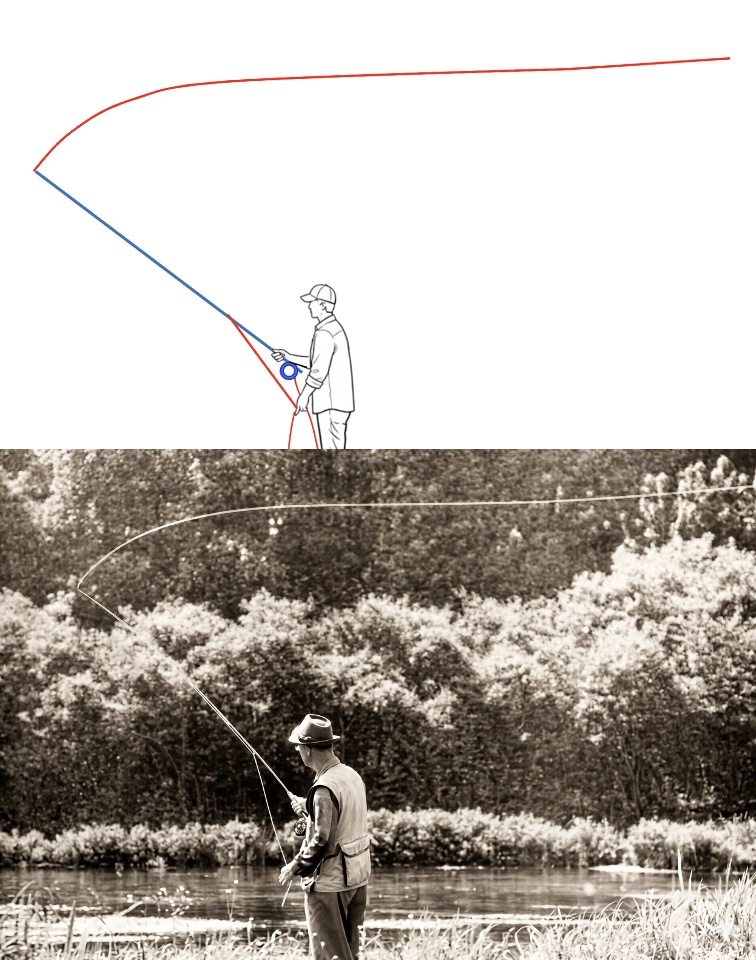
上記の (C) をイラスト化したものが以下です。
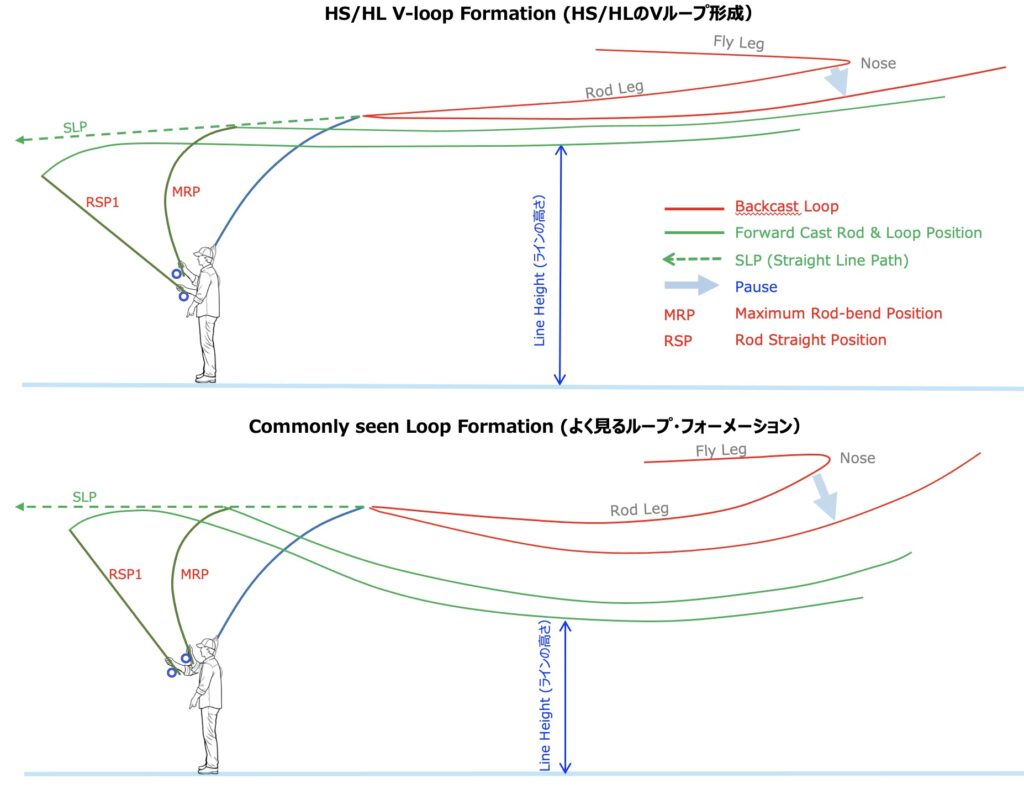
<図1-1>のイラストで表現しようとしていることは:
1: イラストの上段は、HS/HL投法によってループ先端の尖った「Vループ」を形成した状態。 一般的によく見る下段の投法に比べて、ロッドレグ(ループの底辺)が直線状であることを示しています。
2: それぞれのイラスト上でバックループの一番低い部分に青線を引くことで、HS/HLで形成したループが総じてハイライン(上空を飛行する)であることを示しています。
イラストの下段は、キャスターの技量に関わらず多くの方によく見かける、いわゆる良い形状(私は、リメリック形状と呼んでいます)のループです。決して悪い例として挙げているわけではありません。
但し、上述したHS/HLによる効果は期待しにくい、と言うことになります。
このイラストの上段のように直線状に伸びたバックループが得られれば、デリバリー(プレゼンテーション)に入る時に、ロッドはより効率よく大きく曲がり、よってラインの推進力とスピードは増し、もしロングキャストを狙うのであれば特出して有利。 取り分けトーナメントキャスターには必須のテクニックと言うことになります。
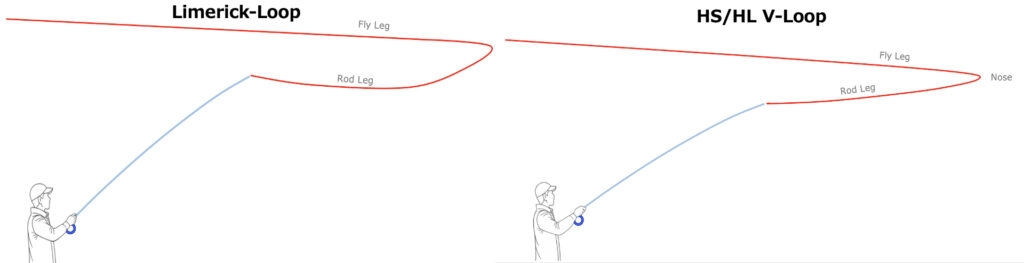
HS/HLでキャストされたVループは、なぜそのロッドレグ(ループの底辺)はより直線状になるのでしょうか?
フライキャスティングにおいては、フライレグ(ループの上辺)が推進力の主体を担い、ループ全体の挙動をほぼ制御するのですが、V形状のループは推進力とスピードが高く、リメリック形状のループ(図2)よりも、フライレグがロッドレグ(ループの底辺)を強く牽引しながら進もうとします。これによってロッドレグがタイトに引っ張られ、結果、直線状に近いロッドレグを生むことになる、と言うことです。
念のために補足しておきますと、HS/HLでキャストされたループはVループを形成しますが、逆にVループであればそのキャストはHS/HLであると言う訳ではありません。
2. HS/HLの3つのキー・エッセンス
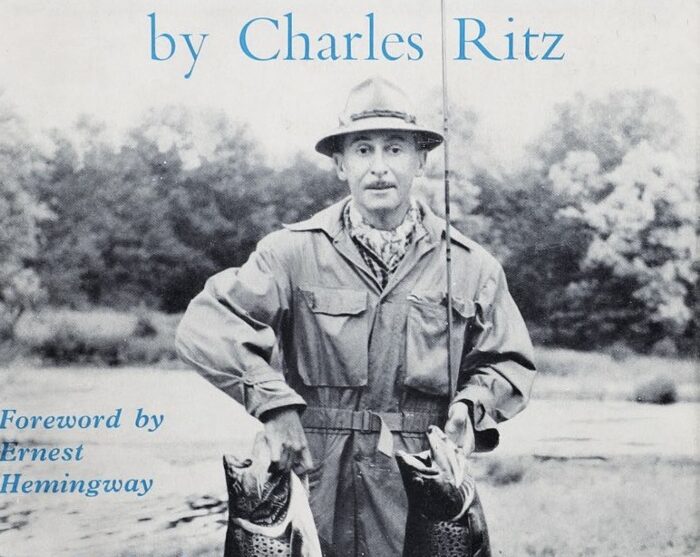
シャルル・リッツは、1960年のチューリッヒで開催されたキャスティング・トーナメントで見た伝説のキャスター、ジョン・タランティーノを目にしてHS/HLのインスピレーションを得たと言います。
その時に彼を覚醒させた「洞察」とは何であったのか?
おそらくリッツが目撃したのは、驚異的なラインスピードと力強い推進力を伴う「Vループ」であったはずです。
そして、これらを達成させる上でのリッツの気付きは、次の3点にあったと私は推察しています。
(1)上下に移動する可変回転軸。
(2)ストローク中におけるMRP(マキシマム・ロッドベンド・ポジション)のポジショニング。
(3)最高速度のラインスピードを生み出すためのグリッピング。
以上は、HS/HL投法のエッセンスそのものなのですが、これらの意味についてこれから深掘りしていきたいと思います。
理解を助けるキーワードは、ラインスピード:Velocity を最大限に高めるために何を考え、何をしたら良いか、と言うことになります。
2-1. まず、 (3)のグリップから
リッツのHS/HL投法には、もしかすると我々の日本人が古来から受け継いできた武術の心得が宿っているのかもしれません。
ちょっと、考えすぎかな?
でも事実シャルル・リッツは、澤田賢一郎さんにこのキャスト法を伝えた時に、いみじくも手の動きは「武術の動き」、と言う言葉を使ったそうです。日本人として不思議な縁を感じます。
日本では武道は中学校の必修科目ですが、皆さんは体育の授業で「剣道」は習いましたでしょうか?
私は、剣道を指導してくれた体育の先生のアドバイスを今でも思い出します。
「竹刀(しない)を持つ時の要は、にぎり(グリップ)にあり」、と。
私は、ツーハンド・キャスティングにおいて最高スピードを得るためのキーは、平安時代から1200年の歴史を経て熟成した「剣道グリップ」そのものにある、と言い切っていいと考えています。
「剣道グリップ」の握り方は以下のビデオを参考にしてください。ツーハンドロッドに適用されるグリッピングの説明は、これそのもので、他に補足する事項はありません。YouTubeはここをクリック。日本語字幕は画面上の設定モードから選べます。
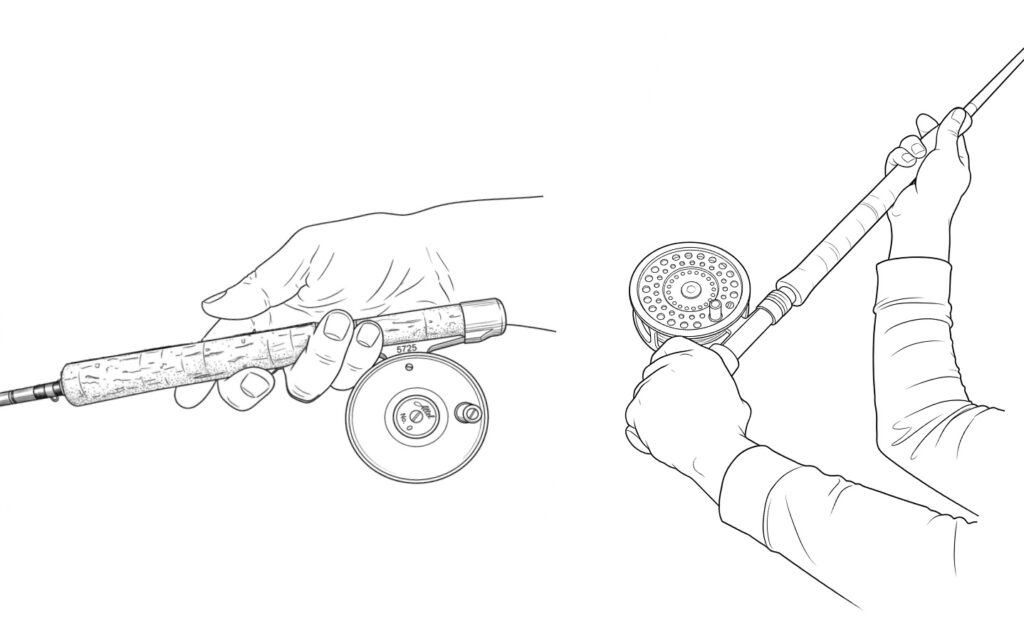
シングルハンドロッドのグリップ。 イラストは、これからバックキャストに入る直前の状態。 シングルハンド・キャスティングにも剣道グリップが適応されますが、細かく言うと、コルクハンドル上にVの字に親指と人差し指を乗せるときには、剣道グリップのポジションよりも少しだけ親指がロッドの真上に寄ります(セミ・サムオントップ・グリップ)。一方、バックキャストにおいては、親指は完璧に真上、完全なサムオントップになります。そうでないとバックループが飛行する時に最大スピードは得られません。
握りは小指と薬指だけで、あとの指はユルユルに浮かしているだけ。これがリッツスタイルのHS/HLグリップの基本です。このグリッピングを最大限に活かすことを狙ったのが、リッツスタイルと呼ばれるコルクハンドルのデザインです。リッツスタイルのコルクハンドルは、ロッドを握るのは小指と薬指が主体であることを前提に、この両指が握る部分のハンドル径を一番細くし、尚且つフライリールに隣接する位置に小指と薬指を持っていけることがミソ。キャスト中にリールの重さがカウンターウェイトになってスイングスピードを阻害しないようデザインされています。
ツーハンドロッドのグリップ。イラストは、「剣道グリップ」によるツーハンドロッドのグリップです。ボトムハンドの握りは小指と薬指に集中させて、あとの指は殆ど浮かしている状態です。トップハンドもボトムハンドと同様、小指と薬指が主体で残る指はユルユルの状態が基本ですが、ゆるく握るからと言ってストローク中にトップハンドが下方にスライドダウンさせないことが大事です。この握りが最もラインスピードが出るはずです。
何故、「剣道グリップ」がフライキャスティングの理想的なグリップであるのかと言うと、純粋にスポーツとして見た時に、剣道とフライキャスティングもその目指すべき二つの最重要課題が同じだからです。
- どちらも、剣先、あるいはロッドティップの移動が最高速になることを追求している。そして、
- どちらもストローク中に同一プレーン(平面)上を最高速で移動させることを狙う、がその理由です。
剣の刃は平らです。太く硬い竹のような物体を切る時には、切断面のプレーン(面)と剣の刃が通過するプレーンが完全平面で完全に一致していなくては、絶対にクリーンカットで一発では切り落とせません。
フライキャスティングもストローク中に、ティップからバットまで左右にブレずに同一面を通り抜けていかないとラインの推進力は得られません。
FFIでは、これを 「インプレーンのトラッキングの原則」、と言います。
「剣道グリップ」の要は、「パワーの源泉は “小指と薬指“、そしてパワーを入れた直後の“脱力” にあり」、と説きます。
多くのフライキャスティングの教書は、サムオントップ、Vグリップ、等々、いずれも親指にフォーカスした説明が多いですが、親指を強調するグリップにしてしまうと最高速のラインスピードは望みようがありません。
これは飽く迄も私個人の感覚ですが、シングルハンドロッド・キャストの時に指にかけるパワーの配分は、フォワードキャストでは小指+薬指が60%、親指は40%。バックキャストでは小指+薬指+中指+ヒール(肉球部)で100%です。
ツーハンドロッドのデリバリーキャストでは、トップハンドでは小指+薬指が80%、親指と人差し指がつくるV字部の付け根部が20%、ボトムハンドは小指と薬指が100%です。
- 力を加えた後の「脱力」の重要性
- 多くのトーナメントキャスターは、パワーを入れた直後の「脱力」の重要性を知っています。
「脱力」の大切さは、「ハンマーの釘叩き」をイメージすれば、直ぐに納得する人もいるのではないでしょうか?
5寸釘を板に打ち付けるとしましょう。ハンマーは恐らく、ハンマーの柄(え)を小指と薬指だけで握って、残りの指の握り加減はユルユルにした状態から、スパン!と打って、ヒットと同時に「脱力」する。すると、釘はグイッと木に深く入っていく。
ところが、もし5本指全部で全力で握り締めた状態で5寸釘を打って、脱力もしない、となったらどうですか?釘は深く入らないどころか、釘が真ん中で曲がってしまう、が関の山ですよね!
人間の手は、それ自体がテコの原理で動かせるように、恐ろしく機能的にできています。
小指と薬指で握る時には、小指と薬指が力点、親指が支点、ハンマーヘッドが作用点としてテコの原理が見事に活きるのです。
この体に備わった恵みを最大限に活用するのが、武術の心得です。
この原理は、ゴルフスイング、野球のバッティング、テニススイング、そしてフライキャスティングにおいても同じです。
因みに、フライキャスティングの場合 「脱力」には別の意味もあって、「脱力」することによって、ロッドのカウンターフレックス、バイブレーションを吸収して減衰させると言う大事な効果があります。これは見逃せないポイントではありますが、あくまで副次的な効果と言えます。
以上、ピン!ときた方は、この章の理解については卒業です。
- 2-2.次に(1)の可変回転軸と、(2)MRPの話を一緒に進めます。
MRPとは、「マキシマム・ロッドベンド・ポジションの略」で、ストローク中にロッドが最大限に曲がり、最大限にロッドにエネルギーが蓄積される位置、を指します。 MRPを意識してキャストするのは、ひじょうに大事なことです。
ここにおいても、理解を助けるキーワードは、スピード=velocity を最大限に高めるために何を考え、何をしたら良いか、と言うことになります。
まず、ムチの例を使って説明します。
フライラインに比べてかなりの質量を持つテーパードラインであるムチがその熟達者によって打たれる時、そのライン先端のターンオーバーのスピードはマッハ1(1225km/時)を越え、弾ける時のパンッと言う音はソニックブームの音と言われています。
これは究極のハイスピードと言えますが、そのムチの熟練者の投げ方がHS/HLのHS(ハイスピード)のエッセンスを捉えている、と言っていいと思います。
フライキャスティングの場合、ターンオーバーがムチのように強力過ぎると悪影響も考慮する必要があって、必要以上に高速でターンさせればリーダーが弾き切れてフライが吹っ飛ぶ可能性があります。しかし実際には、フライやリーダー、それにフライラインのフロントテーパーがスピードを緩和する役目を担います。それでもフライキャスティングでもターンオーバーする最後の瞬間は条件次第では160km/時を超え得ます。昔、私がトーナメントキャスティングをやっていた時は、何度も自分のフライラインによるムチをくらい、しょっちゅうミミズ腫れを作っていました。
と言うことで、ムチはやめておいて、代わりにハンドタオルで実験してみましょう。
できたら75cm位の長さのハンドタオルを用意してみてください。
ハンドタオルの端っこを「剣道グリップ」で握って、パンっ!と言う破裂音が出るように 「タオルムチ打ち」にチャレンジしてみてください。
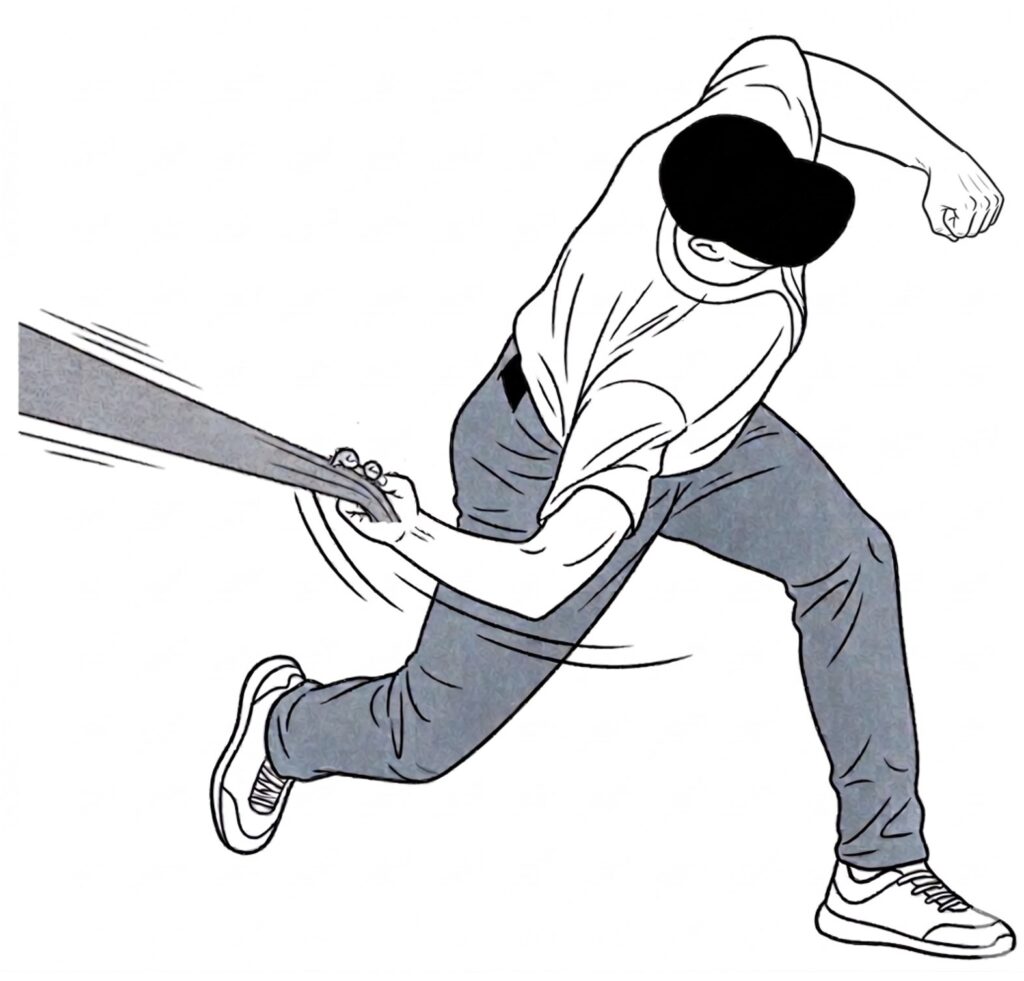
ふーん、なるほど。 最高の破裂音は出ましたか? その調子!
それでは、今度は、
- 肩の付け根だけを回転軸にして、あとは腕のどの部分も曲げないように、「タオルムチ打ち」をしてみてください。
- 次に、肘だけを回転軸にして、あとは腕のどの部分も曲げないように、「タオルムチ打ち」をしてみてください。
- 最後に、手首だけを回転軸にして、あとは腕のどの部分も曲げないように、「タオルムチ打ち」をしてみてください。
ご想像通りだと思いますが、回転軸は(A) (B) (C)のどこか一点だけを基点にしても、全然、スピードが出ないですよね?全ての回転軸たる支点が有機的に連携し合わなくてはスピードは出ない。
実際は、これに加えてムチ使いは、更に(D)指による回転と、(E)下半身からの回転が加わります。
実は上記の説明では、スピードが出て、キレのいい破裂音を出すためのキモのワザが、まだ語られていません。
それでは、その核心に進みたいと思います。
<図4>は日本が誇る、世界的に有名な野球選手の投球フォームです。
このピッチャーが誰とは言いませんが、おそらくこの人からフォームから学ぶのなら、文句のある人はいないと思います!
このピッチャーの下のイラストは、HS/HLによる私のロングキャストのフォームです。この記事を読んでおられるなら文句ない、ですよね(笑)!?
因みにこのイラストは自分のビデオ動画から起こしたものです。ラインは、SA社のExpert Distance WF5F、追い風2.0m/秒で40M飛んだキャストです。ここをクリックすると、動画で見られます。
この投球フォームを、フライキャスティングに照らしながら、キーポイントを順を追って解説して行きたいと思います。
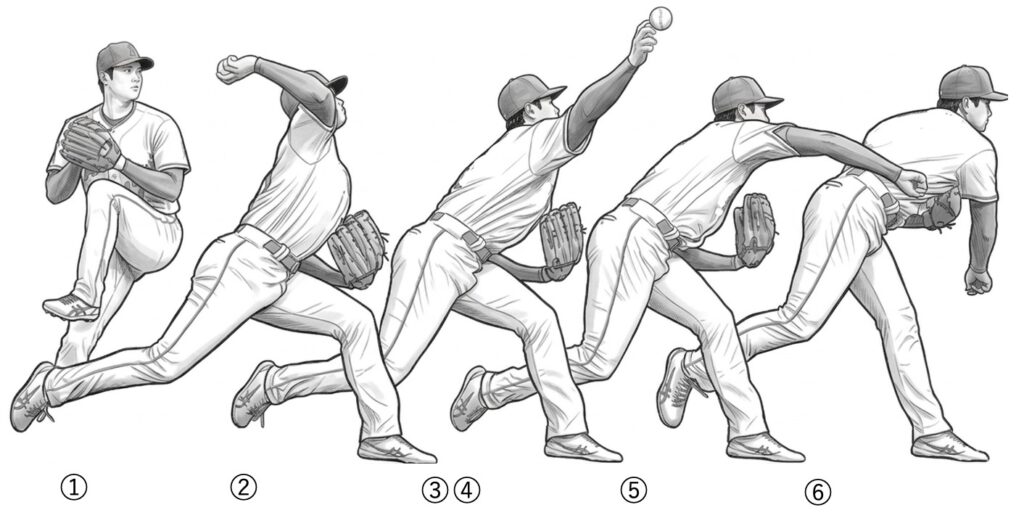
- ① キーポジション:
ここからストロークに入る状態。上半身はオープンに開き、パワーチャージはこの時点で既に始まっています。
- ② トランスレーション(並進運動):
肘と下半身がストロークをリードしながら、前腕を引きずるような腕の角度を保ちながら並進前進。
- ③ ④ ローテーション(回転運動):
肘が限界まで前に出たら、軸足を左足に移行させながら、主に肘を中心に前腕回転運動し始める。その時、リストと指は全開に開いている(コックとも言います)ことが鉄則。
- ⑤ パワースナップ(クイックローテーション):
ローテーションの終盤近くで、後方に開いたリストと指を、一気に、パワースナップでベンドダウンしてシュートする。
- ⑥ フォロースルー(ドリフト)、脱力:
パワースナップでリストと指をベンドダウンした直後、“脱力“します。
- ポーズ(静止):
ストロークが完了した状態で、ボール、フライラインとフライのターゲットへの入り方を見届ける。
上記の野球のピッチングとHS/HLによるロングキャストのフライキャスティングのフェーズ毎のフォームを見比べると、野球のピッチングとキャスティングの各フェーズのモーションが目指すところ(筋肉の使い方、体重移動)は、全く同じ言葉で説明できることがお分かりいただけると思います。
しかし、根本的に異なる部分があります。フライキャスティングの場合は、フライロッドと言うフレキシブルなデバイスを介してキャストすることから、これを最適化させる特有のモーション、⚫︎ロッドティップをできるだけ長い距離の直線上 (SLP) を通過させ、かつ、⚫︎ロッドに出来る限り大きなエネルギーをロードさせる、と言う大事なミッションを伴います。
順を追って見て行きたいと思います。
- では、HS/HLが他のキャスティングスタイルと比べて特異な点は?
上述のような30mを越えるようなキャストは渓流やフラッツでのキャストには現実的ではないので、今度は50フィート以下のプレゼンテーションキャストにHS/HLの説明を落とし込みたいと思います。
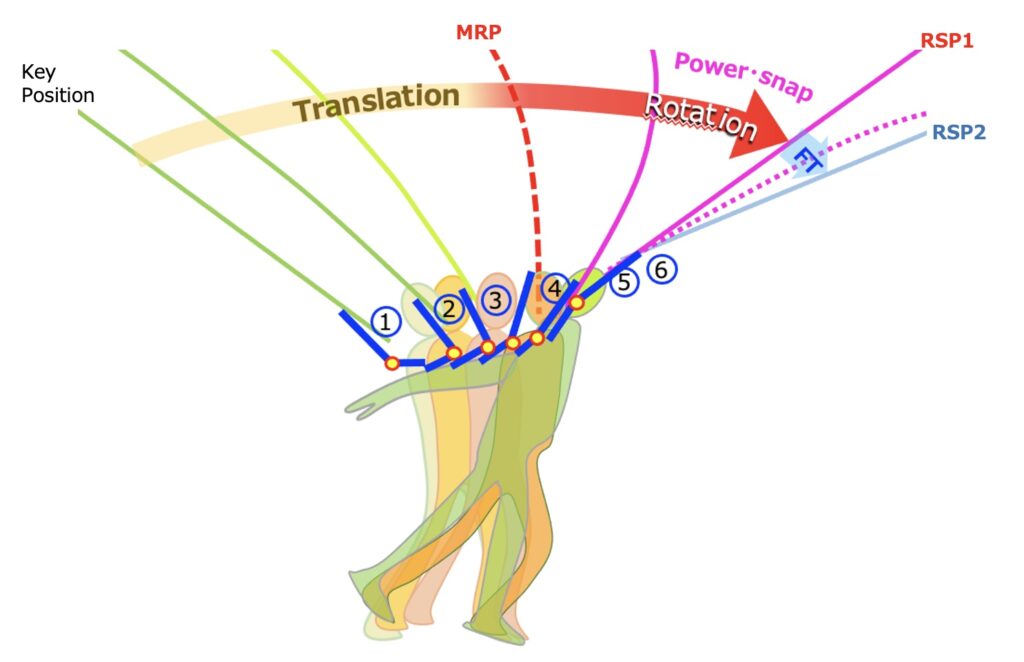
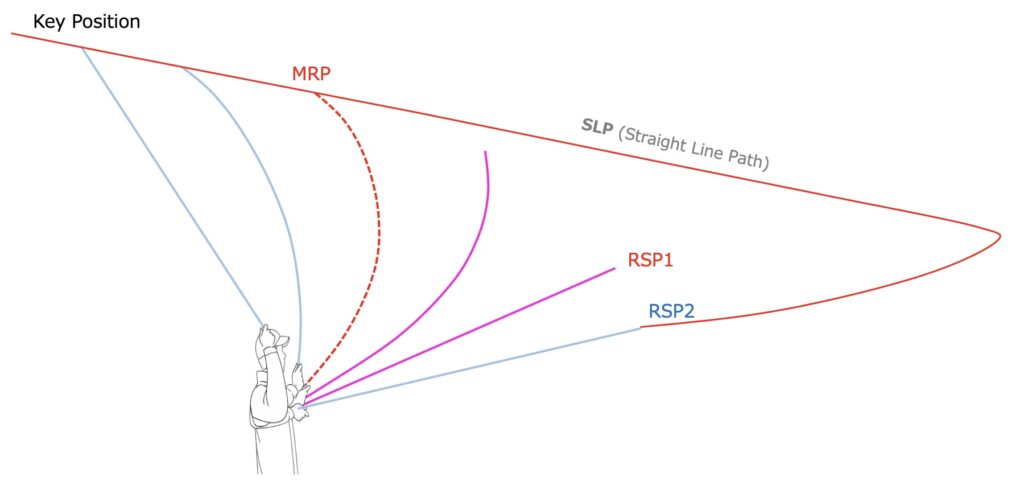
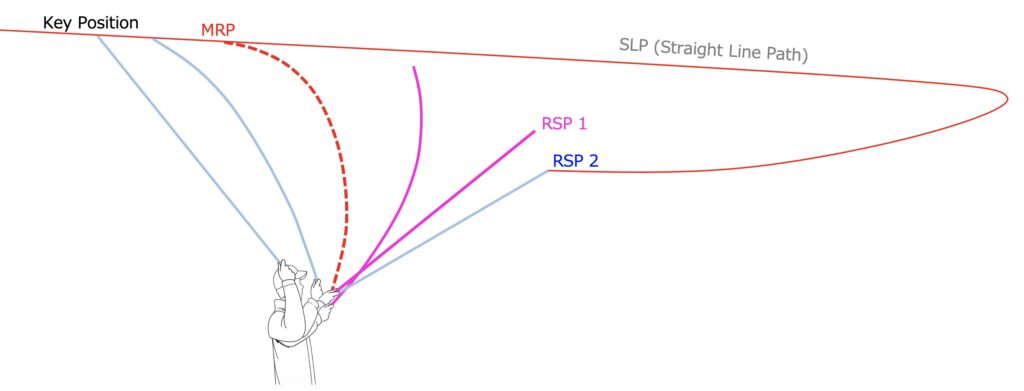
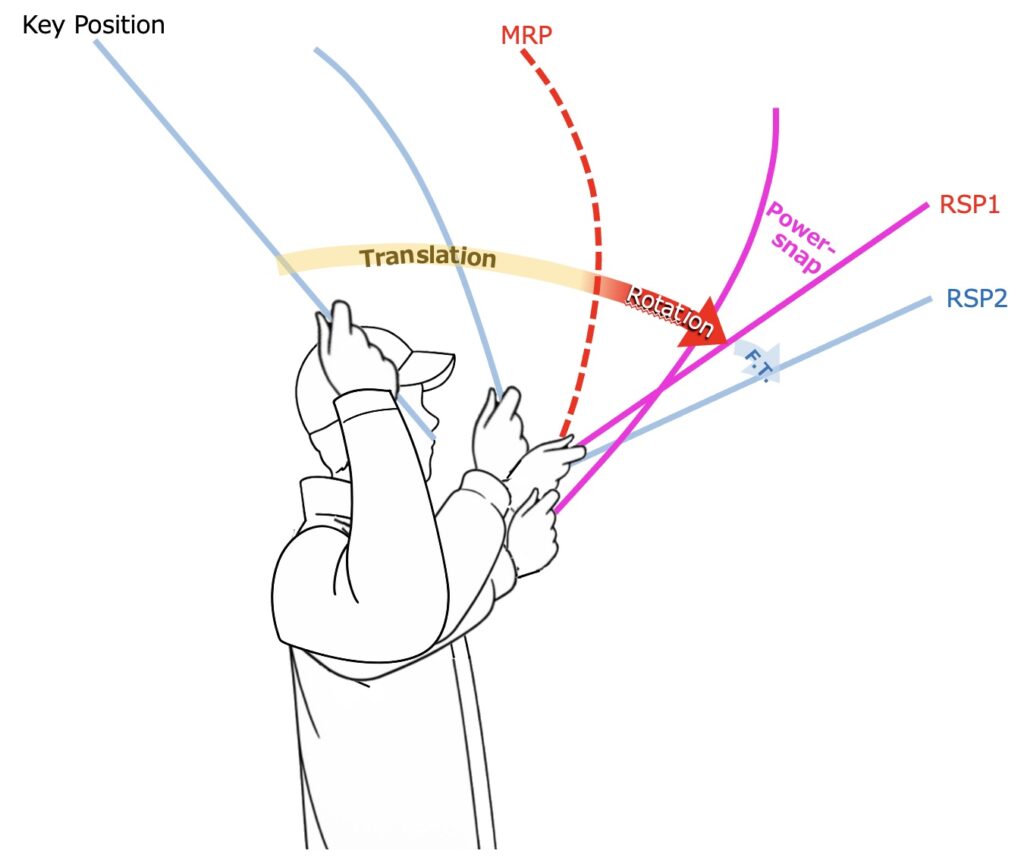
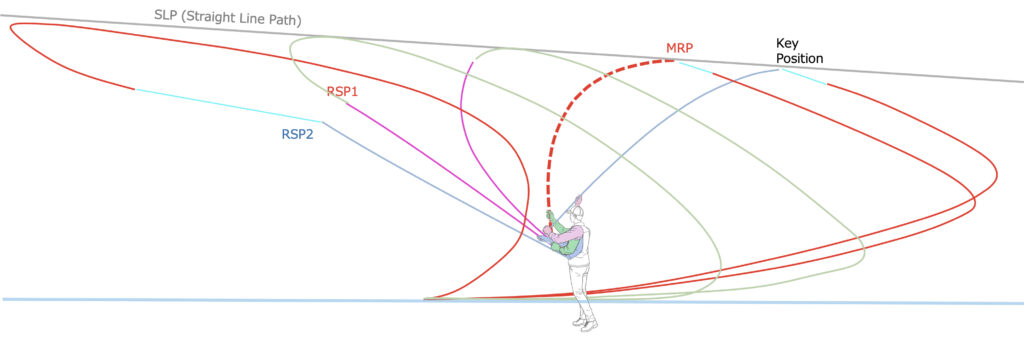
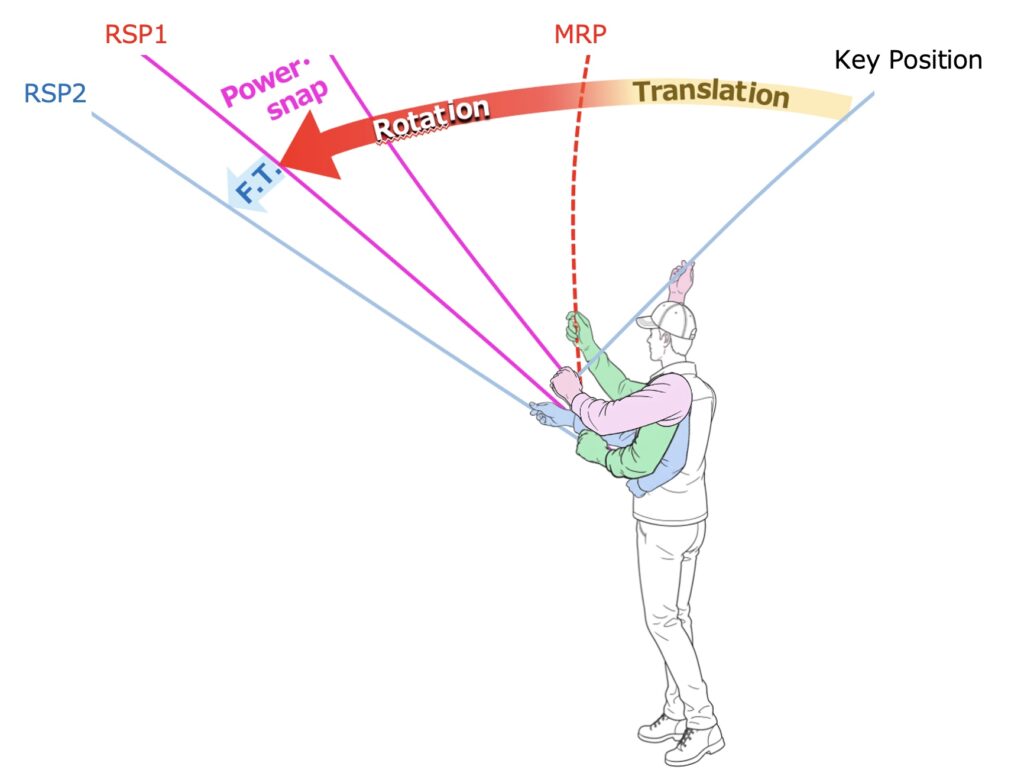
以下の<図6-1(ループフォーメーション)>と, これに対応するクローズアップ図<図6-2(ロッドハンドモーション)>をご覧下さい。
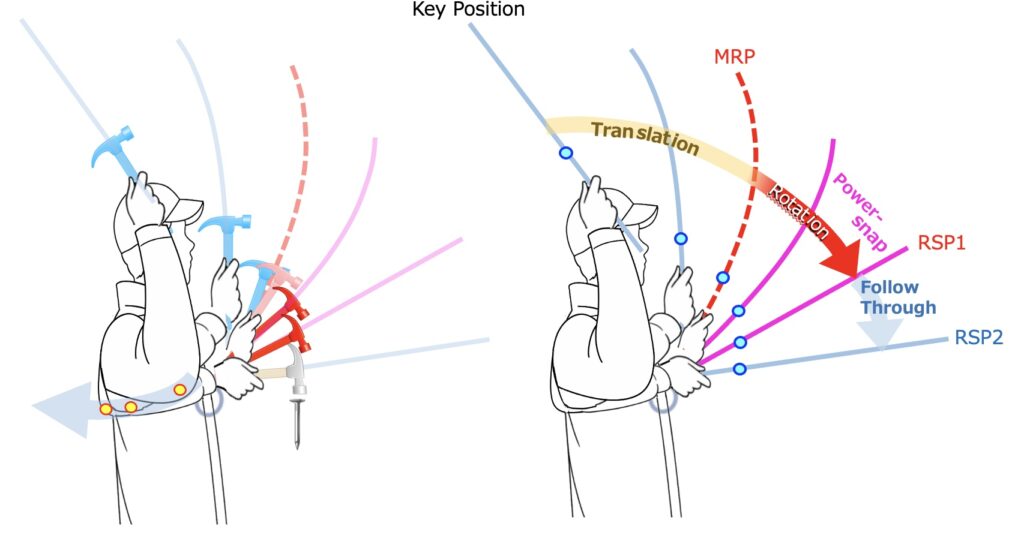
ハンマーと「エルボー・プル」のメカニズム:
ロッドのコルクハンドルの先端から15cmのロッド上に仮想のハンマーヘッドがあるとイメージしてください。RSP2の位置でクギは、お腹の前40cmにあるイメージです。ハンマーヘッドはかなりお腹に近いと感じるはずです。
黄色点が肘の頂点の位置です。
① キーポジション:ストロークの開始時点。この時点で既にロッドはローディングし始めています。
② トランスレーション (青ハンマーの軌跡): キーポジションから、MRPまでロッドのバット部で地面を突き刺すイメージでロッドをほぼ真下に引き降ろします。この過程では、できるだけロッドの角度を保つためにストロークが進むほどに、リストはより開く(コックする)ことになります。そして、このトランスレーションの間に、ロッドをMRP (マキシマム・ロッドベンド・ポジション)まで持っていってしまいます。
③ ローテーション: MRPを過ぎてローテーションのフェーズに入ると、ロッドティップの軌道はSLP (ストレートラインパス) を外れて更に加速していきます(図6-1参照)。MRPでエネルギーがフルチャージされたロッドがアンベンド(復元)する過程で、ローテーションのスピードにロッドの反発力を加えてロッドティップはグングン加速していきます。
④-1 パワースナップ-1: ここがHS/HLにおいて最も大事な二つのポイントの内の一つ目。
ストロークの最後で、開いていたリストと親指を、手首を回転軸の基点にして、一気にベンドダウンしてパワースナップを掛けます。 イラストの中で赤のハンマーがクギをヒットさせるモーションがこのステージです。
テコの原理に当てはめると、ハンマーヘッドの位置が作用点、肘と手首の間の中間点が支点、肘が力点になります。
このモーションによってロッドティップはRSP1のポイントで最高速に達します。RSP1で「それまで蓄積したありったけのエネルギーを、一滴も残さずフライラインに向けて放出してしまえ!」、と言う覚悟、がここではひじょうに大事です。
④-2 パワースナップ-2: ここがHS/HLにおいて最も大事な二つのポイントの内のニつ目。
パワースナップの瞬間に「エルボー・プル(引き)」を入れます。この“肘の引き”の動作はRSP2まで続きます。
黄色点が肘の頂点の位置、後方に引いていることに注目してください。
この「エルボー・プル」を入れるモーションによって、ラインスピードをブーストさせる、いわばホールに近い効果を出します。ダブルホールをマスターした方ならお分かりと思いますが、ホールは15cmの引っ張りだけでもホールなしと比べたら次元の違うラインスピードを出せますよね?
これと同じことをロッドハンド(ロッドを持つ手)だけでやってしまうのがHS/HLです。勿論、パワースナップのタイミングで更にホールをシンクロさせれば、最高速のラインスピードを得ることになります。
⑤ フォロースルー(脱力とプレスダウン): RSP1に向けてパワースナップを掛けた後、直ちに脱力しますが、脱力後も続けてロッドが止まる(RSP2)までプレスダウン(押し込み)します。
⑥ ポーズ(静止):フォロースルーでカウンターフレックスによるロッドバイブレーションは吸収されているので、ポーズ中は正に、静止しているのみです。
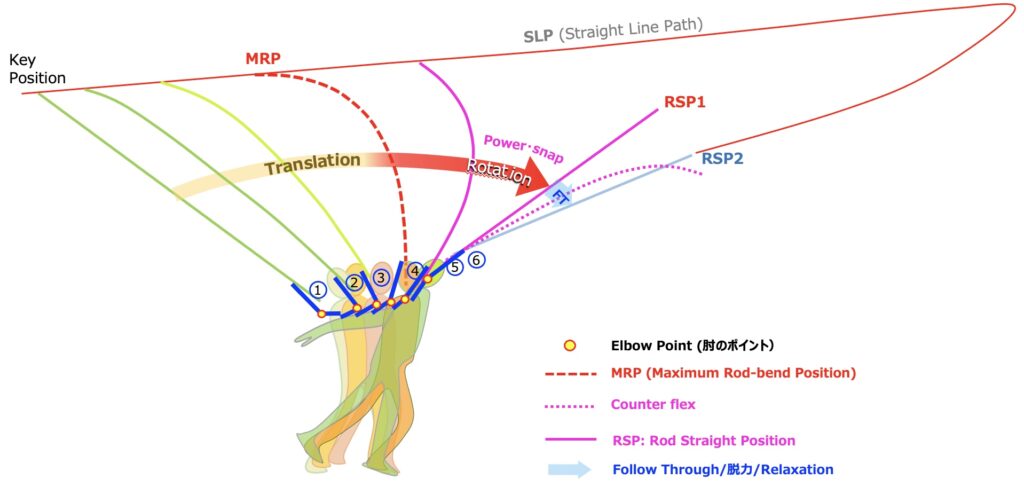
キャスティングにもし聖典があるとすれば、その最初のページに出てくるのが 「SLP (ストレートラインパス)の 原理」 と言う言葉です。これは、キャスティングストローク中、ラインを引っ張るロッドティップが直線上 (これをSLP:ストレートラインパスと言います) を進む時に最大のキャスト効率を得ることができる、と言うことを意味します。
このことからSLPは常に念頭においてキャストすることは極めて大事なことですが、正確に言うと、ストローク中にロッドティップは終始SLP上にあるのではなくて、あるタイミングでSLPを逸脱してロッドティップを降下させる必要があります。
さもなければラインは進行方向に展開して行く過程でロッドに衝突することになります。
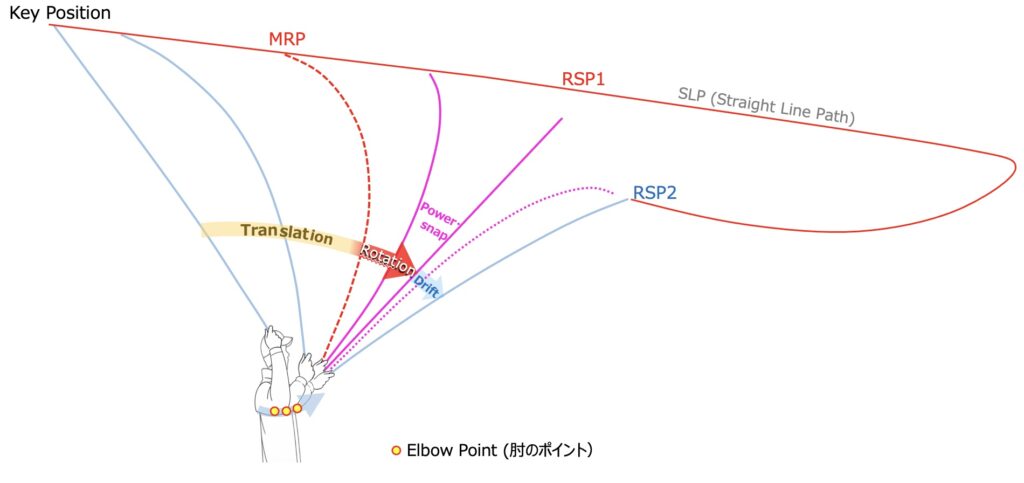
このようにループの通り道を作ってあげるために、意図的に、パワーオフの状態でロッドティップを下げる動作を「ドリフト」と言います(図7-1のRSP1からRSP2の部分)。
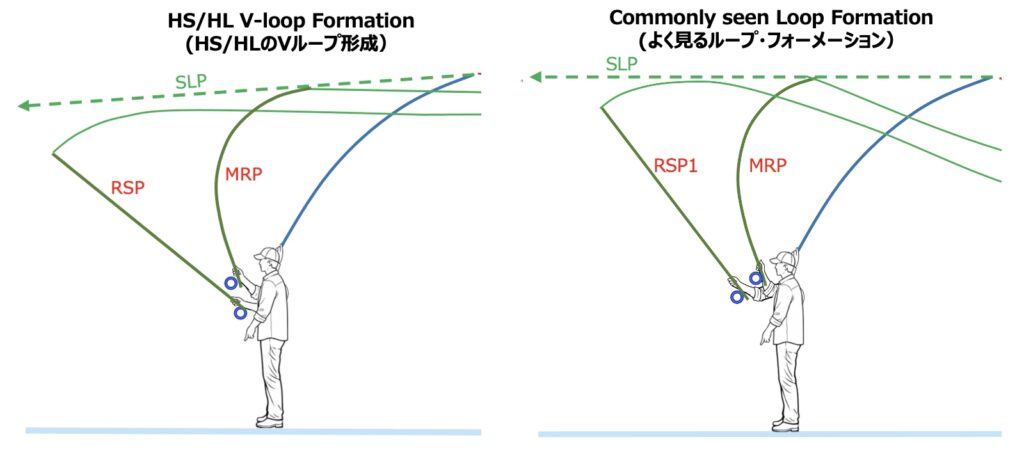
このドリフトによってロッドティップを降下させる方法を取るのが、一般的によく見られる、リメリック形状ループ<図7-1>を形成するキャストです。この一般的なキャスト法の場合は、ストローク中に肘のポイントがラインの進行方向に移動している点にも着目してください。
対して、HS/HLの場合<図7-2>、肘は後方に引き(エルボープル)ます。
以下の図はいずれもプレゼンテーション時のループフォーメーションをイラスト化しています。
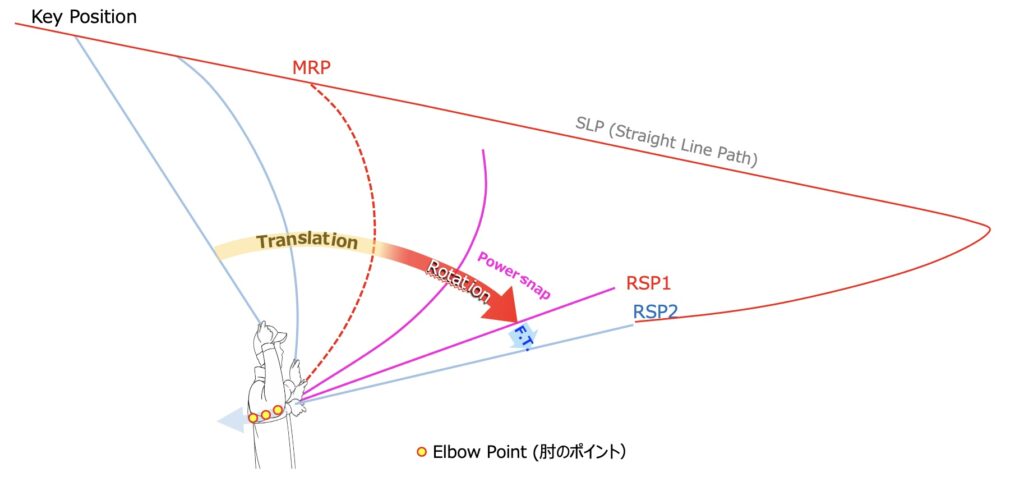
HS/HL<図7-2>では、SLP上を移動するのはストロークの始まる位置(キーポジション)からMRP (マキシマムロッドベンドポジション)までで、MRPを過ぎた後はパワーオン状態を維持したままRSP1 (ロッド・ストレート・ポジション1)に突入します。そしてRSP1に達すると一気に脱力し、それまで貯め込まれた全エネルギーが一気にフライラインに向けて放出されることになります。
上記の二つのイラストの対比で示しているように、パワーオンした状態でのロッドティップが辿る軌跡の道程がHS/HLの場合、<図7-1>に比べるとずっと長い、つまりより多くのエネルギーがロードされ、結果、より大きいエネルギーがフライラインに向けて放出されます。そして、ロッドレグ(ループの底辺)は、直線に近くなります。
これが推進力スピード=Mass Velocity がひじょうに高いVループが形成される理由です。
以上が、シャルル・リッツが1960年のジュネーヴでのキャスティング大会でジョンタランティーノを見て覚醒したポイント、HS/HLテクニックのHS(ハイスピード)の核心の部分、であったはずと私は考えています。
シャルル・リッツはループ幅の違いをナローループ、ワイドループと言う言葉では表現せず、オープンループ、クローズドループと呼んでいました。「Vループ」と言う表現そのものは使いませんでしたが、V形状はライン端に向けて末広がりの形状ですから、ラインエンドに向けて広がっているループをオープンループ、閉じているものをクローズドループと呼ぶのは合点がいくところです。<図8>
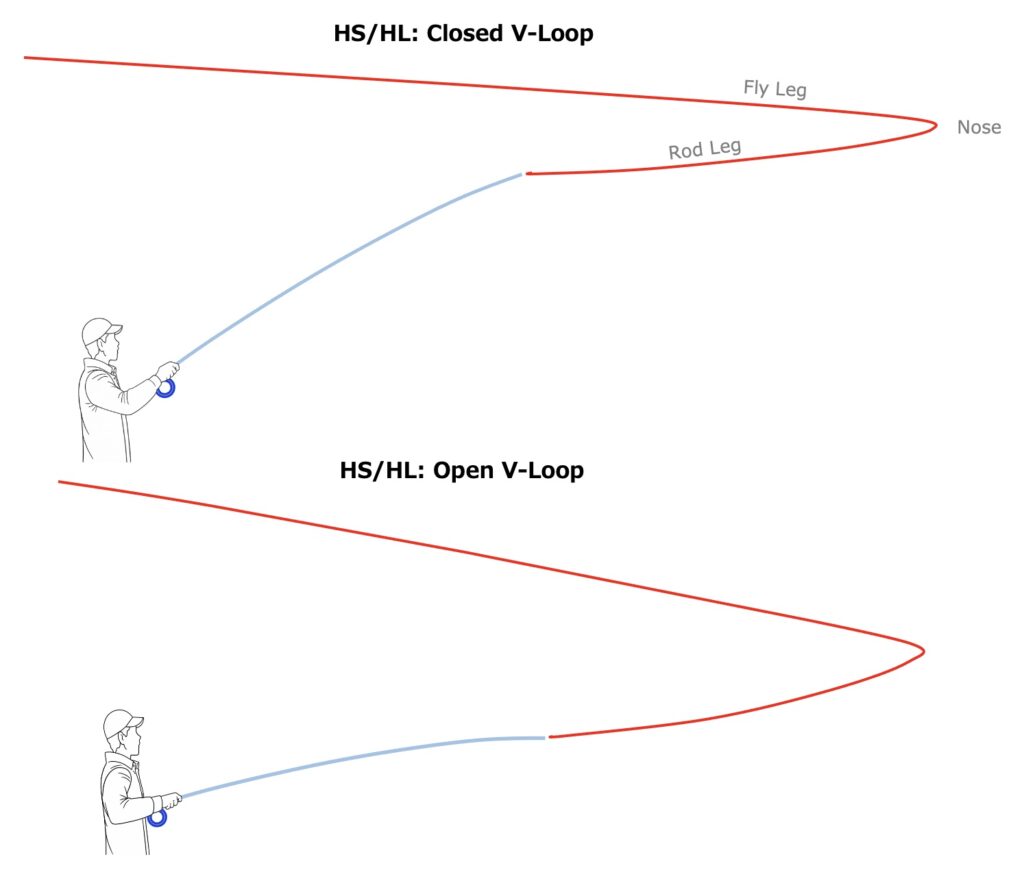
通常、リメリック形状のループ(フライレグとロッドレグが平行のループ)の場合、ループ幅の狭いナローループがキャスト効率が高い形状ですが、HS/HLがVループを作る場合、オープンVループでもクローズドVループでも、推進力スピード(Mass Velocity)は殆ど変わりません。
トーナメントキャスターは、通常、キャスティング・アークを最大限に取る(広げる)キャストをします。 一般的に「アークが広いとワイドループになり、飛距離を妨げる」と言われがちですが、この説明は必ずしも正確ではありません。
正確に言えば、アークがどれほど広くても、ストローク中にロッドティップが直線軌道(SLP)を維持さえすれば、ナローループを形成することができます。
HS/HLキャスティングにおいて、ティップは「キーポジション」から「MRP」に至るまで、このSLPを辿ります。
しかし、特筆すべきはその先です。MRPを過ぎた瞬間、ティップは「パワーオン」の状態を維持したまま、あえて力強く、意図的にその直線軌道から逸脱していくのです<図7-2>。
これにより、広いアークを使いながらも、ロングキャストに不可欠なラインの推進力を維持することが可能になります。シングルハンドかツーハンドかを問わず、これはトーナメントキャスターにとって不可欠なテクニックです。
そして何より、このコンセプトは我々が普段楽しんでいる日常のフライフィッシングに応用でき、そのパフォーマンスをさらなる高みへと引き上げてくれるものなのです。
更に加えると、HS/HLの場合、RSP1のポイントでキャスト方向への全慣性エネルギーがフライラインに対して効率よく放出され、おまけにカウンターフレックス(推進力を阻害するロッドがバウンスする状態)が少ないキャスト法と言えます。
- 2-3, HS/HL、シングルハンド フォルスキャストの場合、ツーハンドロッドの場合は、どうでしょうか?
これまでのところ、HS/HLのキャスティングストロークを、デリバリー(プレゼンテーション)でのみ説明してきましたが、オーバーヘッキャストにおけるフォルキャストの場合と、ツーハンドロッドのデリバリー(プレゼンテーション)ではどうなるのかを、以下、イラストで明らかにしたいと思います。
⚫︎HS/HLのオーバーヘッドキャストのフォルスキャストの場合
<図6>で示したプレゼンテーションキャストと基本的に同じですが、各フェーズのタイミングが異なるだけで、プレゼンテーションキャストの時に比べて、狭いキャスティングアークの中で上述のHS/HLのモーションを凝縮させることになります。
(注:下記のイラストでは、実はかなり上級のテクニックを一つモーションに加えて表しています。MRPからRSP1に向かうパワースナップに向かう時に、スナップを掛けながらロッドハンドを上に向けてスライドさせています。これにより、よりタイトなクローズドVループ(ナローループ)を生成することができます。)
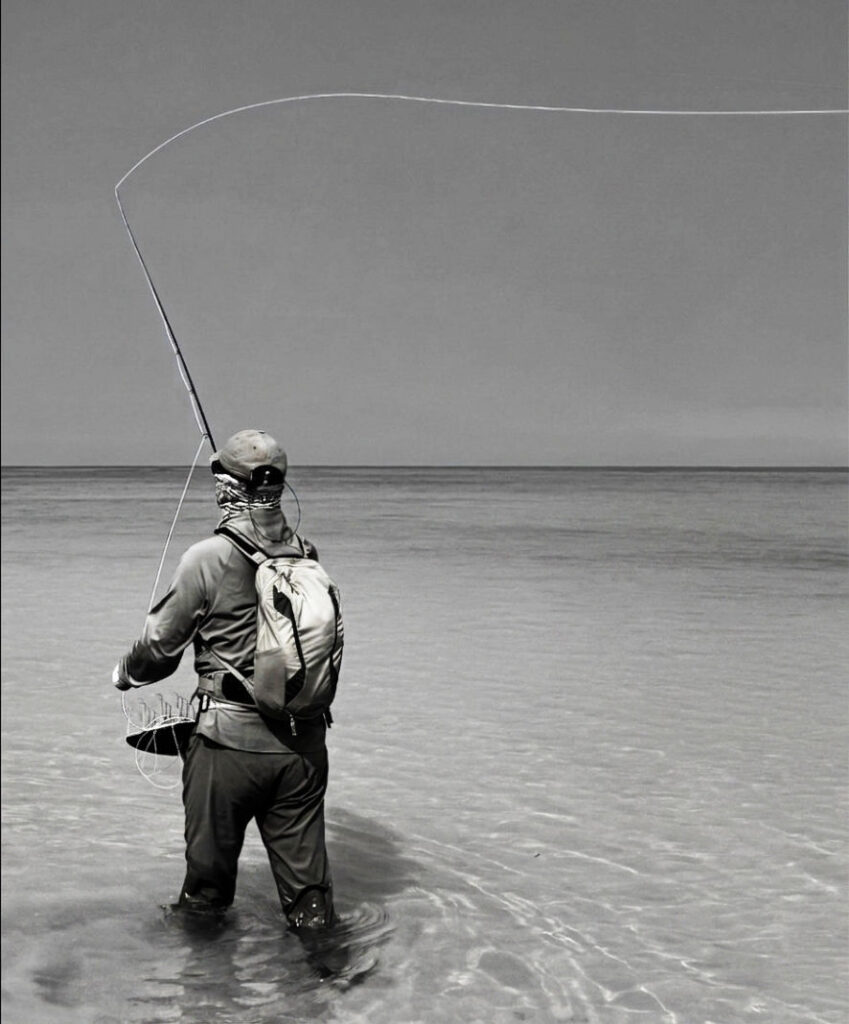
HS/HLのRSP1時点でのフォルスキャストのラインフォーメーション。私とシャルル・リッツの同ポジションの比較。どちらもハイラインで、ロッドのカウンターフレックスのない状態に注目。
ツーハンド、HS/HLスペイキャスティングの場合
ツーハンドロッドでのスペイキャスティングのデリバリー(シューティング)も同じです。ツーハンドロッドを使ってトラディシャル・スペイキャスティングのモーションを描いたのが以下のイラストです。
ツーハンドの場合は、テコの原理で言うと、グリップの15cm先にハンマーヘッドがあると仮定してこの位置が作用点、ボトムハンドを力点、支点をトップハンドから10cm下に設定することになります。
上述のシングルハンドのオーバーヘッドキャストでの「エルボー・ブル」に相当するモーションは、「ボトムハンドの引き」に取って代わります。
スカンジナビアン・アンダーハンドキャスト(スカンジライン、スカジットライン用に多用されるキャスト)の場合は、フライラインはより短く、重い (スカジットラインの場合)のでイラストほどDループを張らせずに、デリバリーストロークをコンパクトに凝縮したモーションになりますが、コンセプトはHS/HLそのものと言っていいと思います。
<図10-1(HS/HLツーハンド・ロッド、ループフォーメーション)>
3.さて、ここで、もう一回、本稿の冒頭で示したイラスト<図1-1>を見てみましょう。
上記の図の中で、キャスターの部分を少しクローズアップ<図1-2>してみますね。
じっくり見てみてください。
図1-2の右のイラストは、一般的によく見るキャストモーションで、このキャスト法が悪いと言っている訳ではありませんが、よく見る例として注目いただきたいのは、ローテーションフェーズで回転軸は、肘の一箇所の位置に固定されている、あるいは肘の位置がストロークと共に前進する例です。
対して、同図の左のHS/HLでは、回転軸が上下に移動する可変回転軸であることがわかりますでしょうか?
加えて、HS/HLでは、エルボー・プルを入れています。
この違いだけで、ラインスピードは、かなり変わってきます。
更に、もう一つ視点を加えると、この図では引っ張られているバックループがHS/HLの場合は、地面とほぼ平行です。
対して右のイラストの場合は、ループが地面に向かっています。(HS/HLによるハイバックキャストのキャスト法については、今回は触れていませんが。)
この状態から次に続くフォワードループは、バックループと180度の関係で展開しようとします。
これをFFIでは、180度の原理と言います。つまりイラストの右ですと、ループは上空に向かい、HS/HLの左は、地面と平行に向かう傾向が出ます。
通常のキャスティング距離においては、このHS/HLのハイループのバックキャストからデリバリーされるラインの方が、ロッドも曲がり易く、つまりロッドにローディングされるエネルギー量が大きく、極めて効率的で推進力スピードの高いループフォーメーションが期待できます。
但し、50フィートを越えるような長さのフライラインでフォルスキャストする場合は、HS/HLと言えどもバックループは地面を向き始めますが、ハイライン度は一般的なキャストと比較する時には高いこととなります。特にロングキャストには、必須のテクニックと言うわけです。
4. そして、最後にもう一回、「タオルムチ打ち」に戻ってみましょう。
冒頭で述べたタオルムチの例を思い返してください。回転軸が肘の一箇所に固定された場合のタオルムチ打ちと同じ事象のモーションなので、結果、パンッと言ういい破裂音が出ない、想像以上にラインスピードが出ていないストローク、が右の例<図1-2>、と言うことになります。
タオルを剣道グリップで握ってぶら下げたら、タオルを握る拳の先端から15cmのタオル上にハンマーヘッドがある、と言うイメージでパワースナップを掛けてみてください。
拳をSLP上を急加速させて、パワースナップを掛ける瞬間、肘は斜め後方に「エルボープル=肘の引き」を入れます。
どうでしょう?これをやるとタオルのスピードがブーストして、パンッという最高の破裂音が出ませんか?
成功したら、この章のエルボープルの意味は納得していただけたことと思います。
同じことをキャスティングでも実践するのがHS/HLと言うわけです。
本日は、ここまでです。 お疲れ様でした!
Tight lines and great casting!
Part 1では、シャルル・リッツがパラボリックアクションのロッド、そしてHS/HLテクニックに辿り着くまでの軌跡を辿りました。
このPart 2では、上級者向けの内容ではありましたが、彼のメソッドの柱の一つである「HS(ハイ・スピード)」の側面に焦点を当ててきました。
今回は、HS/HLのもう一つの重要な柱である「HL(ハイ・ライン)」の要素についてはあえて触れていません。これを十分に説明するには、バックキャストで直線的なロッドレグを作るための具体的な技術や、高軌道のVループを実現するためのリッツ独自のバックキャスト時のグリップ法、そして彼独自の「ドリフト」の解釈について深く掘り下げる必要があるからです。
さて、ここまでの内容を振り返って、私のHS/HLに対する見解を皆さんはどう感じられたでしょうか。
長年、世界各国のキャスターを観察してきて感じているのは、少なくとも実釣の場において、シングルハンドのオーバーヘッドキャストでHS/HLを使いこなしている人は滅多に見かけないということです。
対照的に、上級のスぺイキャスターの間では、「ボトムハンドの引き」や「垂直に移動する可変回転軸」と言った動作は、パラボリック・アクションのロッドでスペイキャスティングを成立させる上で不可欠な要素となっています。結果として、優れたスぺイキャスターの多くは、必然的にHS/HLに近い動きに辿り着いている、そんな強い印象を私は持っています。
今日、「HS/HLはもはや独立した『スタイル』ではなく、現代のフライキャスティングの『本質的な基礎(サブスタンス)』の中に既に吸収されている」と主張する人も多くいます。それも確かに一つの考え方の立ち位置だと思います。
しかし、私はHS/HLとは、その独特な特性を意識的に追求しない限り、なかなか手中に収めることのできないスキルであると信じています。その独自性に目をつむってしまえば、この「宝物」は知らぬ間に私たちの前を通り過ぎてしまうかもしれません。
現代の最前線に立つエリートキャスターたちは、一つのループ形状に固執しません。彼らは時・場所・目的(TPO)に応じて、Vループ、リメリック・ループ、アンダースラング・ループを巧みに使い分けます。この多様性をマスターすることこそが、カーブ、スラック、タックキャストといったトリックキャストの精度を劇的に高めるのです。
同じような進化はスぺイキャスティングでも起きています。HS/HLを根本的なベースとしつつも、使用するラインや対象魚に合わせて技術を適応させる時代に入っています。今日のトップキャスターたちは、トラディショナル・スぺイ・キャスティング(フルスペイライン、スカンジ・シューティングヘッド向け)、スカンジナビアン・アンダーハンド・キャスティング(スカンジやスカジット・シューティングヘッド向け)、さらにはシングルハンド・スぺイ・キャスティングを、その瞬間に最適な道具と技術を選びながらシームレスに使い分けています。
それはまるで、ゴルファーがバッグの中の14本のクラブから最適な一本を選び、状況に応じてスライス、フェード、スピンをコントロールしたショットを打ち分けるのと似ています。
このようにキャスティングを細分化して論じることは、スポーツとしてのフライフィッシングを過度に複雑にし、キャスティングや釣りの楽しさを削いでしまうという批判もあるかもしれません。特に初心者の方にとって、技術的な要求を含む「入門の壁」が高すぎることは、始める前に二の足を踏ませる要因になりかねません。
現在、日本には90名のFFI公認インストラクター(CI)がおり、その多くが皆さんの力になりたいと考えています。
その中には専門的な有料レッスンを行う方もいれば、ボランティアとして活動する方もいます。
FFIのウェブサイトには、お近くのCIを探せる「Find a Certified Casting Instructor」のページがあります。そこを通じてメンターや仲間を見つけることは、素晴らしい選択肢の一つです。また、各地で練習会を運営しているグループも多くあります。もしキャスティングに行き詰まりを感じたら、こうした練習会こそが問題解決の最大のチャンスとなるはずです。
今回のタイトル「HS/HLの真実:To V, or Not to V, That’s the Question, Vであるのか、ないのか、それが問題だ」は、私が50年間研究し続けてきたこのテクニックの核心を、言葉で表現するという私自身の挑戦でもありました。
私のモチベーションは、この傑出したキャスティング法の輝きを、もう一度フライフィッシング界の表舞台に引き戻したいという野心に他なりません。
お付き合いいただきまして、ありがとうございました。
Written and Art by Hiro Masaki. All rights reserved.
HS/HL Revealed : To V, or Not to V, That Is the Question – Part 2
Written and Art by Hiro Masaki
In this article Part 1, we traced Charles Ritz’s journey toward the development of parabolic action and his HS/HL (High Speed / High Line) technique. In this second installment, we will delve into the “inner workings” of HS/HL.
Please note that this discussion is intended for advanced fly casters. (For those currently pursuing FFI Casting Instructor certification, I recommend staying focused on your current training menu before exploring these specialized concepts.)
Charles Ritz explains HS/HL in detail in his book A Fly Fisher’s Life. However, as with many casting styles, fly casting is not something one can fully master simply by reading text.
Fortunately, after Ritz’s time, FFI (Fly Fishers International) has made significant contributions in developing more systematic and rational ways to analyze and teach fly casting. In this article, I will use these modern FFI methods to reveal the inner workings of the HS/HL technique.
While I have remained faithful to the core principles laid out in Charles Ritz’s own writings, I have also incorporated many of my own insights gained through years of experience. I like to think that Ritz himself would wholeheartedly endorse these perspectives.
For example, Ritz never described HS/HL as “a casting method that forms a V-loop.”
However, I personally consider the V-loop to be inseparable from HS/HL, two sides of the same coin.
For me, it comes down to this:
“To V, or not to V, that is the question.”
Let’s get started.
(Note: The technical terminology used in this article adheres to official FFI definitions. If you encounter any unfamiliar terms, I encourage you to consult “Castapedia,” the comprehensive fly casting glossary.)
1. The Advantages of HS/HL
Before we dive into the technical mechanics, it is essential to define exactly what the “advantages” of the HS/HL technique are. Why should a caster strive for it?
- It boosts line velocity. This also means it is advantageous for long-distance casting.
- It enhances the propulsive force. This means the loop is more resistant to headwinds and has greater payload-carrying capability.
- The increased linearity of both the fly and rod legs allows for a consistently higher line path.
The illustration in below visualizes point (C), the linearity of the high line.
The key points I am trying to illustrate in <Fig. 1-1> are:
- The upper Image illustrates a “V-loop” with its characteristic pointed nose, formed using the HS/HL technique. Note how the rod leg (the bottom section of the loop) remains straight and linear compared to the commonly seen loop shape shown in the lower image.
- The blue lines marking the lowest points of the back loops illustrate how HS/HL technique consistently generates high lines, keeping the loop high in the air.”.
In the upper part of the illustration, the HS/HL back cast forms a pointed loop shape, a so-called V-loop.
In contrast, the lower part shows a loop shape commonly seen among many casters, regardless of skill level, the familiar “good-looking” loop (I named it the “Limerick-shape loop,” inspired by the shape of a Limerick fly hook.).
This is not presented as a poor example.
However, it is less likely to exhibit the specific advantages described above for HS/HL.
If, as shown in the upper illustration, one can transition into the delivery (presentation) from a straightened back loop, the rod will bend more efficiently and more deeply.
As a result, line momentum and speed (mass velocity) increase.
For those aiming at long-distance casting, this provides a clear advantage—and for tournament casters, it can be considered an essential technique.
Why does the V-loop created by HS/HL result in a more linear rod leg?
In fly casting, the fly leg (the upper part of the loop) is the primary driver of momentum and largely dictates the behavior of the entire loop. Because a V-shaped loop possesses higher mass velocity than a commonly seen Limerick-shaped loop (Fig. 2), the fly leg pulls the rod leg forward with much greater force. This intense tension stretches the rod leg tight, resulting in its remarkably straight, linear profile.
For clarity, I should add:
While HS/HL casting produces a V-loop, the reverse is not necessarily true.
2. Three Key Essences of HS/HL
Charles Ritz is said to have gained his inspiration for HS/HL after watching the legendary caster Jon Tarantino at a casting tournament held in Zurich in 1960.
What was the “insight” that awakened him at that moment?
Most likely, what Ritz witnessed was a V-loop with extraordinary line speed and powerful forward drive.
From that observation, I believe Ritz recognized three key elements:
- A variable rotation axis that shifts up and down.
- The positioning of the MRP (Maximum Rod-bend Position) within the casting stroke
- The gripping method required to generate maximum line speed
These elements represent the very essence of the HS/HL technique, and I would now like to explore them in more depth.
To better understand these concepts, the key question is: What should I think and do to maximize line velocity?
2-1. Let’s Start with the Grip
Interestingly, Ritz’s HS/HL technique may share a connection with the principles of traditional Japanese martial arts.
Perhaps I am overthinking it.
But when Charles Ritz taught this method to Ken Sawada, he reportedly described the hand movement as being like a “martial arts movement.” As a Japanese person, I feel a strange sense of destiny in that connection.
In Japan, martial arts are a compulsory subject in junior high school. I learned Kendo (Japanese fencing) in gym class and an advice of my Kendo instructor still remains in my memory:
“The secret to wielding the Katana (Japanese Samurai sword) lies entirely in the grip.“
I would go as far as to say that the key to achieving maximum speed in two-handed fly casting is identical to the “Kendo Grip,” a technique refined over 1,200 years since the Heian period. For a visual reference on how to hold the rod, please see the video below. This is exactly how the grip should be applied to a two-handed rod—no further explanation is needed. (Click to watch on YouTube here. (Subtitles available in settings).
Single-Hand Rod Grip: The illustration shows the position just before the start of the backcast. The Kendo-grip principle applies to single-handed casting as well. To be precise, when placing the thumb and index finger in a “V” shape on the cork, the thumb sits slightly closer to the top of the rod than in a standard Kendo grip (a Semi-Thumb-on-Top grip). However, during the backcast, the thumb must be perfectly on top. Without this “Thumb-on-Top” position, you simply cannot achieve maximum speed as the back loop takes flight.
The rod is secured primarily by the pinkie and ring fingers, while the other fingers remain relaxed, almost floating off the cork.This is the fundamental grip in Ritz-style HS/HL. The cork handle design known as the Ritz style was developed specifically to maximize the effectiveness of this grip. In a Ritz-style handle, the rod is intended to be controlled mainly by the pinkie and ring fingers. The essence of the Ritz-style cork grip is that it is designed on the premise that the pinky and ring fingers do most of the gripping. The handle diameter is thinnest where these two fingers hold it, allowing them to be positioned right next to the fly reel. This design ensures that the weight of the reel does not act as a counterweight during casting, which would otherwise slow down your swing speed.
Two-Hand Rod Grip: The illustration shows a two-hand rod grip based on the Kendo-grip. In the bottom hand, the grip is concentrated in the pinkie and ring fingers, while the other fingers remain mostly relaxed and off the handle. The top hand follows the same principle—the pinkie and ring fingers are primary, and the remaining fingers stay relaxed. However, it is important that the top hand does not slide downward during the casting stroke.This gripping method should produce the highest possible line speed.
Why is the Kendo-grip ideal for fly casting?
Because, when viewed purely as sports, kendo (Japanese fencing) and fly casting share the same two fundamental objectives:
- In both, the goal is to achieve maximum speed at the tip-whether it is the tip of the sword or the rod tip.
- In both, the motion aims to move at maximum speed along a single plane during the stroke.
The blade of a Katana (Japanese Samurai sword) is flat. When cutting something hard, like a thick piece of bamboo, the plane of the cut and the plane of the blade must be perfectly aligned. Otherwise, a clean cut in a single stroke is impossible.
Fly casting is no different. If the rod from ‘tip to butt’ does not travel within a single plane without lateral deviation, efficient line propulsion cannot be achieved.
In FFI terminology, this is referred to as the principle of in-plane tracking.
The essence of the Kendo-grip can be summarized as follows:
“The source of power lies in the pinkie and ring fingers, and in the immediate relaxation after applying force.”
While many fly casting manuals focus heavily on the thumb, emphasizing ‘Thumb-on-Top’ or the ‘V-grip’, relying too much on thumb pressure actually makes it impossible to achieve maximum line velocity.
This is my personal sense, but in single-hand casting, the distribution of power applied by the fingers is roughly: Forward cast: 60% pinkie + ring fingers, 40% thumb. Back cast: 100% distributed across pinkie, ring, middle finger, and the heel of the hand.
In a two-handed rod delivery cast, the top hand uses 80% pinky and ring finger and 20% the base of the V formed by the thumb and index finger, while the bottom hand is 100% pinky and ring finger.
Importance of Relaxation after applying force
Many tournament casters understand the importance of the Relaxation immediately after applying Power-snap (quick rotation).
If you think of hammering a nail, the idea becomes clear.
Imagine driving a long nail into a board. You would likely grip the hammer mainly with your pinkie and ring fingers, keeping the other fingers relaxed. Then—Snap!—you strike, and at the exact moment of impact, you release the tension. The nail drives deep into the wood.
However, what if you were to drive a long nail while gripping the hammer with all five fingers at maximum strength and never relaxing your grip? Not only would the nail fail to go deep, but you would most likely just end up bending it in half!
The human hand is built to be incredibly functional, naturally operating on the principle of leverage.
When you grip with the pinky and ring fingers, the law of the lever comes into play: the pinky and ring fingers act as the point of effort, the thumb acts as the fulcrum, and the hammer head serves as the point of power application.
Mastering martial arts means maximizing these natural gifts inherent in our bodies.
This exact same principle applies to a golf swing, batting in baseball, a tennis swing, and a fly casting.
In fly casting, ‘relaxation‘ also has another important effect:
It helps absorb and dampen the rod’s counter-flex and vibration.
This is an important point, though it can be considered a secondary benefit.
If this makes intuitive sense to you, then you have essentially “graduated” from this section.
2-2. Next: Variable Rotational Axis (1) and MRP (2)
Let’s move on to points (1) and (2) together, focusing on the inspiration Ritz drew from watching the legendary tournament caster Jon Tarantino.
MRP stands for Maximum Rod-bend Position, the point within the casting stroke where the rod bends the most and stores the maximum amount of energy.
Casting with awareness of MRP is extremely important.
Here again, the key question is:
What should we think about, and what should we do, to maximize the velocity?
Let’s begin with the example of a whip.
When a skilled user cracks a whip, which is essentially a tapered line with much greater mass than a fly line, the tip can exceed Mach 1 (about 761 mph). The sharp cracking sound is often described as a sonic boom.
This represents the ultimate high speed, and the motion used by a whip expert captures the essence of the “HS” (High Speed) in HS/HL.
In fly casting, however, too much turnover speed can create problems. If the turnover is excessively violent, the leader may snap and the fly can be lost. In practice, the front taper of the fly line, the leader, and the fly help moderate this speed. Even so, under certain conditions, the final turnover in fly casting can easily exceed 100 mph.
Back when I was involved in tournament casting, I was often struck by my own fly line, it felt very much like being whipped, and I frequently ended up with welts.
So, instead of using a whip, let’s try a simple experiment with a hand towel.
If possible, prepare a hand towel about 30 inches long.
Try this “Towel Snap” challenge: Take a hand towel, grip one end using the “Kendo Grip,” and give it a sharp flick—aiming for that explosive, whip-like crack.
Well? Did you get that explosive crack? Great!
Now, let’s try a few variations:
- (A) First, try the “Towel Snap” using only the shoulder as your rotation axis, keeping the rest of your arm completely stiff.
- (B) Next, try using only the elbow as the axis, with no other movement.
- (C) Finally, try using only the wrist.
As you probably guessed, focusing on a single, fixed axis—whether it’s (A), (B), or (C)—will hardly generate any significant speed. True speed is only achieved when all of these rotational axes work together in organic harmony.
In practice, a truly effective ‘whip motion’ goes even further, incorporating two more critical elements: (D) rotation from the fingers, and (E) rotation initiated from the lower body.
However, the “secret sauce” for achieving maximum speed and that razor-sharp crack hasn’t been mentioned yet.
Let’s get to the heart of the matter.
<Fig.4> shows the pitching form of one of Japan’s most world-renowned baseball icons. I won’t name him, but I doubt anyone would complain about learning form from a player of his caliber!
Below the pitcher is an illustration of my own form during an HS/HL long cast. Since you’re reading this article, I trust you won’t complain about the comparison either! (Smile!). For the record, this illustration was traced from a video of me casting an Scientific Anglers Expert Distance WF5F—a 40-meter (132 ft) cast with a slight 2.0 m/s tailwind. [You can watch my video here]
Let’s break down the key points of this pitching motion and see how they translate directly to fly casting.
When you compare the pitching motion of a professional baseball player with the HS/HL long cast, it becomes clear that the objectives of each phase, how we use our muscles and shift our weight, can be described using the exact same language:
① Key Position: The state just before entering the stroke. The upper body is open, and “power charging” has already begun.
② Translation (Linear Movement): Forward translation proceeds as the elbow and lower body lead the stroke, maintaining an arm angle that drags the arm.
③ ④ Rotation: Once the elbow reaches its forward limit, shift your weight to the lead foot and begin the rotational movement of the forearm, primarily around the elbow. It is a strict rule that the wrist and fingers must remain fully open at this stage.
⑤ Power Snap (Quick Rotation): Near the end of the rotation, the cocked wrist and open fingers are snapped down instantly—the “Power Snap”—to execute the shoot.
⑥ Follow-through (Drift) & Relaxation: Immediately after the Power Snap, you must completely relax and release all tension.
The Pause: With the stroke complete, you watch the ball—or in our case, the fly line and fly—as they track toward the target.
However, there is a fundamental difference. In fly casting, we operate through a flexible device—the fly rod. This brings with it a unique mission to optimize the tool’s performance: specifically, ⚫︎ensuring the rod tip travels along a straight line path (SLP) for the greatest possible distance, while ⚫︎simultaneously loading the rod with the maximum amount of energy.
Let’s take a closer look at how we optimize these movements.
So, what makes HS/HL so unique compared to other casting styles?
Casts exceeding 100 feet, like the ones described above, aren’t exactly practical for a mountain stream or a typical day on the flats. To make this relevant for everyday fishing, I want to apply the HS/HL principles to presentation casts at distances of 50 feet or less.
Please take a look at <Fig. 6-1 (Loop Formation)> and the corresponding close-up in <Fig. 6-2 (Rod Hand Motion)> below.
The mechanics behind the Hammer and the ‘Elbow Pull’.
Imagine a virtual hammerhead positioned on your rod, about 6 inches above the top of the cork handle. Picture a nail located 16 inches in front of your stomach at the RSP2. You will notice that the hammerhead feels remarkably close to your body.
In the illustrations, the yellow dot represents the position of the elbow.
① Key Position: This is the start of the stroke. At this point, the rod has already begun to load.
② Translation (The path of the Blue Hammer): From the Key Position to the MRP, pull the rod almost straight down, as if you are trying to pierce the ground with the rod’s butt. During this process, to maintain the rod angle, the wrist must open (cock) further as the stroke progresses. The goal is to bring the rod to its MRP (Maximum Rod-bend Position) entirely within this translation phase.
③ Rotation: Once you pass the MRP and enter the rotation phase, the rod tip trajectory begins to accelerate further, moving beyond the SLP (Straight Line Path)—refer to <Fig. 6-1>. As the rod, fully charged with energy at the MRP, begins to unbend, its recoil power merges with the speed of your rotation, causing the rod tip to accelerate rapidly.
④-1 Power Snap – Part 1: This is the first of the two most critical points in HS/HL.
At the very end of the stroke, snap the cocked wrist and thumb downward instantly, using the wrist as the rotational axis. In the illustration, this stage is represented by the Red Hammer striking the nail.
Applying the principle of leverage: the hammer head is the point of power application, the midpoint between the elbow and wrist is the fulcrum, and the elbow is the effort.
Through this motion, the rod tip reaches its maximum velocity at the point of RSP1. At RSP1, your mindset is vital: you must have the resolve to “release every single drop of stored energy into the fly line without leaving a trace behind!”
④-2 Power Snap – Part 2: The second of the two most critical points.
At the exact moment of the Power Snap, incorporate an “Elbow Pull.” This pulling motion continues until RSP2. Notice in the illustration that the yellow dot (the elbow) is pulled backward.
This “Elbow Pull” boosts line speed in a way that mimics the effect of a haul. Anyone who has mastered the double haul knows that even a 6 inches haul produces a level of line speed that is worlds apart from a non-hauled cast. HS/HL achieves this same boost using the rod hand alone. Of course, synchronizing a haul with the timing of this Power Snap will result in the absolute maximum line speed.
⑤ Follow-through (Relaxation & Press-down): Immediately after applying the Power Snap toward RSP1, you must relax all tension. However, even after relaxing, you continue to “press down” the rod until it comes to a complete stop at RSP2.
⑥ The Pause: Since the counter-flex and rod vibrations have been absorbed during the follow-through, the pause is exactly that—a moment of pure stillness.
If fly casting had a “Holy Bible,” the opening page would undoubtedly feature the SLP (Straight Line Path) principle. This rule states that maximum casting efficiency is achieved when the rod tip, which pulls the line, travels in a perfectly straight line during the stroke.
While keeping SLP in mind is vital for any caster, to be technically precise, the rod tip does not remain on the SLP for the entire duration of the stroke. At a specific timing, the tip must deviate from the SLP and descend. If it didn’t, the unfolding line would collide with the rod as it travels forward.
In commonly seen casting, the deliberate action of lowering the rod tip during a “power-off” state to create a clear path for the loop is known as “Drift”(indicated between RSP1 and RSP2 in <Fig. 7-1>. This method produces the familiar, well-rounded Limerick-shaped loop. In this standard stroke, you will notice that the elbow typically moves forward, toward the direction of the cast.
In contrast, look at the HS/HL technique <Fig. 7-2>. Instead of moving forward, the elbow is pulled backward—the “Elbow Pull.”
[You can watch my casting video here]
The following illustrations compare the loop formations of these two styles during a presentation cast.
In the HS/HL stroke (Fig. 7-2), the rod tip follows the SLP only from the Key Position to the MRP. Once past the MRP, the stroke remains “Power-On,” maintaining acceleration as it surges toward RSP1. Upon reaching RSP1, all tension is instantly released, and every ounce of stored energy is discharged into the fly line at once.
As the comparison between these two illustrations shows, the distance the rod tip travels while under “Power-On” acceleration is significantly longer in HS/HL than in the commonly seen stroke (Fig. 7-1). This translates to a much greater load on the rod, which in turn releases far more energy into the line. The result is a rod leg that remains remarkably linear.
This is the secret behind the formation of the V-loop, a loop characterized by immense momentum and velocity. I am convinced that this was the very “Aha!” moment Charles Ritz experienced while watching Jon Tarantino in Zurich—the absolute core of the “High Speed” in HS/HL.
Interestingly, Ritz did not use terms like “narrow” or “wide” to describe loop width; instead, he referred to them as “Open” or “Closed” loops. While he never used the term “V-loop” itself, a V-shape naturally widens toward the end of the line. Thus, it makes perfect sense to describe a loop that opens toward the line end as an “Open Loop,” and a tighter one as a “Closed Loop” (Fig. 8).
In a commonly seen Limerick-shaped loop (where the fly leg and rod leg are parallel), a narrow width is essential for efficiency. However, with the HS/HL V-loop, the mass velocity remains exceptionally high regardless of whether the V is “Open” or “Closed.”
Tournament casters typically utilize the widest possible casting arc. It is commonly claimed that a wide arc leads to a wide loop, hindering distance, but this explanation is not entirely accurate.
More precisely, no matter how wide the arc is, a narrow loop can be formed as long as the rod tip maintains a Straight Line Path (SLP) during the stroke.
In HS/HL casting, the tip follows this SLP from the Key Position to the MRP.
However, the most critical part happens next: the moment it passes the MRP, the tip deliberately and powerfully deviates from that linear path while remaining “Power-On” (Fig. 7-2).
This allows the line to maintain the momentum essential for long-distance casts even with an expansive arc. Whether using a single-handed or two-handed rod, this remains an indispensable technique for the tournament caster.
More importantly, this concept can be applied to our everyday fly fishing to elevate our performance on the water.
Furthermore, in HS/HL casting, all inertial energy is efficiently released into the fly line at the RSP1 point. This method also minimizes counter-flex—the counter-productive bouncing of the rod—ensuring that nothing interferes with the forward momentum.
2-3, What about single-handed false cast or the use of two-handed rods?
Up to this point, I have explained the HS/HL stroke specifically in the context of the delivery (presentation) cast. However, I would now like to clarify how this applies to the forward stroke during false casting, as well as the delivery stroke with a two-handed rod. The following illustrations will help visualize these mechanics.
● HS/HL during Overhead False Casting:
The mechanics are fundamentally the same as the presentation cast shown in <Fig. 6>. The primary difference lies in the timing of each phase; during false casting, the HS/HL motions described above must be condensed within a narrower casting arc.
(Note: The illustration below actually incorporates an advanced technique into the motion. During the power snap from MRP to RSP1, the rod hand slides upward while executing the snap. This allows for the generation of a tighter and closed V-loop, or narrow loop.)
The line formation shown here represents the RSP1 (Rod Straight Position) during a false cast. For comparison, I have included a side-by-side of myself and Charles Ritz in the same position. Note that both exhibit a “high line” and the rod is completely free of counter-flex.
● Two-Handed HS/HL Spey Casting:
The delivery (shooting) phase of Spey casting with a two-handed rod follows the exact same principles. The illustration below depicts the motion of a traditional Spey cast using a two-handed rod.
In the case of a two-handed rod, the principle of leverage applies as follows: the hammer head (located 6 inches from the grip) acts as the point of power application, the bottom hand serves as the effort, and the fulcrum is positioned 4 inches below the top hand.”
In this setup, the “Bottom Hand Pull” replaces the “Elbow Pull” found in the single-handed overhead cast, performing the same vital function of boosting line speed.
In the case of Scandinavian Underhand casting (a style frequently used with Scandi or Skagit lines), the lines are shorter and heavier (Skagit line). As a result, the D-loop doesn’t tension as deeply as shown in the illustration, and the delivery stroke becomes more compact and condensed. However, the underlying concept remains pure HS/HL.
<Fig. 10-1: HS/HL Two-handed Rod Loop Formation>
3. Now, let’s take another look at the illustration from the beginning of this article (Fig.1-1).
Next, let’s zoom in on the caster portion—shown here as <Fig. 1-2>
Take a close look once more.
In the right-hand illustration of <Fig. 1-2>, which represents a commonly seen casting motion, notice how the rotation axis remains fixed at the elbow, or moves forward along with the stroke. I am not suggesting this method is “bad,” but it is an example of commonly seen approach.
In contrast, look at the HS/HL illustration on the left. Do you see how the rotation axis is variable, shifting vertically? Furthermore, in HS/HL, we incorporate the Elbow Pull.
These differences alone results in a massive leap in line speed.
Let’s look at it from another perspective. In this diagram, notice the trajectory of the back loop as it is being pulled. In HS/HL, the loop travels almost parallel to the ground. In the right-hand illustration, the loop is directed toward the ground. (While I won’t delve into the specific techniques for achieving a high backcast in this installment, the difference is clear.)
According to the 180-Degree Principle, the subsequent forward loop will attempt to unfold 180 degrees opposite to the backcast. This means that in the right-hand example, the forward loop tends to aim upward, whereas in HS/HL (the left example), it tends to track parallel to the target. At standard fishing distances, the line delivered from an HS/HL high-backcast loads the rod more efficiently, generating far greater energy and a loop formation with superior mass velocity.
Admittedly, when false casting with more than 50 feet of line, even the HS/HL technique cannot prevent the back loop from beginning to drop toward the ground. However, the degree of ‘High Line’ remains significantly higher than that of a commonly seen cast. This makes it an indispensable technique, especially when aiming for maximum distance.
4. One last time, let’s return to the “Towel Snap.”
If the axis of rotation remains fixed solely at the elbow, the motion becomes sluggish. As a result, you won’t get that sharp “crack,” and the stroke generates far less line speed than expected. This is precisely what is happening in the example on the right (Fig. 1-2).
Now, try this: hold a towel using the Kendo Grip. Imagine there is a hammerhead on the towel, about 6 inches away from the tip of your fist. Apply a “Power Snap” with that weight in mind.
As you accelerate your fist rapidly along the SLP (Straight Line Path), execute an “Elbow Pull” by snapping your elbow diagonally backward at the exact moment of the Power Snap.
Can you feel the difference? The towel’s speed boosts instantly, producing a satisfying, sharp “crack.”
If you’ve succeeded, the significance of the Elbow Pull in this chapter should now be clear.
HS/HL is simply the application of this very principle to your fly casting.
That is all for today. Well done!
Tight lines and great casting!
The Enduring Treasure of HS/HL
In Part 1, we traced Charles Ritz’s journey toward the birth of parabolic action rods and the HS/HL technique.
Here in Part 2, we have focused primarily on the “HS” (High Speed) aspect of his method, albeit at an advanced level.
For now, I have omitted the “HL” (High Line) element, another vital pillar of the HS/HL technique. To fully explain it, we would need to delve into the specific techniques for creating a linear rod leg, the unique gripping methods Ritz used to achieve high-trajectory V-loops on the backcast, and his original approach to “Drift” movement.
Having followed this discussion so far, what is your take on my perspective of the HS/HL technique?
My impression from years of observing casters across various countries is that, at least on the water, you rarely see anyone utilizing HS/HL in single-handed overhead casting. In contrast, among advanced spey casters, movements such as the “pull of the bottom hand” and a “variable rotational axis moving vertically” are essential elements for making spey casting work with a parabolic-action rod. As a result, I have a strong impression that many skilled spey casters naturally arrive at a motion close to HS/HL.
There are many today who argue that HS/HL is no longer a distinct “style” but has already been absorbed into the fundamental “substance” of modern fly casting. That is certainly a valid perspective and position to take.
However, I believe that HS/HL is a skill that remains elusive unless you consciously strive for its unique characteristics. If we turn a blind eye to its distinctiveness, this “treasure” may quietly pass us by.
The elite casters at the forefront of modern fly casting do not rely on a single loop shape. They masterfully alternate between V-loops, Limerick loops, and underslung loops depending on the time, place, and objective (TPO). Mastering this versatility significantly elevates the precision of trick casts like curve, slack, and tuck casts.
The same evolution is happening in Spey casting. While HS/HL remains the fundamental base, we have entered an era where techniques must adapt to the specific fly lines and target species. Today’s top Spey casters seamlessly transition between Traditional Spey casting (for integrated full-belly and Scandi lines), Scandinavian Underhand casting (for Scandi and Skagit shooting heads), and even Single-Hand Spey casting, choosing the right tool and technique for the moment.
In a sense, it is much like how a golfer selects the most suitable club from the 14 in their bag and, depending on the situation, plays different shots while controlling slice, fade, and spin.
Some might criticize that discussing fly casting with such granular technicality makes the sport feel overly complex and drains the joy from both casting and fishing. Especially for beginners, the perceived barrier to entry, including the technical demands, can be daunting, causing many to hesitate before even starting.
In Japan, there are currently 90 CIs, most of whom are eager to help, some offer professional paid lessons, while others volunteer their time. The FFI website features a “Find a Certified Casting Instructor“ page to help you locate a CI in your area. Reaching out to them is a fantastic way to find mentors and fellow enthusiasts. Additionally, many groups host regular practice clinics; if you ever feel you’ve hit a plateau, these group sessions offer the best opportunity to solve technical challenges.
The title of this series, “HS/HL Revealed: To V, or Not to V, That is the Question,” represents my personal challenge to articulate the core of this technique—a subject I have studied for 50 years. My motivation stems from an ambition to bring the exceptional brilliance of this casting method back to the forefront of the fly fishing world once again.
Written and Art by Hiro Masaki. All rights reserved.